Results by title
10 books match the query 'Intervention'
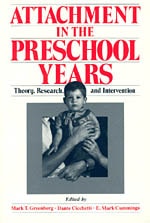
Attachment in the Preschool Years
Theory, Research, and InterventionEdited by Mark T. Greenberg, Dante Cicchetti, and E. Mark Cummings
University of Chicago Press, 1993
"There is a wealth of information and thought in this book; it does not have a weak or uninteresting chapter, starting with the Preface by Emde, and as a whole, it forms a sort of seminar."—John E. Bates, Contemporary Psychology
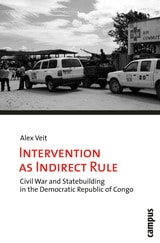
Intervention as Indirect Rule
Civil War and Statebuilding in the Democratic Republic of CongoAlex Veit
Campus Verlag, 2010
One of the largest peace-keeping missions currently being undertaken by the United Nations is in the Democratic Republic of Congo, where the UN is attempting to deal with the civil wars and other conflicts that have plagued the country since 1996. In Intervention as Indirect Rule, Alex Veit uses a close study of the district of Ituri, a major battlefield and a laboratory for international intervention, to explore the micropolitics of warfare and statebuilding. Combining detailed firsthand empirical data with a historically informed analysis, Veit shows the effect that contemporary humanitarian interventions have on state-society relations. He also pays particular, and much needed, attention to the question of why the very organizations that should be helping with international statebuilding efforts—local authorities and civil society groups—so often instead turn out to be corrupt or hostile. Ultimately Veit argues that international intervention tends inadvertently to replicate—or even amplify—historical structures of political inequality, rather than establishing a liberal form of statehood.
Literature as Intervention
Challenging Normativity in the Writing of Elisabeth Reichert, Charlotte Roche and Elfriede JelinekCornelia Wech
University of London Press, 2020
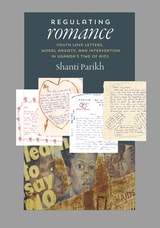
Regulating Romance
Youth Love Letters, Moral Anxiety, and Intervention in Uganda’s Time of AIDSShanti Parikh
Vanderbilt University Press, 2016
Parikh also examines the unintended consequences of Uganda's aggressive HIV campaigns that thrust sexuality and anxieties about it into the public sphere. In a context of economic precarity and generational tension that constantly complicates young people's notions of consumption-based romance, communities experience the dilemmas of protecting and policing young people from reputational and health dangers of sexual activity. "They arrested me for loving a school girl" is the title of a chapter on controlling delinquent daughters and punishing defiant boyfriends for attempting to undermine patriarchal authority by asserting their adolescent romantic agency. Sex education programs struggle between risk and pleasure amidst morally charged debates among international donors and community elders, transforming the youthful female body into a platform for public critique and concern. The many sides of this research constitute an eloquently executed critical anthropology of intervention.
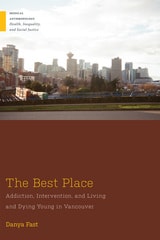
The Best Place
Addiction, Intervention, and Living and Dying Young in VancouverDanya Fast
Rutgers University Press, 2024
Winner of the CASCA Labrecque-Lee Book Prize
In both local and international imaginations, Vancouver, Canada, is often celebrated as one of the world’s most beautiful, cosmopolitan, and livable cities. Simultaneously, the city continues to be ground zero for successive waves of public health emergency and intervention, including a recent and unprecedented drug overdose crisis driven by the proliferation of illicitly manufactured fentanyl and related analogs in the local drug supply. In The Best Place: Addiction, Intervention, and Living and Dying Young in Vancouver, Danya Fast explores these politics of place from the perspectives of young people who use drugs. Those who are the subject of this book were in many ways relegated to the social, spatial, and economic margins of the city. Yet, they were also often at the very center of city life and state projects, including the project of protecting life in the context of the current overdose crisis.
The CIA in Guatemala
The Foreign Policy of InterventionBy Richard H. Immerman
University of Texas Press, 1982
Using documents obtained through the Freedom of Information Act, recently opened archival collections, and interviews with the actual participants, Immerman provides us with a definitive, powerfully written, and tension-packed account of the United States' clandestine operations in Guatemala and their consequences in Latin America today.
Violence
Analysis, Intervention, and PreventionSean Byrne
Ohio University Press, 2012
In a world desperate to comprehend and address what appears to be an ever-enlarging explosion of violence, this book provides important insights into crucial contemporary issues, with violence providing the lens. Violence: Analysis, Intervention, and Prevention provides a multidisciplinary approachto the analysis and resolution of violent conflicts. In particular, the book discusses ecologies of violence, and micro-macro linkages at the local, national, and international levels as well as intervention and prevention processes critical to constructive conflict transformation.
The causes of violence are complex and demand a deep multidimensional analysis if we are to fully understand its driving forces. Yet in the aftermath of such destruction there is hope in the resiliency, knowledge, and creativity of communities, organizations, leaders, and international agencies to transform the conditions that lead to such violence.

Violence
Analysis, Intervention, and PreventionSean Byrne
Ohio University Press, 0
In a world desperate to comprehend and address what appears to be an ever-enlarging explosion of violence, this book provides important insights into crucial contemporary issues, with violence providing the lens. Violence: Analysis, Intervention, and Prevention provides a multidisciplinary approach to the analysis and resolution of violent conflicts. In particular, the book discusses ecologies of violence, and micro-macro linkages at the local, national, and international levels as well as intervention and prevention processes critical to constructive conflict transformation.
The causes of violence are complex and demand a deep multidimensional analysis if we are to fully understand its driving forces. Yet in the aftermath of such destruction there is hope in the resiliency, knowledge, and creativity of communities, organizations, leaders, and international agencies to transform the conditions that lead to such violence.

When the State Fails
Studies on Intervention in the Sierra Leone Civil WarTunde Zack-Williams
Pluto Press, 2012
Compared with Iraq, Afghanistan and Kosovo, the recent western intervention in Sierra Leone has been largely forgotten. When the State Fails rectifies this, providing a comprehensive and critical analysis of the intervention.
The civil war in Sierra Leone began in 1991 and was declared officially over in 2002 after UK, UN and regional African military intervention. Some claimed it as a case of successful humanitarian intervention. The authors in this collection provide an informed analysis of the impact of the intervention on democracy, development and society in Sierra Leone. The authors take a particularly critical view of the imposition of neoliberalism after the conflict.
As NATO intervention in Libya shows the continued use of external force in internal conflicts, When the State Fails is a timely book for all students and scholars interested in Africa and the question of ‘humanitarian intervention’.
Writing Across Difference
Theory and InterventionJames Rushing Daniel
Utah State University Press, 2021
No text in composition has made such a sweeping attempt to place the multiple areas of translingualism, anti-racism, anticolonialism, interdisciplinarity, and disability into conversation or to represent the field as broadly unified around the concept of difference. The chapters in this book specifically explore how monolingual ideology is maintained in institutions and how translingual strategies can (re)include difference; how narrative-based interventions can promote writing across difference in classrooms and institutions by complicating dominant discourses; and how challenging dominant logics of class, race, ability, and disciplinarity can present opportunities for countering divisiveness.
Writing Across Difference offers writing scholars a sustained intellectual encounter with the crisis of difference and foregrounds the possibilities such an encounter offers for collective action toward a more inclusive and equitable society. It presents a variety of approaches for intervening in classrooms and institutions in the interest of focalizing, understanding, negotiating, and bridging difference. The book will be a valuable resource to those disturbed by the bigotry, violence, and fanaticism that mark our political culture and who are seeking inspiration, models, and methods for collective response.
Contributors: Anis Bawarshi, Jonathan Benda, Megan Callow, James Rushing Daniel, Cherice Escobar Jones, Laura Gonzales, Juan Guerra, Stephanie Kerschbaum, Katie Malcolm, Nadya Pittendrigh, Mya Poe, Candice Rai, Iris Ruiz, Ann Shivers-McNair, Neil Simpkins, Alison Y. L. Stephens, Sumyat Thu, Katherine Xue, Shui-yin Sharon Yam