Results by title
8 books match the query 'Invasion'

After the Invasion
The Soviet Army and Czech Society 1968—1991Marie Cerná
Karolinum Press, 2024
This book addresses different aspects of the Soviet army’s twenty-year presence in Czechoslovakia between 1968 and 1991. It explores the circumstances of the Soviet settling in the country, immediately related to the invasion of the Warsaw Pact armies in August 1968; its active interference in the political developments in the early stage of the “normalization” era; and the universal support provided by the normalization era regime. It examines the darker side of this support when the constant favoring of Soviet interests—often to the detriment of the local population and the environment—went hand in hand with the resignation of the Czechoslovak state to lawfulness and the execution of effective administration on its territory.
Based on extensive local and national primary sources, the volume describes the often problematic coexistence of the Soviet garrisons and local inhabitants, who did not have sufficient protection at the central level. In this context, it points out the contradictory logic that framed the mutual coexistence: the official policy of friendship on the one hand and the counter-intelligence protection of Soviet military premises on the other. Marie Cerná records the traces that the presence of the Soviet army left in the collective memory and examines the circumstances of its departure from the country in 1990 and 1991, which began immediately after the change of the political regime. She presents the long-term presence of the Soviet army as a fundamentally political and politicized matter, which was first the subject of power controversies and later of propaganda and intentional manipulation.
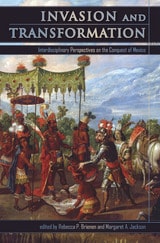
Invasion and Transformation
Interdisciplinary Perspectives on the Conquest of MexicoRebecca P. Brienen
University Press of Colorado, 2020
Was Moteuczoma really as weak as history portrayed him? As Susan D. Gillespie instead suggests in "Blaming Moteuczoma," the representation of Moteuczoma as a scapegoat for the Aztec defeat can be understood as a product of indigenous resistance and accommodation following the imposition of Spanish colonialism. Chapters address the various roles (real and imagined) of Moteuczoma, Cortés, and Malinche in the fall of the Aztecs; the representation of history in colonial art; and the complex cultural transformations that actually took place.
Including full-color reproductions of seventeenth-century paintings of the Conquest, Invasion and Transformation will appeal to scholars and students of Latin American history and anthropology, art history, colonial literature, and transatlantic studies. Contributors include Rebecca P. Brienen, Louise M. Burkhart, Ximena Chávez Balderas, Constance Cortez, Viviana Diáz Balsera, Martha Few, Susan D. Gillespie, Margaret A. Jackson, Diana Magaloni Kerpel, Matthew Restall, Michael Schreffler.

Invasion of Indian Country in the Twentieth Century
American Capitalism and Tribal Natural ResourcesDonald Fixico
University Press of Colorado, 1998
In The Invasion of Indian Country in the 20th Century, Donald Fixico details the course of this struggle, providing a wealth of information on the resources possessed by individual tribes and the way in which they were systematically defrauded and stripped of these resources. Fixico contends that federal policies originally devised to protect Indian interests ironically worked against the Indian nations as the tribes employed new tactics with the Council of Energy Resources Tribes, using the law in courts and applying aggressive business leadership to combat the capitalist invasion by mainstream America.
Fixico's analysis of this war being waged throughout the century and today serves as an indispensable reference tool for anyone interested in Native American history and current government policy with regard to Indian lands.
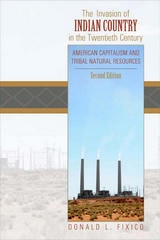
Invasion of Indian Country in the Twentieth Century
American Capitalism and Tribal Natural Resources, Second EditionDonald Fixico
University Press of Colorado, 2012
Invasion of the Body Snatchers
Don Siegel, directorLaValley, Al
Rutgers University Press, 1989
Invasion of the Mind Snatchers
Television's Conquest of America in the FiftiesEric Burns
Temple University Press, 2010
When the first television was demonstrated in 1927, a headline in The New York Times read, “Like a Photo Come to Life.” It was a momentous occasion. But the power of television wasn’t fully harnessed until the 1950s, when the medium was, as Eric Burns says, “At its most preoccupying, its most life-altering.” And Burns, a former NBC News correspondent who is an Emmy-winner for his broadcast writing, knows about the impact of television.
Invasion of the Mind Snatchers chronicles the influence of television that was watched daily by the baby boomer generation. As kids became spellbound by Howdy Doody and The Ed Sullivan Show, Burns reveals, they often acted out their favorite programs. Likewise, they purchased the merchandise being promoted by performers, and became fascinated by the personalities they saw on screen, often emulating their behavior. It was the first generation raised by TV and Burns looks at both the promise of broadcasting as espoused by the inventors, and how that promise was both redefined and lost by the corporations who helped to spread the technology.
Yet Burns also contextualizes the social, cultural, and political events that helped shape the Fifties—from Sputnik and the Rosenberg trial to Senator Joseph McCarthy’s Red Scare. In doing so, he charts the effect of television on politics, religion, race, and sex, and how the medium provided a persuasive message to the young, impressionable viewers.

The Invasion
Janet Lewis
Michigan State University Press, 2000
The Invasion, a novel originally published in 1932, marked the debut of historical novelist Janet Lewis, who went on to write numerous poems and short stories as well as the novels The Wife of Martin Guerre and The Trial of Soren Quist. Lewis grew up in the Lake country of the Old Northwest and The Invasion is based on family stories she heard as a child.The Invasion displays well-researched historical accuracy, an innate understanding of and feeling for Native American culture enhanced by the author's fluency in the Ojibway language, and an economy of style that is remarkable for a first novel.
In 1790, John Johnston, a cultivated young Irishman, came to the far corner of the Northwest Territory to make his fortune intending to spend only a year. Instead he married Ozhah-guscoday- wayquay (The Woman of the Glade), daughter of the Ojibway chief Waub- ojeeg, and settled on the St. Mary's River. Together they founded a family that was loved, respected, and famous throughout the region for honesty, fairness, and hospitality. Their home was the center of culture for the area and for every visiting traveler, Native American or white. The Invasion chronicles a time when one culture violently supplanted another even as it depicts a family that blends two cultures together.
Henry Rowe Schoolcraft considered the Johnston family his most valued connection to the Native American population. He eventually married Jane Johnston, daughter of John and The Woman of the Glade, and remain close to her entire family. In his diary, Schoolcraft wrote of the Johnstons, "I have in fact stumbled, as it were, on the only family in Northwest America who could in Indian lore have acted as my guide, philosopher, and friend."

The Invasion of Virginia, 1781
Michael Cecere
Westholme Publishing, 2017
The American War for Independence was fought in nearly every colony, but some colonies witnessed far more conflict than others. In the first half of the war, the bulk of military operations were concentrated in Massachusetts, New York, New Jersey, and Pennsylvania. A shift in British strategy southward after the Battle of Monmouth in 1778 triggered numerous military engagements in 1779 and 1780 in Georgia and the Carolinas.Surprisingly, Virginia, the largest of the original thirteen colonies, saw relatively little fighting for the first six years of the Revolutionary War. This changed in 1781 when British and American forces converged on Virginia. The war’s arrival did not result from one particular decision or event, but rather, a series of incidents and battles beginning in the fall of 1780 at Kings Mountain, South Carolina.
Benedict Arnold’s sudden appearance in Virginia in early 1781 with 1,600 seasoned British troops and his successful raid up the James River to Richmond and subsequent occupation of Portsmouth, demonstrated Virginia’s vulnerability to attack and the possibility that the colonies could be divided and subdued piecemeal, a strategy Britain had attempted to deploy several times earlier in the war. British General Henry Clinton’s decision to reinforce Arnold in Virginia expanded Britain’s hold on the colony while events in North Carolina, including the battle of Guilford Court House, led British General Charles Cornwallis to conclude that defeating the Patriots in Virginia was the key to ending the war. As a result, Cornwallis marched his army north in May 1781 to assume command of what was now a very powerful British force of over 7,000 troops. The war had returned to Virginia with a vengeance, and how it did so and what happened as a result is the focus of The Invasion of Virginia 1781.