Results by title
17 books match the query 'Inventions'
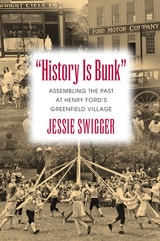
"History Is Bunk"
Assembling the Past at Henry Ford's Greenfield VillageJessie Swigger
University of Massachusetts Press, 2014
In 1916 a clearly agitated Henry Ford famously proclaimed that “history is more or less bunk.” Thirteen years later, however, he opened the outdoor history museum Greenfield Village in Dearborn, Michigan. It was written history's focus on politicians and military heroes that was bunk, he explained. Greenfield Village would correct this error by celebrating farmers and inventors.
The village eventually included a replica of Thomas Edison's Menlo Park, New Jersey, laboratory, the Wright brothers' cycle shop and home from Dayton, Ohio, and Ford's own Michigan birthplace. But not all of the structures were associated with famous men. Craft and artisan shops, a Cotswold cottage from England, and two brick slave cabins also populated the village landscape. Ford mixed replicas, preserved buildings, and whole-cloth constructions that together celebrated his personal worldview.
Greenfield Village was immediately popular. But that only ensured that the history it portrayed would be interpreted not only by Ford but also by throngs of visitors and the guides and publicity materials they encountered. After Ford's death in 1947, administrators altered the village in response to shifts in the museum profession at large, demographic changes in the Detroit metropolitan area, and the demands of their customers.
Jessie Swigger analyzes the dialogue between museum administrators and their audiences by considering the many contexts that have shaped Greenfield Village. The result is a book that simultaneously provides the most complete extant history of the site and an intimate look at how the past is assembled and constructed at history museums.
American Genesis
A Century of Invention and Technological Enthusiasm, 1870-1970Thomas P. Hughes
University of Chicago Press, 2004
A sweeping history of the inventors, inventions, and innovations that together created modern America.
A stunning, wide-ranging history from one of the foremost historians of technology of our age American Genesis tells the sweeping story of the technological revolution that made modern America. Unlike other histories of technology, which focus on particular inventions like the light bulb or the automobile, American Genesis makes these inventions characters in a broad chronicle, both shaped by and shaping a culture. By weaving scientific and technological advancement into other cultural trends, and bringing in fascinating characters like Edison, Ford, and Frederick Taylor, Hughes demonstrates here the myriad ways in which the two are inexorably linked, and in a new preface, he recounts his earlier missteps in predicting the future of technology and follows its move into the information age.
American Genesis
A Century of Invention and Technological Enthusiasm, 1870-1970Thomas P. Hughes
University of Chicago Press, 2004
*PULITZER PRIZE FINALIST*
A sweeping history of the inventors, inventions, and innovations that together created modern America.
A stunning, wide-ranging history from one of the foremost historians of technology of our age American Genesis tells the sweeping story of the technological revolution that made modern America. Unlike other histories of technology, which focus on particular inventions like the light bulb or the automobile, American Genesis makes these inventions characters in a broad chronicle, both shaped by and shaping a culture. By weaving scientific and technological advancement into other cultural trends, and bringing in fascinating characters like Edison, Ford, and Frederick Taylor, Hughes demonstrates here the myriad ways in which the two are inexorably linked, and in a new preface, he recounts his earlier missteps in predicting the future of technology and follows its move into the information age.
Attack of the Difficult Poems
Essays and InventionsCharles Bernstein
University of Chicago Press, 2011
Charles Bernstein is our postmodern jester of American poesy, equal part surveyor of democratic vistas and scholar of avant-garde sensibilities. In a career spanning thirty-five years and forty books, he has challenged and provoked us with writing that is decidedly unafraid of the tensions between ordinary and poetic language, and between everyday life and its adversaries. Attack of the Difficult Poems, his latest collection of essays, gathers some of his most memorably irreverent work while addressing seriously and comprehensively the state of contemporary humanities, the teaching of unconventional forms, fresh approaches to translation, the history of language media, and the connections between poetry and visual art.
Applying an array of essayistic styles, Attack of the Difficult Poems ardently engages with the promise of its title. Bernstein introduces his key theme of the difficulty of poems and defends, often in comedic ways, not just difficult poetry but poetry itself. Bernstein never loses his ingenious ability to argue or his consummate attention to detail. Along the way, he offers a wide-ranging critique of literature’s place in the academy, taking on the vexed role of innovation and approaching it from the perspective of both teacher and practitioner.
From blues artists to Tin Pan Alley song lyricists to Second Wave modernist poets, The Attack of the Difficult Poems sounds both a battle cry and a lament for the task of the language maker and the fate of invention.
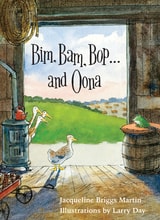
Bim, Bam, Bop . . . and Oona
Jacqueline Briggs Martin
University of Minnesota Press, 2019
An irresistible read-aloud picture book, in which a little odd-duck-out discovers her unique strengths
When these ducks go to the pond, it is Bim, Bam, Bop . . . and Oona, always last. They’re all ducks, but Bim, Bam, and Bop are runners, and Oona’s a waddler. “Last is a blot on my life,” she says to her frog friend, Roy. “I don’t feel as big as a duck should feel.” But she’s good with gizmos, Roy reminds her. So Oona tinkers with things, scraps, and strings, and eventually creates just the right gadget to get her to the pond first.
Spunky Oona will inspire and delight all who see her final triumphant creation. With its fun read-aloud words (from Brrrrrring to OOO-hoolie-hoo!), her story is wonderful to hear. Its charming illustrations invite readers to imagine our own new gizmos, and her victory reminds us to look for our own special gifts. A tale about being true to yourself, building confidence, and finding friendship, Bim, Bam, Bop . . . and Oona is sure to bring smiles to readers and listeners of all ages.
Ginseng and Other Tales from Manila
Marianne Villanueva
Calyx, 1991

History Is Bunk
Assembling the Past at Henry Ford's Greenfield VillageSwigger Jessie
University of Massachusetts Press, 0
Imagination and Invention
Gilbert Simondon
University of Minnesota Press, 2023
A radical rethinking of the theory and the experience of mental images
Here, in English translation for the first time, is Gilbert Simondon’s fundamental reconception of the mental image and the theory of imagination and invention. Drawing on a vast range of mid-twentieth-century theoretical resources—from experimental psychology, cybernetics, and ethology to the phenomenological reflections of Sartre and Merleau-Ponty—Imagination and Invention provides a comprehensive account of the mental image and adds a vital new dimension to the theory of psychical individuation in Simondon’s earlier, highly influential work.
Simondon traces the development of the mental image through four phases: first a bundle of motor anticipations, the image becomes a cognitive system that mediates the organism’s relation to its milieu, then a symbolic and abstract integration of motor and affective experience to, finally, invention, a solution to a problem of life that requires the externalization of the mental image and the creation of a technical object. An image cannot be understood from the perspective of one phase alone, he argues, but only within the trajectory of its progressive metamorphosis.

Les Paul
Guitar WizardBob Jacobson
Wisconsin Historical Society Press, 2012
This addition to the Badger Biographies series for young readers tells the story of Les Paul, the legendary “Wizard of Waukesha,” who pioneered the solid body electric guitar, multi-track recording, and many other musical inventions. Fascinated since boyhood with musical technology, the young Les moved from experimenting with his mother’s player piano and phonograph to developing his own amplifier and tinkering with crystal radios.
After leaving his hometown of Waukesha at age 17 to pursue a musical career—a decision his mother supported—the budding jazz guitarist lived in Chicago, New York, and Los Angeles, in each city finding a new audience and new musical partnerships. A regular on the radio, Les became a fixture in early television, appearing on the Ed Sullivan Show, and later, a show of his own with partner Mary Ford. Along the way, he overcame numerous physical challenges, including recovery from electric shock and rehabilitation after a horrific car accident—both of which threatened his musical career. And yet, Les Paul pushed musical technology forward more than any other musician of the twentieth century. This Grammy Hall of Fame inductee died in 2009, making Les Paul: Guitar Wizard a timely addition to the series. This lively story is rounded out with sidebars on radio call letters and how an electric guitar works, a full discography, and over 60 historic photographs.
Power and Invention
Situating ScienceIsabelle Stengers
University of Minnesota Press, 1997

Restoring Baird's Image
Donald F. McLean
The Institution of Engineering and Technology, 2000
The Life and Times of A.D. Blumlein
Russell Burns
The Institution of Engineering and Technology, 2000
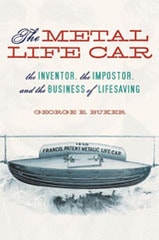
The Metal Life Car
The Inventor, the Impostor, and the Business of LifesavingGeorge E. Buker
University of Alabama Press, 2008
Engineering the battlefield—one armored advance at a time.
For centuries sailing vessels crept along the coastline, ready to flee ashore in case of danger or trouble; this worked well until weather or poor sailing drove these ships against an unforgiving coast. Saviors and salvors (often the same people) struggled to rescue both humans and cargo, often with results as tragic for them as for the sailors and passengers.
Joseph Francis (b. Boston, Massachusetts, 1801) was an inventor who also had the ability to organize a business to produce his inventions and the salesmanship to sell his products. His metal lifeboats, first used in survey expeditions in Asia Minor and Central America, came into demand among the world’s merchant marine, the U.S. Navy, and the U.S. Revenue Service. His corrugated “life car” was the keystone to development of the U.S. Life-Saving Service. Francis’s metal bateaux and lifeboats played an important role in the Third Seminole War in Florida. His metal pontoon army wagons served in the trans-Mississippi campaigns against the Indians.
In Europe, he was acclaimed as a genius and sold patent rights to shipyards in Liverpool and the Woolwich Arsenal in England, Le Havre seaport in France, in the free city of Hamburg, and in the Russian Empire. But while Francis was busy in Europe, Captain Douglass Ottinger, U.S. Revenue Marine Service, claimed to be the inventor of Francis’s life car and obtained support in the U.S. Congress and the Patent Office for his claim. Francis had to battle for decades to prove his rights, and Americans remained generally unfamiliar with his devices, thereby condemning Civil War armies to inferior copies while Europe was using, and acclaiming, his inventions.
The Rate and Direction of Inventive Activity Revisited
Edited by Josh Lerner and Scott Stern
University of Chicago Press, 2012
While the importance of innovation to economic development is widely understood, the conditions conducive to it remain the focus of much attention. This volume offers new theoretical and empirical contributions to fundamental questions relating to the economics of innovation and technological change while revisiting the findings of a classic book. Central to the development of new technologies are institutional environments, and among the topics discussed here are the roles played by universities and other nonprofit research institutions and the ways in which the allocation of funds between the public and private sectors affects innovation. Other essays examine the practice of open research and how the diffusion of information technology influences the economics of knowledge accumulation. Analytically sophisticated and broad in scope, this book addresses a key topic at a time when economic growth is all the more topical.
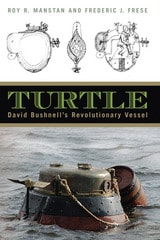
Turtle
David Bushnell's Revolutionary VesselRoy R. Manstan
Westholme Publishing, 2010
The Remarkable History and Reconstruction of the First Operational Submarine
At the onset of the American Revolution, the British expected to quell the rebellion quickly with a show of overwhelming force. In an experiment in asymmetric warfare, David Bushnell created the first submarine vessel designed specifically “for the destruction of vessels of war.” On a quiet September night in 1776, sergeant Ezra Lee maneuvered Bushnell’s strange little craft out from Manhattan and into the midst of the greatest naval fleet ever assembled in the Americas. Lee’s goal was to sink the British flagship HMS Eagle by attaching a powerful explosive to its hull. Although the mission was unsuccessful, Bushnell’s concept of submarine warfare was considered by George Washington to have been “an effort of genius.”
David Bushnell was raised in the town of Saybrook at the mouth of the Connecticut River. More than two centuries later, another Turtle would be launched into the same river within sight of Bushnell’s first forays with his vessel during the summer of 1775. Under the direction of technical arts teacher Frederic J. Frese, students at Old Saybrook High School created a working replica of Bushnell’s submarine, facilitated through an education partnership with the Naval Undersea Warfare Center in Newport, Rhode Island, where Roy R. Manstan was a mechanical engineer and Navy trained diver. With twenty-first century submariners at the helm, the Turtle replica was subjected to a series of operational tests at the Mystic Seaport Museum in Mystic, Connecticut.
In Turtle: David Bushnell’s Revolutionary Vessel, the authors provide new insight into Bushnell’s “engine of devastation,” tracing the history of undersea warfare before Bushnell and the origin of the many innovations Bushnell understood would be necessary for conducting a covert submarine attack. The knowledge gained from testing the Turtle replica enabled the authors to speculate as to what America’s first submariner Ezra Lee experienced that September night and what may have caused the attack to fail.
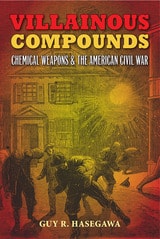
Villainous Compounds
Chemical Weapons and the American Civil WarGuy R. Hasegawa
Southern Illinois University Press, 2015
In chilling detail, Hasegawa describes the weapons proposed and prepared for use during the war and introduces the people behind the concepts. Although many of the ideas for chemical weapons had a historical precedent, most of the suggested agents were used in industry or medicine, and their toxicity was common knowledge. Proponents, including a surprisingly high number of civilian physicians, suggested a wide variety of potential chemical weapons—from liquid chlorine in artillery shells to cayenne pepper solution sprayed from fire engines. Some weapons advocates expressed ethical qualms, while others were silent on the matter or justified their suggestions as necessary under current circumstances.
As Hasegawa explains, bureaucrats in the war departments of both armies either delayed or rejected outright most of these unusual weapons, viewing them as unneeded or unworkable. Nevertheless, many of the proposed armaments presaged the widespread use of chemical weapons in the twentieth and twenty-first centuries. For example, while Civil War munitions technology was not advanced enough to deliver poison gas in artillery shells as some advocates suggested, the same idea saw extensive use during World War I. Similarly, forms of an ancient incendiary weapon, Greek fire, were used sparingly during the Civil War and appeared in later conflicts as napalm bombs and flamethrowers.
Especially timely with today’s increased chemical threats from terrorists and the alleged use of chemical agents in the Syrian Civil War, Villainous Compounds: Chemical Weapons and the American Civil War reveals the seldom-explored chemical side of Civil War armaments and illuminates an underappreciated stage in the origins of modern chemical warfare.
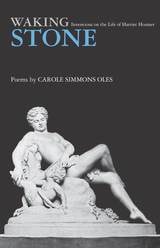
Waking Stone
Inventions on the Life of Harriet HosmerCarole Simmons Oles
University of Arkansas Press, 2006