Results by title
2 books match the query 'Irish America'
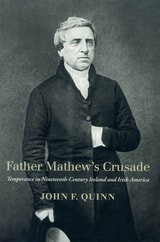
Father Mathew's Crusade
Temperance in Nineteenth-Century Ireland and Irish AmericaJohn F. Quinn
University of Massachusetts Press, 2002
For centuries, the Irish have been famed, and often derided, for their attachment to alcohol. Yet in the 1830s and 1840s, Ireland became a temperance stronghold. The man almost singlehandedly responsible for this surprising transformation was Father Theobald Mathew (1790–1856), a popular Franciscan friar. Over a ten-year period, five million Irish men, women, and children took the pledge at his hands, while hundreds of public houses were forced to shut their doors or switch to selling coffee and tea.
By the end of the 1840s, however, Mathew's “miracle” was already coming undone. The Great Famine was ravaging Ireland and Mathew's years of nonstop campaigning had left him sick, exhausted, and bankrupt. Undeterred, he traveled to the United States in 1849 to generate support and administer the pledge to as many new immigrants as he could find. Failing health forced him to return to Ireland where he died in 1856, leaving behind a weak and fragmented movement.
In the late nineteenth century, several Irish priests revived Mathew's crusade. In the United States, Irish American bishops supported the Catholic Total Abstinence Union (CTAU) and joined hands with the Women's Christian Temperance Union in their war against liquor. In Ireland, Father James Cullen formed the Pioneers, a total abstinence association for devout Catholics. While the CTAU languished after the United States Congress passed the Prohibition Amendment in 1919, the Pioneers continued to thrive in Ireland into the 1960s. Although the group's membership has declined in recent years, there are still today a large number of Irish teetotalers.
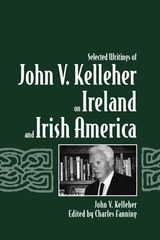
Selected Writings of John V. Kelleher on Ireland and Irish America
John V. Kelleher. Edited by Charles Fanning
Southern Illinois University Press, 2002
A collection of eighteen critical essays and twenty-six translations spanning the career of one of the founding intellects of Irish Studies, the Selected Writings of John V. Kelleher on Ireland and Irish America consists of five accessible sections. The first gathers Kelleher’s essays on the most widely known Irish cultural phenomenon—the literary renaissance of the early twentieth century. Part two contains his judicious assessments of Irish literature in its post-Revolutionary phase. The third section includes Kelleher’s insightful essays on the experience of the Irish in America. The fourth section contains essays that examine early Irish literature and culture, opening with a benchmark essay for Irish Studies, “Early Irish History and Pseudo-History,” which was read at the inaugural meeting of the American Conference for Irish Studies in 1961. The collection concludes with Kelleher’s translations and adaptations of poems in Old, Middle, and Modern Irish, illustrating his command of the language at every stage.