Results by title
7 books match the query 'Iron industry and trade'

Alabama Blast Furnaces
Joseph H. Woodward II, with an introduction by James R. Bennett II
University of Alabama Press, 2007
Forging Alabama’s legacy: The definitive history of every blast furnace from pioneer charcoal fires to industrial giants.
Alabama Blast Furnaces by Joseph H. Woodward II offers the only comprehensive history of every blast furnace constructed in Alabama between 1815 and 1940, tracing a vital chapter in the state's iron and steel legacy. Beginning with the pioneering Cedar Creek charcoal furnace in 1815, Woodward meticulously chronicles four distinct eras:
Pioneer Era (1815–1861): Early, locally focused furnaces that laid the foundation of Alabama’s iron industry;
Civil War Era (1861–1865): Furnaces mobilized for the Confederate war effort, including Northern raids, labor shortages,
and innovation under duress;
Reconstruction Era (1866–1879): Transition from stone-stack furnaces toward iron- and steel-shelled technology; and
Modern Era (1880–1940): The rise of large-scale coke-fired plants that propelled Alabama onto the national and international stage.
The heart of the book is a rich series of illustrated, furnace-by-furnace histories—capturing specifics on every site, including four that were built but never operated. With 50 detailed illustrations and rigorous documentation, this reissue—part of the Library of Alabama Classics series—features a new introduction by historian James R. Bennett, who situates Woodward’s work in its historical context and underscores its lasting relevance.
Originally compiled in 1940 by a member of the Woodward Iron Company family, the volume remains a seminal reference for scholars, students, and industrial history enthusiasts. Its thorough scope ensures every furnace—whether a modest pioneer operation or a towering industrial complex—has its story preserved. As one reviewer notes, this work covers furnaces that “made Alabama internationally significant in the iron and steel industry,” offering a level of detail unmatched in regional history.
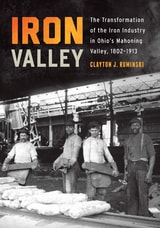
Iron Valley
The Transformation of the Iron Industry in Ohio's Mahoning Valley, 1802–1913Clayton J. Ruminski
The Ohio State University Press, 2017
Youngstown, Ohio, and the surrounding Mahoning Valley supplied the iron that helped transform the United States into an industrial powerhouse in the nineteenth century. The story of the Mahoning Valley’s unorthodox rise from mid-scale iron producer to twentieth-century “Steel Valley” is a tale of innovation, stagnation, and, above all, extreme change. Located halfway between Pittsburgh and Cleveland, the Mahoning Valley became a major supplier of pig iron to America’s biggest industrial regions. For much of the nineteenth century, outside consumers relied on the Valley’s pig iron, but this reliance nurtured a reluctance on the part of Youngstown iron companies to diversify or expand their production.
In Iron Valley: The Transformation of the Iron Industry in Ohio’s Mahoning Valley, 1802–1913, Clayton J. Ruminski argues that Youngstown-area iron manufacturers were content to let others in the industry innovate, and only modernized when market conditions forced them to do so. Desperate to find new markets, some Youngstown iron manufacturers eventually looked toward steel and endured a rapid, but successful, industrial transformation that temporarily kept their old enterprises afloat in a rapidly evolving industry. Richly illustrated with rare photographs of Mahoning Valley ironmasters, mills, furnaces, and workers, Iron Valley sheds light on a previously underrepresented and vital region that built industrial America.
Iron in the Pines
The Story of New Jersey's Ghost Towns and Bog IronPierce, Arthur
Rutgers University Press, 1966
With warmth and accuracy, Arthur D. Pierce tells the story of the years when iron was king, and around it rose a rustic feudal economy. There were glass factories, paper mills, cotton mills, and brickmaking establishments. Here, too, were men who made those years exciting: Benedict Arnold and his first step toward treason; Charles Read, who dreamed of an empire and died in exile; Revolutionary heroes and heroines, privateers, and rogues. The author's vivid pictures of day-to-day life in the old iron communities are based upon careful research. This book proves that the human drama of documented history belies any notion that fiction is stranger than truth.

MAKING IRON STEEL
INDEPENDENT MILLS IN PITTSBURGH, 1820-19JOHN N. INGHAM
The Ohio State University Press, 1991
Mastering Iron
The Struggle to Modernize an American Industry, 1800-1868Anne Kelly Knowles
University of Chicago Press, 2012
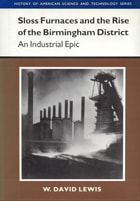
Sloss Furnaces and the Rise of the Birmingham District
An Industrial EpicW. David Lewis
University of Alabama Press, 1994
"A masterpiece that deserves to be ranked with such seminal and influential works as Cash’s Mind of the South." —Edwin T. Layton Jr., author of The Revolt of the Engineers: Social Responsibility and the American Profession
This pathbreaking book tells the dramatic story of a unique manufacturing complex and the city that it helped to create. The events recounted and interpreted by W. David Lewis are of more than local or regional significance. The rise of Sloss furnaces and Birmingham epitomized the emergence of the United States as the world's foremost economic power. Similarly, the closing of a once-profitable ironmaking installation amid social and technological changes that convulsed Birmingham nine decades after the city's founding typified challenges that were facing America at the dawn of the postindustrial age.
Above all, Sloss Furnaces resonates with the class of competition and the frenetic energy with which southerners joined other Americans in a rush to transform a continent after a fratricidal drive for independence had failed. The sweeping narrative that Lewis has produced amply justifies its subtitle, An Industrial Epic.
The Story of Coal and Iron in Alabama
Ethel Armes
University of Alabama Press, 2011
“The principal authority for the general treatment of the history of coal, and of iron and steel, in
Alabama is the work of Miss Ethel Armes. The Story of Coal and Iron in Alabama is a comprehensive
and scholarly work portraying in attractive style the growth of the mineral industries in its
relation to the development of the state and of the South, in preparation of which the author spent
more than five years.”
—Thomas McAdory Owen, History of Alabama and Dictionary of Alabama Biography