Results by title
16 books match the query 'Irony'
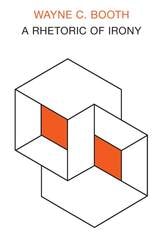
A Rhetoric of Irony
Wayne C. Booth
University of Chicago Press, 1975
In the first and longer part of his work, Booth deals with the workings of what he calls "stable irony," irony with a clear rhetorical intent. He then turns to intended instabilities—ironies that resist interpretation and finally lead to the "infinite absolute negativities" that have obsessed criticism since the Romantic period.
Professor Booth is always ironically aware that no one can fathom the unfathomable. But by looking closely at unstable ironists like Samuel Becket, he shows that at least some of our commonplaces about meaninglessness require revision. Finally, he explores—with the help of Plato—the wry paradoxes that threaten any uncompromising assertion that all assertion can be undermined by the spirit of irony.
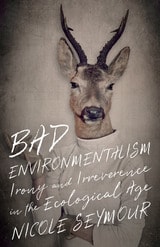
Bad Environmentalism
Irony and Irreverence in the Ecological AgeNicole Seymour
University of Minnesota Press, 2018
Traces a tradition of ironic and irreverent environmentalism, asking us to rethink the movement’s reputation for gloom and doom
Activists today strive to educate the public about climate change, but sociologists have found that the more we know about alarming issues, the less likely we are to act. Meanwhile, environmentalists have acquired a reputation as gloom-and-doom killjoys. Bad Environmentalism identifies contemporary texts that respond to these absurdities and ironies through absurdity and irony—as well as camp, frivolity, irreverence, perversity, and playfulness.
Nicole Seymour develops the concept of “bad environmentalism”: cultural thought that employs dissident affects and sensibilities to reflect critically on our current moment and on mainstream environmental activism. From the television show Wildboyz to the short film series Green Porno, Seymour shows that this tradition of thought is widespread—spanning animation, documentary, fiction film, performance art, poetry, prose fiction, social media, and stand-up comedy since at least 1975. Seymour argues that these texts reject self-righteousness and sentimentality, undercutting public negativity toward activism and questioning basic environmentalist assumptions: that love and reverence are required for ethical relationships with the nonhuman and that knowledge is key to addressing problems like climate change.
Funny and original, Bad Environmentalism champions the practice of alternative green politics. From drag performance to Indigenous comedy, Seymour expands our understanding of how environmental art and activism can be pleasurable, even in a time of undeniable crisis.
Chic Ironic Bitterness
R. Jay Magill, Jr.
University of Michigan Press, 2009
A brilliant and timely reflection on irony in contemporary American culture
“This book is a powerful and persuasive defense of sophisticated irony and subtle humor that contributes to the possibility of a genuine civic trust and democratic life. R. Jay Magill deserves our congratulations for a superb job!”
—Cornel West, University Professor, Princeton University
“A well-written, well-argued assessment of the importance of irony in contemporary American social life, along with the nature of recent misguided attacks and, happily, a deep conviction that irony is too important in our lives to succumb. The book reflects wide reading, varied experience, and real analytical prowess.”
—Peter Stearns, Provost, George Mason University
“Somehow, Americans—a pragmatic and colloquial lot, for the most part—are now supposed to speak the Word, without ironic embellishment, in order to rebuild the civic culture. So irony’s critics decide it has become ‘worthy of moral condemnation.’ Magill pushes back against this new conventional wisdom, eloquently defending a much livelier American sensibility than the many apologists for a somber ‘civic culture’ could ever acknowledge."
—William Chaloupka, Chair and Professor, Department of Political Science, Colorado State University
The events of 9/11 had many pundits on the left and right scrambling to declare an end to the Age of Irony. But six years on, we're as ironic as ever. From The Simpsons and Borat to The Daily Show and The Colbert Report, the ironic worldview measures out a certain cosmopolitan distance, keeping hypocrisy and threats to personal integrity at bay.
Chic Ironic Bitterness is a defense of this detachment, an attitude that helps us preserve values such as authenticity, sincerity, and seriousness that might otherwise be lost in a world filled with spin, marketing, and jargon. And it is an effective counterweight to the prevailing conservative view that irony is the first step toward cynicism and the breakdown of Western culture.
R. Jay Magill, Jr., is a writer and illustrator whose work has appeared in American Prospect, American Interest, Atlantic Monthly, Foreign Policy, International Herald Tribune, New York Times, Wall Street Journal, and Print, amongother periodicals and books. A former Harvard Teaching Fellow and Executive Editor of DoubleTake, he holds a Ph.D. in American Studies from the University of Hamburg in Germany. This is his first book.
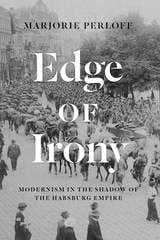
Edge of Irony
Modernism in the Shadow of the Habsburg EmpireMarjorie Perloff
University of Chicago Press, 2016
Perloff explores works ranging from Karl Kraus’s drama The Last Days of Mankind and Elias Canetti’s memoir The Tongue Set Free to Ludwig Wittgenstein’s notebooks and Paul Celan’s lyric poetry. Throughout, she shows that Austro-Modernist literature is characterized less by the formal and technical inventions of a modernism familiar to us in the work of Joyce and Pound, Dada and Futurism, than by a radical irony beneath a seemingly conventional surface, an acute sense of exile, and a sensibility more erotic and quixotic than that of its German contemporaries. Skeptical and disillusioned, Austro-Modernism prefers to ask questions rather than formulate answers.
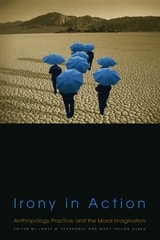
Irony in Action
Anthropology, Practice, and the Moral ImaginationEdited by James Fernandez and Mary Taylor Huber
University of Chicago Press, 2001
The first group of essays explores the limits to irony's liberating qualities from the constrained use of irony in congressional hearings to its reactive presence amid widening disparities of wealth despite decades of world development. The second section presents irony's more positive dimensions through an array of examples such as the use of irony by Chinese writers and Irish humorists. Framed by the editors' theoretical introduction to the issues posed by irony and responses to the essays by two literary scholars, Irony in Action is a timely contribution in the contemporary reinvention of anthropology.
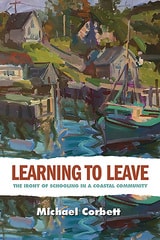
Learning to Leave
The Irony of Schooling in a Coastal CommunityMichael Corbett
West Virginia University Press, 2020
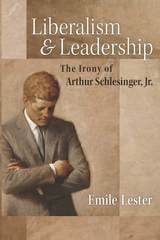
Liberalism and Leadership
The Irony of Arthur Schlesinger, Jr.Emile Lester
University of Michigan Press, 2019
Most scholars and pundits today view Franklin Delano Roosevelt and John F. Kennedy as aggressive liberal leaders, while viewing Schlesinger’s famous histories of their presidencies as celebrations of their steadfast progressive leadership. A more careful reading of Schlesinger’s work demonstrates that he preferred an ironic political outlook emphasizing the virtues of restraint, patience, and discipline. For Schlesinger, Roosevelt and Kennedy were liberal heroes and models as much because they respected the constraints on their power and ideals as because they tested traditional institutions and redefined the boundaries of presidential power.
Aggressive liberalism involves the use of inspirational rhetoric and cunning political tactics to expand civil liberties and insure economic equality. Schlesinger’s emphasis on the crucial role that irony has played and should play in liberalism poses a challenge to the aggressive liberalism advocated by liberal activists, political thinkers, and pundits. That his counsel was grounded in conservative insights as well as liberal values makes it accessible to leaders across the political spectrum.
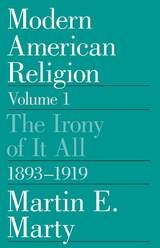
Modern American Religion, Volume 1
The Irony of It All, 1893-1919Martin E. Marty
University of Chicago Press, 1986
"Marty writes with the highest standards of scholarship and with his customary stylistic grace. No series of books is likely to tell us as much about the religious condition of our own time as "Modern American Religion."—Robert L. Spaeth, Minneapolis Star Tribune
"The wealth of material and depth of insight are beyond reproach. This book will clearly stand as an important meteorological guide to the storm front of modernity as it swept Americans into the twentieth century."—Belden C. Lane, Review of Religions
"Whatever one thinks about Marty's theological or philosophical position as a historian, the charm of his friendly circumspective approach to American religious history is irresistible."—John E. Wilson, Theological Studies
"Marty attempts to impose historical order on the divergent ways a century of Americans have themselves tried to find order in their worlds. . . . [He] meets the challenge deftly. . . . It is a book relevant to our time. . . . Engages the heart and mind jointly."—Andy Solomon, Houston Post
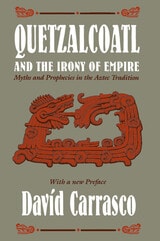
Quetzalcoatl and the Irony of Empire
Myths and Prophecies in the Aztec TraditionDavid Carrasco
University of Chicago Press, 1992
"This book, rich in ideas, constituting a novel approach . . . represents a stimulating and provocative contribution to Mesoamerican studies. . . . Recommended to all serious students of the New World's most advanced indigenous civilization."—H. B. Nicholson, Man
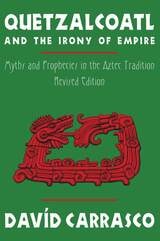
Quetzalcoatl and the Irony of Empire
Myths and Prophecies in the Aztec Tradition, Revised EditionDavíd Carrasco
University Press of Colorado, 2000
- American Anthropologist
"A must for both professional and serious non-professional students in Mesoamerica. Those who are interested in complex society and urbanism in general, as well as students of comparative religion, will find it stimulating. Most importantly, for anyone interested in the history of ideas, the book illuminates the tremendously powerful impact and role of a complex deity/mythico-historical figure in shaping one of the world's great pristine civilizations."
- Queen's Quarterly
Reading Hegel
Irony, Recollection, CritiqueRobert Lucas Scott
University of Chicago Press, 2025
The relationship between Hegel and literary theory has for a long time been both contested and paradoxical. On the one hand, “theory” is often skeptical of all that Hegel ostensibly stood for: idealism, systematicity, and identity at the expense of difference. Yet, in spite of itself, literary theory is taken to owe a profound debt to Hegel’s philosophy. Robert Lucas Scott’s book complicates this account and argues that literary theory has made the mistake of abstracting Hegel’s thought from its more dynamic presentation in Hegel’s writings, reducing “Hegel” to a series of propositions or positions. Literary theory, Scott argues, misses what is perhaps the greatest innovation of Hegel’s philosophy: a presentation of experience that begins precisely by setting aside all preconceptions or prior assumptions. It is on this point that Hegel’s philosophy itself approaches literature: its content cannot be simply abstracted from the singular experience of reading it. Only through a mode of reading alive to speculative experience can literary theory become truly Hegelian. Scott’s exposition of Hegel offers a model of reading with relevance beyond philosophy: one that is critical without pretensions of mastery and detachment and that honors the singularity of the reading experience without succumbing to the subjectivism of the “postcritical.”
The book also includes engagements with the work of Luther, Kant, Marx, Gillian Rose, Fredric Jameson, Robert Brandom, Catherine Malabou, and more in its recovery of Hegel’s thought for a critical understanding of our time.

The Chinese Postmodern
Trauma and Irony in Chinese Avant-Garde FictionXiaobin Yang
University of Michigan Press, 2002
The book seeks to redefine Chinese modernity and postmodernity through the analyses of both orthodox and avant-garde works. In doing so, the author draws on a number of theories, psychoanalysis and deconstruction in particular, revealing the hidden connection between the deconstructive mode of writing and the experience of history after trauma and showing how avant-garde literature brings about a varied literary paradigm that defies the dominant, subject-centered one in twentieth-century China.
The distinctiveness of The Chinese Postmodern is also found in its portrayal of the changes of literary paradigms in modern Chinese literature. By way of characterizing avant-garde fiction, it provides an overview of twentieth-century Chinese literature and offers a theorization of the intellectual history of modern China. Other issues concerning literary theory are explored, including the relationships between postmodernity and totalitarian discourse, between historical trauma and literary writing, and between psychic trauma and rhetorical irony. This book will appeal to readers in the fields of Chinese literature and culture, modern Chinese history, literary theory, and comparative literature.
Xiaobin Yang is Croft Assistant Professor, University of Mississippi.
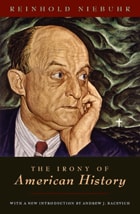
The Irony of American History
Reinhold Niebuhr
University of Chicago Press, 2008
“The supreme American theologian of the twentieth century.”—Arthur Schlesinger Jr., New York Times
“Niebuhr is important for the left today precisely because he warned about America’s tendency—including the left’s tendency—to do bad things in the name of idealism. His thought offers a much better understanding of where the Bush administration went wrong in Iraq.”—Kevin Mattson, The Good Society
“Irony provides the master key to understanding the myths and delusions that underpin American statecraft. . . . The most important book ever written on US foreign policy.”—Andrew J. Bacevich, from the Introduction
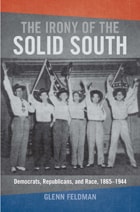
The Irony of the Solid South
Democrats, Republicans, and Race, 1865–1944Glenn Feldman
University of Alabama Press, 2013
Race, Politics, and the Making of the Modern South.
The Irony of the Solid South examines how the south became the “Solid South” for the Democratic Party and how that solidarity began to crack with the advent of American involvement in World War II. Relying on a sophisticated analysis of secondary research—as well as a wealth of deep research in primary sources such as letters, diaries, interviews, court cases, newspapers, and other archival materials—Glenn Feldman argues in The Irony of the Solid South that the history of the solid Democratic south is actually marked by several ironies that involve a concern with the fundamental nature of southern society and culture and the central place that race and allied types of cultural conservatism have played in ensuring regional distinctiveness and continuity across time and various partisan labels. Along the way, this account has much to say about the quality and nature of the New Deal in Dixie, southern liberalism, and its fatal shortcomings.
Feldman focuses primarily on Alabama and race but also considers at length circumstances in the other southern states as well as insights into the uses of emotional issues other than race that have been used time and again to distract whites from their economic and material interests. Feldman explains how conservative political forces (Bourbon Democrats, Dixiecrats, Wallace, independents, and eventually the modern GOP) ingeniously fused white supremacy with economic conservatism based on the common glue of animus to the federal government. A second great melding is exposed, one that joined economic fundamentalism to the religious kind along the shared axis of antidemocratic impulses.
Feldman’s study has much to say about southern and American conservatism, the enduring power of cultural and emotional issues, and the modern south’s path to becoming solidly Republican.
Truth and Irony
Terence J. Martin
Catholic University of America Press, 2016

Without Empathy
Irony and the Satirical Impulse in Eight Major FilmmakersMK Raghavendra
Intellect Books, 2025
In Without Empathy, MK Raghavendra investigates how irony and satire function in cinema by focusing on the work of eight visionary directors—Luis Buñuel, R.W. Fassbinder, Stanley Kubrick, Robert Altman, Paul Verhoeven, Aki Kaurismäki, Aleksei Balabanov, and David Lynch. At a time when irony is increasingly scrutinized as a mode of expression, this book reconsiders its role in film, revealing how these auteurs deploy wit and subversion in ways that unsettle audience expectations.
Through close readings of selected works, Raghavendra identifies layers of meaning beneath the surface of films often misread. The book situates these directors within broader traditions of cinematic satire, while simultaneously interrogating what their work has to say about society, culture, and human folly. Without Empathy is a lucid read for scholars and students of film studies and communication, providing a provocative lens on how satirical intent is not always recognizable today and how its actual targets can make society uncomfortable.