Results by title
6 books match the query 'Islam and secularism'
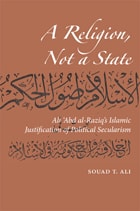
A Religion, Not a State
Ali 'Abd al-Raziq's Islamic justification of Political SecularismSouad T Ali
University of Utah Press, 2009
Utah Series in Middle East Studies
In this notable work, Souad T. Ali examines the seminal writings of Egyptian reformist scholar Ali'Abd al-Raziq, often regarded as the intellectual father of Islamic secularism, and his controversial argument that the caliphate should be considered a human innovation, rather than a religious imperative. 'Abd al Raziq contended that Islam is "a religion, not a state; a message, not a government," a major departure from the traditional view that religious and political spheres are intertwined and inseparable in Islam.
Opponents denounced 'Abd al-Raziq's ideas as a foreign corruption imported from the West. Ali's careful, objective, and scholarly examination of 'Abd al-Raziq's work, however, reveals that his arguments are not based in Western thought. Rather, they sit firmly within the dictates of Islam's sacred texts, particularly the Quran and Hadith, and also enjoy considerable support from the historical record.
This analysis critically challenges prevalent misinterpretations of Islam that have endured for centuries. Ali recognizes the varied models and discourses that have arisen throughout different epochs, especially so the role that Western intervention has played in placing the question of Islam's modernity at the forefront of intellectual debate. Throughout, the study emphasizes the atmosphere of openness and tolerance that is a requisite for free, intelligent debate.

Bound Together
The Secularization of Turkey’s Literary Fields and the Western Promise of FreedomBaris Büyükokutan
University of Michigan Press, 2021
Bound Together takes a new look at twentieth-century Turkey, asking what it will take for Turkish women and men to regain their lost freedoms, and what the Turkish case means for the prospects of freedom and democracy elsewhere. Contrasting the country’s field of poetry, where secularization was the joint work of pious and nonpious people, with that of the novel, this book inquires into the nature of western-nonwestern difference.
Turkey’s poets were more fortunate than its novelists for two reasons. Poets were slightly better at developing the idea of the autonomy of art from politics. While piety was a marker of political identity everywhere, poets were better able than novelists to bracket political differences when assessing their peers as the country was bitterly polarized politically and as the century wore on. Second, and more important, poets of all stripes were more connected to each other than were novelists. Their greater ability to find and keep one another in coffeehouses and literary journals made it less likely for prospective cross-aisle partnerships to remain untested propositions.
Islam and Secularity
The Future of Europe's Public SphereNilüfer Göle
Duke University Press, 2015
Modernity, Islam, and Secularism in Turkey
Bodies, Places, and TimeAlev Cinar
University of Minnesota Press, 2005
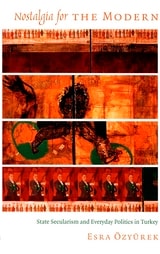
Nostalgia for the Modern
State Secularism and Everyday Politics in TurkeyEsra Özyürek
Duke University Press, 2006
Drawing on her ethnographic research in Istanbul and Ankara during the late 1990s, Özyürek describes how ordinary Turkish citizens demonstrated their affinity for Kemalism in the ways they organized their domestic space, decorated their walls, told their life stories, and interpreted political developments. She examines the recent interest in the private lives of the founding generation of the Republic, reflects on several privately organized museum exhibits about the early Republic, and considers the proliferation in homes and businesses of pictures of Atatürk, the most potent symbol of the secular Turkish state. She also explores the organization of the 1998 celebrations marking the Republic’s seventy-fifth anniversary. Özyürek’s insights into how state ideologies spread through private and personal realms of life have implications for all societies confronting the simultaneous rise of neoliberalism and politicized religion.
Secularizing Islamists?
Jama'at-e-Islami and Jama'at-ud-Da'wa in Urban PakistanHumeira Iqtidar
University of Chicago Press, 2011
Secularizing Islamists? provides an in-depth analysis of two Islamist parties in Pakistan, the highly influential Jama‘at-e-Islami and the more militant Jama‘at-ud-Da‘wa, widely blamed for the November 2008 terrorist attack in Mumbai, India. Basing her findings on thirteen months of ethnographic work with the two parties in Lahore, Humeira Iqtidar proposes that these Islamists are involuntarily facilitating secularization within Muslim societies, even as they vehemently oppose secularism.
This book offers a fine-grained account of the workings of both parties that challenges received ideas about the relationship between the ideology of secularism and the processes of secularization. Iqtidar particularly illuminates the impact of women on Pakistani Islamism, while arguing that these Islamist groups are inadvertently supporting secularization by forcing a critical engagement with the place of religion in public and private life. She highlights the role that competition among Islamists and the focus on the state as the center of their activity plays in assisting secularization. The result is a significant contribution to our understanding of emerging trends in Muslim politics.