Results by title
3 books match the query 'Israel. Tseva haganah le-Yiśraʼel'
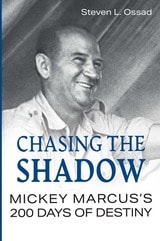
Chasing the Shadow
Mickey Marcus's 200 Days of DestinySteven L. Ossad
University of Missouri Press, 2024
The life of David “Mickey” Marcus has become the stuff of legends and myths (even fantasy), conspiracy, wild exaggeration, and untethered embellishment. The image of Marcus cast by the character portrayed by Kirk Douglas in the film version of his life still dominates most evocations of the man, for good or ill. And these days, reactions to the book or film rest mostly on the current headlines rather than the historical context of the struggle in which Marcus died, or the events that cast him as a real-life player in an event marked by destiny.
Chasing the Shadow: Mickey Marcus’s 200 Days of Destiny is the first comprehensive and balanced biography of David Daniel “Mickey” Marcus, a founder of American Civil Affairs and Military Government doctrine and practice and a seminal figure in early Israeli military history. Far from merely a tribute to Mickey Marcus's legacy, Ossad’s work serves as a critical tool for understanding the realities of mid-20th-century warfare in a Postwar colonial struggle and the dynamics of U.S.-Israeli military and political relations in 1948, the critical year for Israel’s struggle for independence. Indeed, Chasing the Shadow is a valuable read for those interested in Middle East history, Jewish military history, and a fascinating character whose story is told in an engaging, informative, and insightful narrative.
For God and Country?
Religious Student-Soldiers in the Israel Defense ForcesBy Elisheva Rosman-Stollman
University of Texas Press, 2014
In many modern armies the religious soldier is suspect. Civilians and officers alike wonder if such a soldier might represent a potential fifth column. This concern is especially prominent in the public discourse over the presence of religious Orthodox Jews serving in the Israel Defense Forces. Will they obey their commanding officer or their rabbi? With research collected over almost a decade, including hundreds of hours of interviews, Elisheva Rosman examines this question of loyalties and reveals how religious soldiers negotiate a place for themselves in an institution whose goals and norms sometimes conflict with those of Orthodox Judaism.
For God and Country? focuses on the pre-service study programs available to religious conscripts. Many journalists and scholars in Israel are suspicious of the student-soldiers who participate in these programs, but in fact, as Rosman’s research demonstrates, the pre-service study programs serve as mediating structures between the demands of Religious Zionism and the demands of the Israel Defense Forces and do not encourage their students to disobey orders. This was especially apparent during the disengagement from Gaza in 2005. Many in Israeli society predicted student-soldiers would defy their orders, per the instruction of their religious leaders, but this did not happen as expected. In high profile cases such as this and in matters encountered daily by religious soldiers—the mixing of the sexes, for instance—Rosman has discovered that the pre-service study programs can successfully serve as agents of civil society, both able to curb the military’s efforts to meddle in civilian affairs and vice versa.

Operation Defensive Shield
Witnesses to Israeli War CrimesEdited by Muna Hamzeh and Todd June
Pluto Press, 2003
On March 29, 2002 the Israeli army launched Operation Defensive Shield, the largest military offensive against Palestinian civilians since the 1948 Arab-Israeli War. During the operation, the military used the most advanced weaponry at its disposal: Merkava tanks, Apache attack helicopters and F-15 fighter jets. When the operation ended on April 21, Israel had destroyed the Palestinian economic and social infrastructure, leveled large swathes of residential area, killed 220 people, injured hundreds more and arrested thousands.
This book documents these events through a collection of electronic witness narratives written by Palestinians who were under attack and by Israeli and international peace activists who witnessed the results of these attacks. Deeply moving and courageous, these narratives offer a uniquely powerful and intimate account of the daily reality for Palestinians who endured Ariel Sharon's military strategy, and the death and destruction that strategy has caused throughout the Occupied Territories.
Most important, the witnesses' voices bring to life the aggressive nature of this strategy -- they belie the noble motives ascribed to Sharon and those in his government and military who designed and carried it out. The editors argue that Operation Defensive Shield is a prelude to Israel's ethnic cleansing of the Palestinians. They provide historical context, a chronology, and an analysis of the conflict that situates the horror of these days in their proper perspective.
Operation Defensive Shield: Witnesses to Israeli War Crimes is an essential record for those who want to understand what happened in the West Bank in the spring of 2002, and what it portends for the future of the region.