Results by title

5 books match the query 'Israeli fiction'
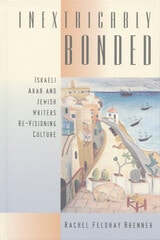
cover of Inextricably Bonded: Israeli Arab and Jewish Writers Re-Visioning Culture

Inextricably Bonded

Israeli Arab and Jewish Writers Re-Visioning Culture

Rachel Feldhay Brenner

University of Wisconsin Press, 2003

    Despite the tragic reality of the continuing Israeli-Arab conflict and deep-rooted beliefs that the chasm between Israeli Jews and Israeli Arabs is unbridgeable, this book affirms the bonds between the two communities. Rachel Feldhay Brenner demonstrates that the literatures of both ethnic groups defy the ideologies that have obstructed dialogue between the two peoples.
    Brenner argues that literary critics have ignored the variety and the dissent in the novels of both Arab and Jewish writers in Israel, giving them interpretations that embrace the politics of exclusion and conform with Zionist ideology. Brenner offers insightful new readings that compare fiction by Jewish writers Amos Oz, A.B. Yehoshua, David Grossman, and others with fiction written in Hebrew by such Arab-Israeli writers as Atallah Mansour, Emile Habiby, and Anton Shammas. This parallel analysis highlights the moral and psychological dilemmas faced by both the Jewish victors and the Arab vanquished, and Brenner suggests that the hope for release from the historical trauma lies—on both sides—in reaching an understanding with and of the adversary.
    Drawing upon the theories of Walter Benjamin, Jacques Lacan, Sigmund Freud, Emanuel Levinas, and others, Inextricably Bonded is an innovative and illuminating examination of literary dissent from dominant ideology.
[more]
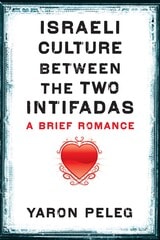
cover of Israeli Culture between the Two Intifadas: A Brief Romance

Israeli Culture between the Two Intifadas

A Brief Romance

By Yaron Peleg

University of Texas Press, 2008

Over the past two decades, profound changes in Israel opened its society to powerful outside forces and the dominance of global capitalism. As a result, the centrality of Zionism as an organizing ideology waned, prompting expressions of anxiety in Israel about the coming of a post-Zionist age. The fears about the end of Zionism were quelled, however, by the Palestinian uprising in 2000, which spurred at least a partial return to more traditional perceptions of homeland. Looking at Israeli literature of the late twentieth century, Yaron Peleg shows how a young, urban class of Israelis felt alienated from the Zionist values of their forebears, and how they adopted a form of escapist romanticism as a defiant response that replaced traditional nationalism.

One of the first books in English to identify the end of the post-Zionist era through inspired readings of Hebrew literature and popular media, Israeli Culture between the Two Intifadas examines Israel's ambivalent relationship with Jewish nationalism at the end of the twentieth century.
[more]
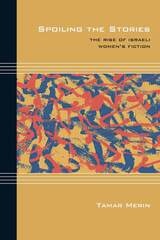
cover of Spoiling the Stories: The Rise of Israeli Women's Fiction

Spoiling the Stories

The Rise of Israeli Women's Fiction

Tamar Merin

Northwestern University Press, 2016
In Spoiling the Stories, Tamar Merin presents the as yet untold story of the rise of prose by Israeli women, while further exploring and expanding the gendered models of literary influence in modern Hebrew literature. The theoretical idea upon which this book is based is that of intersexual dialogue, a term that refers to the various literary strategies employed by Israeli female fiction writers expressing their voice within a male-dominated and (still) inherently Oedipal literary tradition. Spoiling the Stories focuses on intersexual dialogue as it evolved in the first three decades after the establishment of the state of Israel in the works of Yehudit Hendel, Amalia Kahana Carmon, and Rachel Eytan. According to Merin, these three women writers were the most important in the history of modern Hebrew literature: each was a significant participant in the poetic development of her time.
 
[more]
cover of The Boom in Contemporary Israeli Fiction

The Boom in Contemporary Israeli Fiction

Edited by Alan Mintz

Brandeis University Press, 1997
A critical introduction to contemporary Israeli literature that places works and writers in their cultural and social context. Five essays explore facets of what Mintz calls the complexity of cultural reverberations in Israeli fiction of the past two decades, a period during which "literature and the institutions of literary culture became the principal mode of encountering and mediating modernity." Among the major concerns addressed are the emergence of female writers, characterization of redefined gender roles, re-imagining the Holocaust, de-marginalization of Sephardic writing, and adoption of innovative techniques like magic realism and experimental narrative strategies. The collection shows how contemporary Israeli literature both chronicles and confronts cultural and societal dichotomies -- collectivism vs. individualism, native Israelis vs. Holocaust survivors, male vs. female, religion vs. secular, Ashkenazic vs. Sephardic -- that characterize a nation whose self-conception has been shaped by its complex and conflicted history. CONTRIBUTORS: Robert Alter, Nancy Berg, Yael S. Feldman, Anne Golomb Hoffman, Alan Mintz, Gilead Morahg
[more]
cover of The Zionist Paradox: Hebrew Literature and Israeli Identity

The Zionist Paradox

Hebrew Literature and Israeli Identity

Yigal Schwartz

Brandeis University Press, 2014

Many contemporary Israelis suffer from a strange condition. Despite the obvious successes of the Zionist enterprise and the State of Israel, tension persists, with a collective sense that something is wrong and should be better. This cognitive dissonance arises from the disjunction between “place” (defined as what Israel is really like) and “Place” (defined as the imaginary community comprised of history, myth, and dream). Through the lens of five major works in Hebrew by writers Abraham Mapu (1853), Theodor Herzl (1902), Yosef Luidor (1912), Moshe Shamir (1948), and Amos Oz (1963), Schwartz unearths the core of this paradox as it evolves over one hundred years, from the mid-nineteenth century to the 1960s.
[more]