Results by title

10 books match the query 'Italian literature'
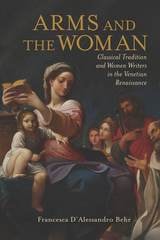
cover of Arms and the Woman: Classical Tradition and Women Writers in the Venetian Renaissance

Arms and the Woman

Classical Tradition and Women Writers in the Venetian Renaissance

Francesca D'Alessandro Behr

The Ohio State University Press, 2018


Arms and the Woman: Classical Tradition and Women Writers in the Venetian Renaissance by Francesca D’Alessandro Behr focuses on the classical reception in the works of female authors active in Venice during the Early Modern Age. Even in this relatively liberal city, women had restricted access to education and were subject to deep-seated cultural prejudices, but those who read and wrote were able, in part, to overcome those limitations.
 
In this study, Behr explores the work of Moderata Fonte and Lucrezia Marinella and demonstrates how they used knowledge of texts by Virgil, Ovid, and Aristotle to systematically reanalyze the biased patterns apparent both in the romance epic genre and contemporary society. Whereas these classical texts were normally used to bolster the belief in female inferiority and the status quo, Fonte and Marinella used them to envision societies structured according to new, egalitarian ethics. Reflecting on the humanist representation of virtue, Fonte and Marinella insisted on the importance of peace, mercy, and education for women. These authors took up the theme of the equality of genders and participated in the Renaissance querelle des femmes, promoting women’s capabilities and nature.
 
[more]
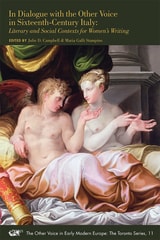
cover of In Dialogue with the Other Voice in Sixteenth-century Italy: Literary and Social Contexts for Women's Writing

In Dialogue with the Other Voice in Sixteenth-century Italy

Literary and Social Contexts for Women's Writing

Edited by Julie D. Campbell and Maria Galli Stampino

Iter Press, 2011

This excellent collection of essays and texts surveys the culture and intellectual context of early modern Italy in order to render more intelligible the writing of Italian women. The role of women in society and the persistent misogyny even of the most pro-woman texts are explored in the essays, and the recent critical debates are examined. The translations make available in English a selection of male-authored texts which directly or indirectly elicited the spirited responses of women, for which the volume is aptly entitled “In Dialogue.” A valuable classroom resource, the volume is an important addition to The Other Voice: Toronto series.
—Elissa Weaver
Professor of Italian, Emerita, University of Chicago
[more]
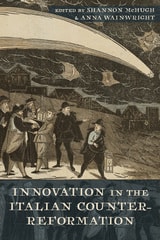
cover of Innovation in the Italian Counter-Reformation

Innovation in the Italian Counter-Reformation

Shannon McHugh

University of Delaware Press, 2011

The enduring "black legend" of the Italian Counter-Reformation, which has held sway in both scholarly and popular culture, maintains that the Council of Trent ushered in a cultural dark age in Italy, snuffing out the spectacular creative production of the Renaissance. As a result, the decades following Trent have been mostly overlooked in Italian literary studies, in particular. The thirteen essays of Innovation in the Italian Counter-Reformation present a radical reconsideration of literary production in post-Tridentine Italy. With particular attention to the much-maligned tradition of spiritual literature, the volume’s contributors weave literary analysis together with religion, theater, art, music, science, and gender to demonstrate that the literature of this period not only merits study but is positively innovative. Contributors include such renowned critics as Virginia Cox and Amedeo Quondam, two of the leading scholars on the Italian Counter-Reformation.

Published by University of Delaware Press. Distributed worldwide by Rutgers University Press.
 
[more]
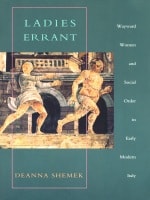
cover of Ladies Errant: Wayward Women and Social Order in Early Modern Italy

Ladies Errant

Wayward Women and Social Order in Early Modern Italy

Deanna Shemek

Duke University Press, 1998

The issue of a woman’s place—and the possibility that she might stray from it—was one of early modern Italy’s most persistent social concerns. Ladies Errant takes as its starting point the vast literature of this era devoted to the proper conduct and education of women. Deanna Shemek uses this foundation to present the problem of wayward feminine behavior as it was perceived to threaten male identity and social order in the artistic and intellectual articulations of the Italian Renaissance.
Seeing errancy as an act of resistance rather than of error, Shemek carries her study beyond the didactic and prescriptive literature on femininity in early modern Italy to an arena in which theories about femininity are considered jointly with real and fictional instances of women’s waywardness. As prostitutes, warriors, lovers, and poets, the women of Shemek’s study are found in canonical texts, marginal works, and popular artistic activity, appearing, for instance, in literature, paintings, legal proceedings, and accounts of public festivals. By juxtaposing these varied places of errancy—from Ariosto’s chivalric Orlando furioso to the prostitutes’ race in the Palio di San Giorgio—Shemek points to the important contact between elite and popular cultures in early modernity, revealing the strength and flexibility of a gender boundary fundamental to early modern conceptions of social order.
[more]
cover of Publishing Women: Salons, the Presses, and the Counter-Reformation in Sixteenth-Century Italy

Publishing Women

Salons, the Presses, and the Counter-Reformation in Sixteenth-Century Italy

Diana Robin

University of Chicago Press, 2007

Even the most comprehensive Renaissance histories have neglected the vibrant groups of women writers that emerged in cities across Italy during the mid-1500s—and the thriving network of printers, publishers, and agents that specialized in producing and selling their books. In Publishing Women, Diana Robin finally brings to life this story of women’s cultural and intellectual leadership in early modern Italy, illuminating the factors behind—and the significance of—their sudden dominance.

Focusing on the collective publication process, Robin portrays communities in Naples, Venice, Rome, Siena, and Florence, where women engaged in activities that ranged from establishing literary salons to promoting religious reform. Her innovative cultural history considers the significant roles these women played in tandem with men, rather than separated from them. In doing so, it collapses the borders between women’s history, Renaissance and Reformation studies, and book history to evoke a historical moment that catapulted women’s writings and women-sponsored books into the public sphere for the first time anywhere in Europe.
[more]
cover of Redreaming the Renaissance: Essays on History and Literature in Honor of Guido Ruggiero

Redreaming the Renaissance

Essays on History and Literature in Honor of Guido Ruggiero

Mary Lindemann

University of Delaware Press, 2024
Redreaming the Renaissance seeks to remedy the dearth of conversations between scholars of history and literary studies by building on the pathbreaking work of Guido Ruggiero to explore the cross-fertilization between these two disciplines, using the textual world of the Italian Renaissance as proving ground. In this volume, these disciplines blur, as they did for early moderns, who did not always distinguish between the historical and literary significance of the texts they read and produced. Literature here is broadly conceived to include not only belles lettres, but also other forms of artful writing that flourished in the period, including philosophical writings on dreams and prophecy; life-writing; religious debates; menu descriptions and other food writing; diaries, news reports, ballads, and protest songs; and scientific discussions. The twelve essays in this collection examine the role that the volume’s dedicatee has played in bringing the disciplines of history and literary studies into provocative conversation, as well as the methodology needed to sustain and enrich this conversation.
[more]
cover of Secret of the Muses Retold: Classical Influences on Italian Authors of the Twentieth Century

Secret of the Muses Retold

Classical Influences on Italian Authors of the Twentieth Century

John T. Kirby

University of Chicago Press, 2000

Precious repositories of ancient wisdom? Musty relics of outmoded culture? Timeless paragons of artistic achievement? Hegemonic tools of intellectual repression? Just what are the classics, anyway, and why do (or should) we still pay so much attention to them? What is the literary canon? What is myth, and how do we use it?

These are some of the questions that gave rise to John Kirby's Secret of the Muses Retold. This new study of works by five twentieth-century Italian writers investigates the abiding influence of the Greek and Roman classics, and their rich legacy in our own day. The result is not only a splendid introduction to contemporary Italian literature, but also a lucid and stimulating meditation on the insights that writers such as Umberto Eco and Italo Calvino have tapped from the wellspring of ancient tradition.

Kirby's book offers an impassioned plea for the recuperation of the humanities in general, and of classical studies in particular. No expertise in Greek, Latin, Italian, or literary theory is presumed, and both traditional and postmodern perspectives are accommodated.
[more]
cover of The Arcadia of Jacopo Sannazaro: A New Translation with Commentary

The Arcadia of Jacopo Sannazaro

A New Translation with Commentary

Nicholas R. Jones

University of Michigan Press, 2025

Five hundred years ago, working from hints in classical Greek and Latin poets, the young author Jacopo Sannazaro crafted the book called Arcadia, a narrative in richly descriptive Italian prose interwoven with elegant and passionate poems. A young man—transparently a stand-in for the author—leaves his home in Naples to join a community of shepherds in the remote Greek region of Arcadia. Yet he finds that this seemingly idyllic land is as fraught as the homeland he fled. Like the author’s humanist community in Naples, ravaged in the fifteenth century by invasion and regime change, the eloquent shepherd-poets of Arcadia are driven to distraction and depression by the frustrations of desire and the social unrest that threatens their pastoral lives. Amidst all that, they tell each other their personal histories and share their sorrows in song.
Sannazaro’s Arcadia is widely recognized as a foundational text of pastoral poetry, humanism, and Italian literature. But the book itself has been largely inaccessible to English-language students and readers. This new translation uses contemporary American English to convey Arcadia’s youthful vigor, narrative energy, and poetic inventiveness. The extensive introduction and commentaries place Arcadia in the context of late fifteenth-century humanist thought and writing, as well as the complicated crisis of Naples in the years just before 1500. This translation is designed to facilitate the re-entry of Arcadia into scholarly discourse and general readership while outlining its lasting cultural influence on poetry, drama, art and music.
[more]
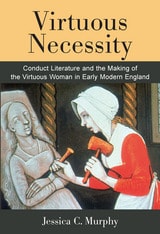
cover of Virtuous Necessity: Conduct Literature and the Making of the Virtuous Woman in Early Modern England

Virtuous Necessity

Conduct Literature and the Making of the Virtuous Woman in Early Modern England

Jessica C. Murphy

University of Michigan Press, 2015
While many scholars find the early modern triad of virtues for women—silence, chastity, and obedience—to be straightforward and nonnegotiable, Jessica C. Murphy demonstrates that these virtues were by no means as direct and inflexible as they might seem. Drawing on the literature of the period—from the plays of Shakespeare to a conduct manual written for a princess to letters from a wife to her husband—as well as contemporary gender theory and philosophy, she uncovers the multiple meanings of behavioral expectations for sixteenth- and seventeenth-century women. Through her renegotiation of cultural ideals as presented in both literary and nonliterary texts of early modern England, Murphy presents models for “acceptable” women’s conduct that lie outside of the rigid prescriptions of the time.

Virtuous Necessity will appeal to readers interested in early modern English literature, including canonical authors such as Shakespeare, Spenser, and Milton, as well as their female contemporaries such as Amelia Lanyer and Elizabeth Cary. It will also appeal to scholars of conduct literature; of early modern drama, popular literature, poetry, and prose; of women’s history; and of gender theory.
[more]
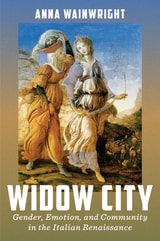
cover of Widow City: Gender, Emotion, and Community in the Italian Renaissance

Widow City

Gender, Emotion, and Community in the Italian Renaissance

Anna Wainwright

University of Delaware Press, 2025

Widow City: Gender, Emotion, and Community in the Italian Renaissance investigates the ever-evolving role of the widow in medieval and early modern Italian literature, from canonical authors such as Dante, Petrarch, and Boccaccio, to the numerous widowed writers who rose to prominence in the sixteenth century—including Vittoria Colonna, Veronica Gambara, and Francesca Turina—and radically changed the conversation on public mourning. Engaging with broader intellectual discussions around gender, the history of emotions, the politics of mourning, and the construction of community, Widow City argues that widows served as key models demonstrating to readers not just how to mourn, but how to live well after devastating loss. At the same time, widows were figures of great anxiety: their status as unattached women, and the public performance of their grief, were viewed as very real threats to the stability of the social order. They are thus key to broader intellectual understandings of community and civic life in the Italian Middle Ages and Renaissance.
[more]