Results by title
11 books match the query 'James Baldwin'
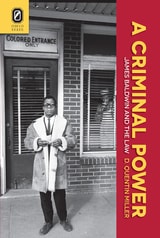
A Criminal Power
James Baldwin and the LawD. Quentin Miller
The Ohio State University Press, 2012
Black Manhood in James Baldwin, Ernest J. Gaines, and August Wilson
Keith Clark
University of Illinois Press, 2002
Challenging the standard portrayals of Black men in African American literature
From Frederick Douglass to the present, the preoccupation of black writers with manhood and masculinity is a constant. Black Manhood in James Baldwin, Ernest J. Gaines, and August Wilson explores how in their own work three major African American writers contest classic portrayals of black men in earlier literature, from slave narratives through the great novels of Richard Wright and Ralph Ellison.
Keith Clark examines short stories, novels, and plays by Baldwin, Gaines, and Wilson, arguing that since the 1950s the three have interrupted and radically dismantled the constricting literary depictions of black men who equate selfhood with victimization, isolation, and patriarchy. Instead, they have reimagined black men whose identity is grounded in community, camaraderie, and intimacy.
Delivering original and startling insights, this book will appeal to scholars and students of African American literature, gender studies, and narratology.

I Never Made Love with James Baldwin
A MemoirStanley Cohen
Seagull Books, 2026
One man's life unfolds into a memoir of the defining cultural figures of the mid-twentieth century and beyond.
I Never Made Love with James Baldwin is a dazzling memoir told through a succession of attorney Stanley Cohen's vivid encounters with some of the most compelling figures of the twentieth century and beyond. Moving between America, Europe, and Asia, Cohen recounts moments shared with artists, writers, jurists, and financiers, including Alexander Calder, Joseph Heller, Robert Caro, Ruth Bader Ginsburg, Yehuda Hanani, and members of the Rothschild family. These figures appear not as distant icons but as sharp, human presences—brilliant, eccentric, generous, and flawed. Cohen’s life unfolds like a performance, shaped less by planning than by intensity: conversations, friendships, arguments, and coincidences that flare briefly and leave lasting marks. With wit, candor, and an eye for the telling detail, he captures a vast social and creative network spanning the mid-twentieth century to the present. The result is an intimate, unconventional portrait of an exceptional life and of the people who lit its path.
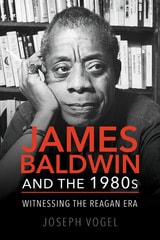
James Baldwin and the 1980s
Witnessing the Reagan EraJoseph Vogel
University of Illinois Press, 2018
Joseph Vogel offers the first in-depth look at Baldwin's dynamic final decade of work. Delving into the writer's creative endeavors, crucial essays and articles, and the impassioned polemic The Evidence of Things Not Seen, Vogel finds Baldwin as prescient and fearless as ever. Baldwin's sustained grappling with "the great transforming energy" of mass culture revealed his gifts for media and cultural criticism. It also brought him into the fray on issues ranging from the Reagan-era culture wars to the New South, from the deterioration of inner cities to the disproportionate incarceration of black youth, and from pop culture gender-bending to the evolving women's and gay rights movements.
Astute and compelling, James Baldwin and the 1980s revives and redeems the final act of a great American writer.
James Baldwin and the Heavenly City
Prophecy, Apocalypse, and DoubtChristopher Z. Hobson
Michigan State University Press, 2018
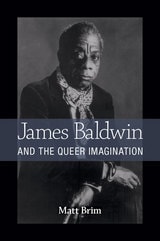
James Baldwin and the Queer Imagination
Matt Brim
University of Michigan Press, 2014

James Baldwin and the Queer Imagination
Matt Brim
University of Michigan Press, 2014
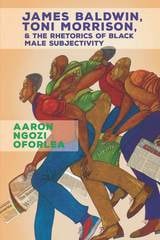
James Baldwin, Toni Morrison, and the Rhetorics of Black Male Subjectivity
Aaron Ngozi Oforlea
The Ohio State University Press, 2017
Oforlea’s book offers new analyses of the character dynamics in Baldwin’s Go Tell It on the Mountain, Tell Me How Long the Train’s Been Gone, and If Beale Street Could Talkand Morrison’s Beloved, Song of Solomon, and Tar Baby. The black male characters in these novels encounter the discursive divide, or a cultural dissonance, when they encounter dominant representations of black male identities. They use these opportunities to construct a counter-discourse about black male subjectivity. Ultimately, Oforlea argues, these characters are strategic about when and how they want to appropriate and subvert dominant ideologies. Their awareness that post-racial discourses perpetuate racial inequality serves as a gateway toward participation in collective struggles for racial justice.
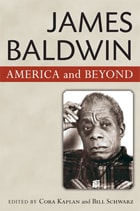
James Baldwin
America and BeyondBill Schwarz and Cora Kaplan, editors
University of Michigan Press, 2011
"This fine collection of essays represents an important contribution to the rediscovery of Baldwin's stature as essayist, novelist, black prophetic political voice, and witness to the Civil Rights era. The title provides an excellent thematic focus. He understood both the necessity, and the impossibility, of being a black 'American' writer. He took these issues 'Beyond'---Paris, Istanbul, various parts of Africa---but this formative experience only returned him to the unresolved dilemmas. He was a fine novelist and a major prophetic political voice. He produced some of the most important essays of the twentieth century and addressed in depth the complexities of the black political movement. His relative invisibility almost lost us one of the most significant voices of his generation. This welcome 'revival' retrieves it. Close call."
---Stuart Hall, Professor Emeritus, Open University
This interdisciplinary collection by leading writers in their fields brings together a discussion of the many facets of James Baldwin, both as a writer and as the prophetic conscience of a nation. The core of the volume addresses the shifting, complex relations between Baldwin as an American—“as American as any Texas GI” as he once wryly put it—and his life as an itinerant cosmopolitan. His ambivalent imaginings of America were always mediated by his conception of a world “beyond” America: a world he knew both from his travels and from his voracious reading. He was a man whose instincts were, at every turn, nurtured by America; but who at the same time developed a ferocious critique of American exceptionalism. In seeking to understand how, as an American, he could learn to live with difference—breaking the power of fundamentalisms of all stripes—he opened an urgent, timely debate that is still ours. His America was an idea fired by desire and grief in equal measure. As the authors assembled here argue, to read him now allows us to imagine new possibilities for the future.
With contributions by Kevin Birmingham, Douglas Field, Kevin Gaines, Briallen Hopper, Quentin Miller, Vaughn Rasberry, Robert Reid-Pharr, George Shulman, Hortense Spillers, Colm Tóibín, Eleanor W. Traylor, Cheryl A. Wall, and Magdalena Zaborowska.
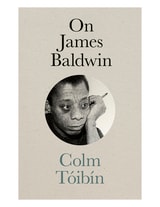
On James Baldwin
Colm Tóibín
Brandeis University Press, 2024
Acclaimed Irish novelist Colm Tóibín first read James Baldwin just after turning eighteen. He had completed his first year at an Irish university and was struggling to free himself from a religious upbringing. He had even considered entering a seminary and was searching for literature that would offer illumination and insight. Inspired by the novel Go Tell It on the Mountain, Tóibín found a writer who would be a lifelong companion and exemplar.
From On James Baldwin
Baldwin was interested in the hidden and dramatic areas in his own being, and was prepared as a writer to explore difficult truths about his own private life. In his fiction, he had to battle for the right of his protagonists to choose or influence their destinies. He knew about guilt and rage and bitter privacies in a way that few of his White novelist contemporaries did. And this was not simply because he was Black and homosexual; the difference arose from the very nature of his talent, from the texture of his sensibility. “All art,” he wrote, “is a kind of confession, more or less oblique. All artists, if they are to survive, are forced, at last, to tell the whole story, to vomit the anguish up.”
On James Baldwin is a magnificent contemporary author’s tribute to one of his most consequential literary progenitors.
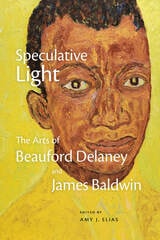
Speculative Light
The Arts of Beauford Delaney and James BaldwinAmy J. Elias, editor
Duke University Press, 2025
Contributors. Hilton Als, Nicholas Boggs, Indie A. Choudhury, Shawn Anthony Christian, Rachel Cohen, Amy J. Elias, Monika Gehlawat, David Leeming, D. Quentin Miller, Fred Moten, Walton M. Muyumba, Robert O’Meally, Ed Pavlić, Levi Prombaum, Robert Reid-Pharr, Tyler T. Schmidt, Abbe Schriber, Jered Sprecher, Stephen C. Wicks, Magdalena Zaborowska