Results by title

7 books match the query 'Jeremy Bentham'
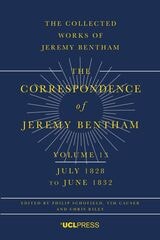
cover of Correspondence of Jeremy Bentham, Volume 13: July 1828 to June 1832

Correspondence of Jeremy Bentham, Volume 13

July 1828 to June 1832

Edited by Philip Schofield, Tim Causer, and Chris Riley

University College London, 2024

A comprehensive collection of letters exchanged by Bentham with notable figures worldwide from 1828 until his death in 1832.

The Correspondence of Jeremy Bentham, Volume 13 contains authoritative and fully annotated texts of all known and publishable letters sent both to and from Bentham between 1st July 1828 and his death on 6th June 1832. In addition to 474 letters, the volume contains three memorandums concerning Bentham’s health shortly before his death, his last will and testament, and extracts from both the autobiography and the manuscript diaries of Bentham’s nephew George. Among the letters that have already been published, most are drawn from the edition of The Works of Jeremy Bentham, prepared under the superintendence of Bentham’s literary executor John Bowring. A small number of letters have been reproduced from newspapers and periodicals.

This volume publishes, for the first time, the entire extant correspondence between Bentham and Daniel O’Connell, the Irish Liberator. Other new acquaintances include the barrister and law reformer, Charles Sinclair Cullen, and the Real Property Commissioner, John Tyrrell. Throughout the period, Bentham maintained regular contact with old friends and connections, but he also engaged in sporadic correspondence with such leading figures in government as the Duke of Wellington, Robert Peel, and Henry Brougham. Further afield, Bentham corresponded, amongst others, with the Marquis de La Fayette in France, Edward Livingston in the United States of America, and José Del Valle in Guatemala.
 
[more]
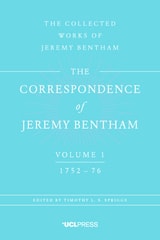
cover of Correspondence of Jeremy Bentham, Volume 1: 1752 to 1776

Correspondence of Jeremy Bentham, Volume 1

1752 to 1776

Jeremy Bentham, edited by Timothy L. S. Sprigge, and series edited by J.H. Burns

University College London, 2017
The first five volumes of the Correspondence of Jeremy Bentham contain more than 1,300 letters written to and from Bentham over fifty years, beginning in 1752 at the age of three and ending in 1797 with correspondence concerning his attempts to set up a national plan for the provision of poor relief. The letters in Volume 1 (1752-1776) document his difficult relationship with his father—Bentham lost five infant siblings and his mother—and his increasing attachment to his surviving brother, Samuel. We also see an early glimpse of Bentham’s education, as he committed himself to philosophy and legal reform. The exchanges in Volume 2 (1777-1780) cover a major event: a trip by Samuel to Russia. This volume also reveals Bentham working intensively on the development of a code of penal law, enhancing his reputation as a legal thinker. Volume 3 (1781-1788) shows that despite developing a host of original ideas, Bentham actually published little during this time. Nevertheless, this volume also reveals how the foundations were being laid for the rise of Benthamite utilitarianism. The letters in Volume 4 (1788-1793) coincide with the publication of An Introduction to the Principles of Morals and Legislation, which had little impact at the time. In 1791 he published The Panopticon: or, The Inspection-House, which he proposed the building of a circular penitentiary house. Bentham’s letters unfold against the backdrop of the French Revolution and show that his initial sympathy for France began to turn into hostility. Bentham’s life during the years in Volume 5 (1794-1797) was dominated by the panopticon, both as a prison and as an indigent workhouse. The letters in this volume document in great detail Bentham’s attempt to build a panopticon prison in London, and the opposition he faced from local aristocratic landowners. 
[more]
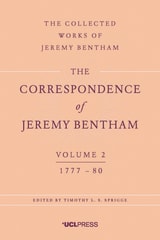
cover of Correspondence of Jeremy Bentham, Volume 2: 1777 to 1780

Correspondence of Jeremy Bentham, Volume 2

1777 to 1780

Jeremy Bentham, edited by Timothy L. S. Sprigge, and series edited by J.H. Burns

University College London, 2017
The first five volumes of the Correspondence of Jeremy Bentham contain more than 1,300 letters written to and from Bentham over fifty years, beginning in 1752 at the age of three and ending in 1797 with correspondence concerning his attempts to set up a national plan for the provision of poor relief. The letters in Volume 1 (1752-1776) document his difficult relationship with his father—Bentham lost five infant siblings and his mother—and his increasing attachment to his surviving brother, Samuel. We also see an early glimpse of Bentham’s education, as he committed himself to philosophy and legal reform. The exchanges in Volume 2 (1777-1780) cover a major event: a trip by Samuel to Russia. This volume also reveals Bentham working intensively on the development of a code of penal law, enhancing his reputation as a legal thinker. Volume 3 (1781-1788) shows that despite developing a host of original ideas, Bentham actually published little during this time. Nevertheless, this volume also reveals how the foundations were being laid for the rise of Benthamite utilitarianism. The letters in Volume 4 (1788-1793) coincide with the publication of An Introduction to the Principles of Morals and Legislation, which had little impact at the time. In 1791 he published The Panopticon: or, The Inspection-House, which he proposed the building of a circular penitentiary house. Bentham’s letters unfold against the backdrop of the French Revolution and show that his initial sympathy for France began to turn into hostility. Bentham’s life during the years in Volume 5 (1794-1797) was dominated by the panopticon, both as a prison and as an indigent workhouse. The letters in this volume document in great detail Bentham’s attempt to build a panopticon prison in London, and the opposition he faced from local aristocratic landowners. 
[more]
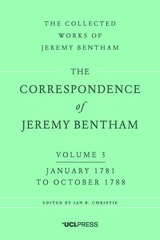
cover of Correspondence of Jeremy Bentham, Volume 3: January 1781 to October 1788

Correspondence of Jeremy Bentham, Volume 3

January 1781 to October 1788

Jeremy Bentham, edited by Ian R. Christie, and series edited by J.H. Burns

University College London, 2017
The first five volumes of the Correspondence of Jeremy Bentham contain more than 1,300 letters written to and from Bentham over fifty years, beginning in 1752 at the age of three and ending in 1797 with correspondence concerning his attempts to set up a national plan for the provision of poor relief. The letters in Volume 1 (1752-1776) document his difficult relationship with his father—Bentham lost five infant siblings and his mother—and his increasing attachment to his surviving brother, Samuel. We also see an early glimpse of Bentham’s education, as he committed himself to philosophy and legal reform. The exchanges in Volume 2 (1777-1780) cover a major event: a trip by Samuel to Russia. This volume also reveals Bentham working intensively on the development of a code of penal law, enhancing his reputation as a legal thinker. Volume 3 (1781-1788) shows that despite developing a host of original ideas, Bentham actually published little during this time. Nevertheless, this volume also reveals how the foundations were being laid for the rise of Benthamite utilitarianism. The letters in Volume 4 (1788-1793) coincide with the publication of An Introduction to the Principles of Morals and Legislation, which had little impact at the time. In 1791 he published The Panopticon: or, The Inspection-House, which he proposed the building of a circular penitentiary house. Bentham’s letters unfold against the backdrop of the French Revolution and show that his initial sympathy for France began to turn into hostility. Bentham’s life during the years in Volume 5 (1794-1797) was dominated by the panopticon, both as a prison and as an indigent workhouse. The letters in this volume document in great detail Bentham’s attempt to build a panopticon prison in London, and the opposition he faced from local aristocratic landowners. 
[more]
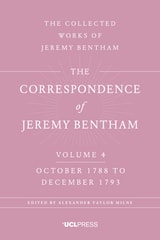
cover of Correspondence of Jeremy Bentham, Volume 4: October 1788 to December 1793

Correspondence of Jeremy Bentham, Volume 4

October 1788 to December 1793

Jeremy Bentham, edited by Alexander Taylor Milne, and general editor John R. Dinwiddy

University College London, 2017
The first five volumes of the Correspondence of Jeremy Bentham contain more than 1,300 letters written to and from Bentham over fifty years, beginning in 1752 at the age of three and ending in 1797 with correspondence concerning his attempts to set up a national plan for the provision of poor relief. The letters in Volume 1 (1752-1776) document his difficult relationship with his father—Bentham lost five infant siblings and his mother—and his increasing attachment to his surviving brother, Samuel. We also see an early glimpse of Bentham’s education, as he committed himself to philosophy and legal reform. The exchanges in Volume 2 (1777-1780) cover a major event: a trip by Samuel to Russia. This volume also reveals Bentham working intensively on the development of a code of penal law, enhancing his reputation as a legal thinker. Volume 3 (1781-1788) shows that despite developing a host of original ideas, Bentham actually published little during this time. Nevertheless, this volume also reveals how the foundations were being laid for the rise of Benthamite utilitarianism. The letters in Volume 4 (1788-1793) coincide with the publication of An Introduction to the Principles of Morals and Legislation, which had little impact at the time. In 1791 he published The Panopticon: or, The Inspection-House, in which he proposed the building of a circular penitentiary house. Bentham’s letters unfold against the backdrop of the French Revolution and show that his initial sympathy for France began to turn into hostility. Bentham’s life during the years in Volume 5 (1794-1797) was dominated by the panopticon, both as a prison and as an indigent workhouse. The letters in this volume document in great detail Bentham’s attempt to build a panopticon prison in London, and the opposition he faced from local aristocratic landowners. 
[more]
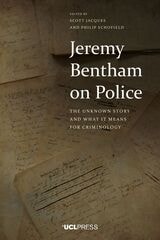
cover of Jeremy Bentham on Police: The Unknown Story and What It Means for Criminology

Jeremy Bentham on Police

The Unknown Story and What It Means for Criminology

Edited by Scott Jacques and Philip Schofield

University College London, 2021

Recovering Bentham’s thoughts on policing and what they mean for criminology today.
 
Jeremy Bentham theorized the panopticon as modern policing emerged across the British Empire, yet while his theoretical writing became canonical in criminology, his perspective on the police remains obscure. Jeremy Bentham on Police recovers the reformer’s writings on policing alongside a series of essays that demonstrate their significance to the past, present, and future of criminology.
 
[more]
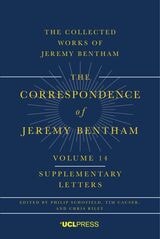
cover of The Correspondence of Jeremy Bentham, Volume 14: Supplementary Letters

The Correspondence of Jeremy Bentham, Volume 14

Supplementary Letters

Edited by Philip Schofield, Tim Causer, and Chris Riley

University College London, 2026

Over 250 letters and other materials by the philosopher and reformer Jeremy Bentham, published in full and in authoritative form for the first time. 

This volume is a supplement to the chronological series The Correspondence of Jeremy Bentham. It contains over 250 letters offering new biographical information and deepens our knowledge of Bentham’s relationship with his family, with the panopticon penitentiary scheme, and with notable “disciples” such as Étienne Dumont, Henry Bickersteth, and Leicester Stanhope. Additionally, this volume deepens our understanding of Bentham’s relationship with his younger brother, Samuel Bentham, and provides a detailed account of Samuel's journey to and sojourn in the Russian Empire. 

[more]