Results by title
7 books match the query 'Jewelry'
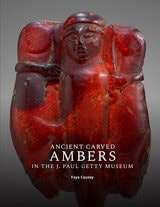
Ancient Carved Ambers in the J. Paul Getty Museum
Faya Causey
J. Paul Getty Trust, The, 0
The catalogue is preceded by a general introduction to ancient amber (which was also published in 2012 as a stand-alone print volume titled Amber and the Ancient World). Through exquisite visual examples and vivid classical texts, this book examines the myths and legends woven around amber—its employment in magic and medicine, its transport and carving, and its incorporation into jewelry, amulets, and other objects of prestige. This publication highlights a group of remarkable amber carvings at the J. Paul Getty Museum.
This catalogue was first published in 2012 at museumcatalogues.getty.edu/amber/. The present online edition of this open-access publication was migrated in 2019 to www.getty.edu/publications/ambers/; it features zoomable, high-resolution photography; free PDF, EPUB, and Kindle/MOBI downloads of the book; and JPG downloads of the catalogue images.
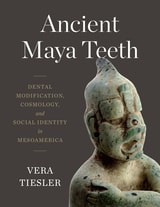
Ancient Maya Teeth
Dental Modification, Cosmology, and Social Identity in MesoamericaVera Tiesler
University of Texas Press, 2024
A study of Maya dental modification from archaeological sites spanning three millennia.
Dental modification was common across ancient societies, but perhaps none were more avid practitioners than the Maya. They filed their teeth flat or pointy, polished and drilled them, and crafted decorative inlays of jade and pyrite. Unusually, Maya of all social classes, ages, and professions engaged in dental modification. What did it mean to them?
Ancient Maya Teeth is the most comprehensive study of Maya dental modification ever published, based on thousands of teeth recovered from 130 sites spanning three millennia. Esteemed archaeologist Vera Tiesler sifts the evidence, much of it gathered with her own hands and illustrated here with more than a hundred photographs. Exploring the underlying theory and practice of dental modification, Tiesler raises key questions. How did modifications vary across the individual’s lifespan? What tools were used? How did the Maya deal with pain—and malpractice? How did they keep their dentitions healthy, functioning, and beautiful? What were the relationships among gender, social identity, and religious identifications? Addressing these and other issues, Ancient Maya Teeth reveals how dental-modification customs shifted over the centuries, indexing other significant developments in Mayan cultural history.
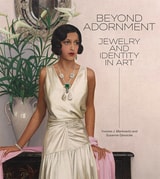
Beyond Adornment
Jewelry and Identity in ArtYvonne J. Markowitz
J. Paul Getty Trust, The, 2025
Why do people wear jewelry? What meaning does it hold for the wearer? And what does the wearer hope it will convey to those they encounter—or to someone viewing their image decades, even centuries, later?
Artistic renderings of the human figure—in portraiture, sculpture, and other media—in a range of allegorical, historical, and religious images often showcase jewelry. The ornaments depicted in such designs offer an abundance of information that not only heightens our understanding of the subject but also provides insights into the imagination of the artist. Jewelry enhances our enjoyment of works of art because it is visually compelling, sensuous, and laden with an array of associations and symbolic meanings.
Bringing together spectacular and significant art objects depicting figures wearing sumptuous personal adornments that define who they are within the specific milieus in which they lived, this richly illustrated and accessible volume represents a novel, interdisciplinary approach to the ways in which jewelry can be studied and understood.
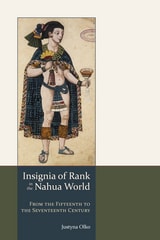
Insignia of Rank in the Nahua World
From the Fifteenth to the Seventeenth CenturyJustyna Olko
University Press of Colorado, 2014
This significant work reconstructs the repertory of insignia of rank and the contexts and symbolic meanings of their use, along with their original terminology, among the Nahuatl-speaking communities of Mesoamerica from the fifteenth through the seventeenth centuries. Attributes of rank carried profound symbolic meaning, encoding subtle messages about political and social status, ethnic and gender identity, regional origin, individual and community history, and claims to privilege.
Olko engages with and builds upon extensive worldwide scholarship and skillfully illuminates this complex topic, creating a vital contribution to the fields of pre-Columbian and colonial Mexican studies. It is the first book to integrate pre- and post-contact perspectives, uniting concepts and epochs usually studied separately. A wealth of illustrations accompanies the contextual analysis and provides essential depth to this critical work. Insignia of Rank in the Nahua World substantially expands and elaborates on the themes of Olko's Turquoise Diadems and Staffs of Office, originally published in Poland and never released in North America.

Liber Amicorum in Honour of Diana Scarisbrick
A Life in JewelsEdited by Beatriz Chadour-Sampson, Sandra Hindman, and Carla Van De Puttelaar
Paul Holberton Publishing, 2022
Coinciding with Diana Scarisbrick’s ninety-fourth birthday, this work honors her extraordinary career as the “world’s leading jewelry historian.”
Through twenty contributions by noted scholars, Liber Amicorum explores the pioneering research accomplished by jewelry historian Diana Scarisbrick. These collected pieces celebrate both the length of Scarisbrick’s career and its wide-ranging nature, touching upon her work with everything from gems, rings, chalices, bindings, and crown jewels to contemporary jewelry production, jewel theft, and individual collections.
Throughout the book, the insightful historical research of the contributors is beautifully supported by high-quality illustrations. These bring their essays to life, highlighting the splendor and fragility of some of the objects that are discussed as each delves into the work of this eminent scholar.
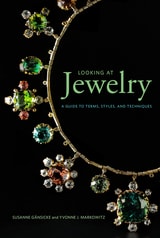
Looking at Jewelry
A Guide to Terms, Styles, and TechniquesSusanne Gänsicke
J. Paul Getty Trust, The, 2019
The fascination with personal adornment is universal. It is a preoccupation that is primal, instinctive, and uniquely human. Jewelry encompasses a seemingly endless number of ornaments produced across time and in all cultures. The range of materials and techniques used in its construction is extraordinary, even revolutionary, with new substances and methods of fabrication added with every generation. In any given society, master artisans have devoted their time, energy, and talent to the fine art of jewelry making, creating some of the most spectacular objects known to humankind.
This volume, geared toward jewelry makers, scholars, scientists, students, and fashionistas alike, begins with a lively introduction that offers a cultural history of jewelry and its production. The main text provides information on the most common, iconic, and culturally significant forms of jewelry and also covers materials, techniques, and manufacturing processes. Containing more than eighty color illustrations, this guide will be invaluable to all those wishing to increase their understanding and enjoyment of the art of jewelry.
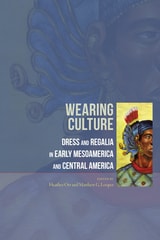
Wearing Culture
Dress and Regalia in Early Mesoamerica and Central AmericaHeather Orr
University Press of Colorado, 2014
Documenting the elaborate practices of costume, adornment, and body modification in Panama, Costa Rica, Nicaragua, Honduras, Oaxaca, the Soconusco region of southern Mesoamerica, the Gulf Coast Olmec region (Olman), and the Maya lowlands, this book demonstrates that adornment was used as a tool for communicating status, social relationships, power, gender, sexuality, behavior, and political, ritual, and religious identities. Despite considerable formal and technological variation in clothing and ornamentation, the early indigenous cultures of these regions shared numerous practices, attitudes, and aesthetic interests. Contributors address technological development, manufacturing materials and methods, nonfabric ornamentation, symbolic dimensions, representational strategies, and clothing as evidence of interregional sociopolitical exchange.
Focusing on an important period of cultural and artistic development through the lens of costuming and adornment, Wearing Culture will be of interest to scholars of pre-Hispanic and pre-Columbian studies.