Results by title
9 books match the query 'Jewish influences'
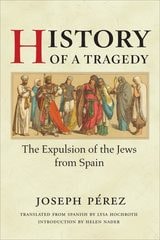
History of a Tragedy
THE EXPULSION OF THE JEWS FROM SPAINJoseph Perez
University of Illinois Press, 2006
Few events in the history of Spain have provoked as much controversy as the expulsion of the Jews in 1492. Conflicts within the Catholic Church, suspicions within the newly unified Spain, and the claims of Spanish merchants combined to make the Spain of Ferdinand and Isabella intolerant and inquisitorial. Yet the roots of Spanish anti-Semitism went deeper. In this concise survey of the expulsion of the Sephardic Jews, Joseph Pérez studies the evolution of the Jewish community in Spain from the time of the Visigoths to the reign of the Catholic kings. He explores the Jewish community’s role in creating and sustaining the vibrant cultural, political, and economic world of medieval Spain, and how growing religious intolerance, a pervasive resentment of the “others,” and a string of escalating encroachments culminated in expulsion.
In Times of Crisis
Essays on European Culture, Germans, and JewsSteven E. Aschheim
University of Wisconsin Press, 2001
The nineteenth- and twentieth-century relationship between European culture, German history, and the Jewish experience produced some of the West’s most powerful and enduring intellectual creations—and, perhaps in subtly paradoxical and interrelated ways, our century’s darkest genocidal moments. In Times of Crisis explores the flashpoints of this vexed relationship, mapping the coordinates of a complex triangular encounter of immense historical import.
In essays that range from the question of Nietzsche’s legacy to the controversy over Daniel Goldhagen’s Hitler’s Willing Executioners, the distinguished historian Steven E. Aschheim presents this encounter as an ongoing dialogue between two evolving cultural identities. He touches on past dimensions of this exchange (such as the politics of Weimar Germany) and on present dilemmas of grasping and representing it (such as the Israeli discourse on the Holocaust). His work inevitably traces the roots and ramifications of Nazism but at the same time brings into focus historical circumstances and contemporary issues often overshadowed or distorted by the Holocaust.
These essays reveal the ubiquitous charged inscriptions of Nazi genocide within our own culture and illuminate the projects of some later thinkers and historians—from Hannah Arendt to George Mosse to Saul Friedlander—who have wrestled with its problematics and sought to capture its essence. From the broadly historical to the personal, from the politics of Weimar Germany to the experience of growing up German Jewish in South Africa, the essays expand our understanding of German Jewish history in particular, but also of historical processes in general.
Key Texts in American Jewish Culture
Kugelmass, Jack
Rutgers University Press, 2003
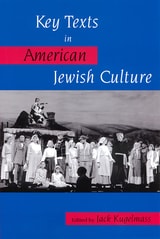
Contributors come from a variety of disciplines, including American studies, anthropology, comparative literature, history, music, religious studies, and women's studies. Each provides an analysis of a specific text in art, music, television, literature, homily, liturgy, or history. Some of the works discussed, such as Philip Roth's novel Counterlife, the musical Fiddler on the Roof, and Irving Howe's World of Our Fathers, are already widely acknowledged components of the American Jewish studies canon. Others-such as Bridget Loves Bernie, infamous for the hostile reception it received among American Jews+ may be considered "key texts" because of the controversy they provoked. Still others, such as Joshua Liebman's Piece of Mind and the radio and TV sitcom The Goldbergs, demonstrate the extent to which American Jewish culture and mainstream American culture intermingle with and borrow from each other.
Passing Illusions
Jewish Visibility in Weimar GermanyKerry Wallach
University of Michigan Press, 2017
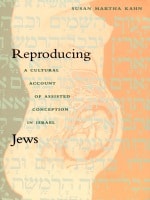
Reproducing Jews
A Cultural Account of Assisted Conception in IsraelSusan Martha Kahn
Duke University Press, 2000
In this ethnographic study of the new reproductive technologies in Israel, Susan Martha Kahn explores the cultural meanings and contemporary rabbinic responses to artificial insemination, in-vitro fertilization, egg donation, and surrogacy. Kahn draws on fieldwork with unmarried Israeli women who are using state-subsidized artificial insemination to get pregnant and on participant-observation in Israeli fertility clinics. Through close readings of traditional Jewish texts and careful analysis of Israeli public discourse, she explains how the Israeli embrace of new reproductive technologies has made Jewish beliefs about kinship startlingly literal. Kahn also reveals how a wide range of contemporary Israelis are using new reproductive technologies to realize their reproductive futures, from ultraorthodox infertile married couples to secular unmarried women.
As the first scholarly account of assisted conception in Israel, this multisited ethnography will contribute to current anthropological debates on kinship studies. It will also interest those involved with Jewish studies.
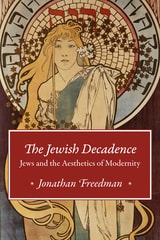
The Jewish Decadence
Jews and the Aesthetics of ModernityJonathan Freedman
University of Chicago Press, 2021
The first to tell this sweeping story, Freedman demonstrates the centrality of decadence to the aesthetics of modernity and its inextricability from Jewishness. Freedman recounts a series of diverse and surprising episodes that he insists do not belong solely to the past, but instead reveal that the identification of Jewishness with decadence persists today.
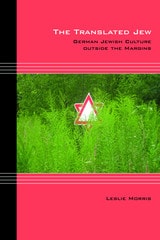
The Translated Jew
German Jewish Culture outside the MarginsLeslie Morris
Northwestern University Press, 2018
The Translated Jew brings together an eclectic set of literary and visual texts to reimagine the transnational potential for German Jewish culture in the twenty-first century. Departing from scholarship that has located the German Jewish text as an object that can be defined geographically and historically, Leslie Morris challenges national literary historiography and redraws the maps by which transnational Jewish culture and identity must be read.
Morris explores the myriad acts of translation, actual and metaphorical, through which Jewishness leaves its traces, taking as a given the always provisional nature of Jewish text and Jewish language. Although the focus is on contemporary German Jewish literary cultures, The Translated Jew also turns its attention to a number of key visual and architectural projects by American, British, and French artists and writers, including W. G. Sebald, Anne Blonstein, Hélène Cixous, Ulrike Mohr, Daniel Blaufuks, Paul Celan, Raymond Federman, and Rose Ausländer.
In thus realigning German Jewish culture with European and American Jewish culture and post-Holocaust aesthetics, this book explores the circulation of Jewishness between the United States and Europe. The insistence on the polylingualism of any single language and the multidirectionality of Jewishness are at the very center of The Translated Jew.
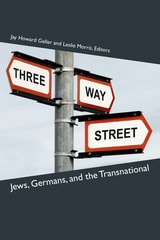
Three-Way Street
Jews, Germans, and the TransnationalJay Howard Geller and Leslie Morris, Editors
University of Michigan Press, 2016
Among the first volumes to focus on German-Jewish transnationalism, this interdisciplinary collection spans the fields of history, literature, film, theater, architecture, philosophy, and theology as it examines the lives of significant emigrants. The individuals whose stories are reevaluated include German Jews Ernst Lubitsch, David Einhorn, and Gershom Scholem, the architect Fritz Nathan and filmmaker Helmar Lerski; and eastern European Jews David Bergelson, Der Nister, Jacob Katz, Joseph Soloveitchik, and Abraham Joshua Heschel—figures not normally associated with Germany. Three-Way Street addresses the gap in the scholarly literature as it opens up critical ways of approaching Jewish culture not only in Germany, but also in other locations, from the mid-nineteenth century to the present.
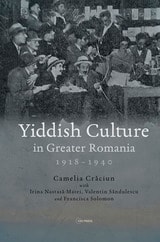
Yiddish Culture in Greater Romania (1918-1940)
Camelia Craciun
Central European University Press, 2025
In the newly created Greater Romania, the Jewish community included more than half a million individuals still speaking Yiddish. Building on pre-war trends, the new nation-state faced an antisemitism problem since its inception. This continued in the period that followed, culminating in the horrors of the Holocaust, which destroyed most of the Yiddish-language community. Most survivors were discouraged from continuing to use a language that reminded them of a painful past.
This volume examines the socio-cultural mechanisms responsible for restructuring the Yiddish cultural life after the changes brought about by the end of World War I and the creation of Greater Romania. It describes how this process evolved until the political regimes banned the activity of Yiddish theaters, press and, ultimately, the usage of Yiddish, thus making cultural life impossible.
The four authors identify the main institutions, individuals and projects that promoted Yiddish cultural life in interwar Romania. They also trace the impact of Yiddish within Romanian society through joint projects, events, and initiatives. Special attention is given to Yiddish theater, which played a key role both within the community and in its interaction with the Romanian-speaking public.