Results by title
12 books match the query 'Jewish literature'
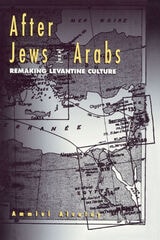
After Jews And Arabs
Remaking Levantine CultureAmmiel Alcalay
University of Minnesota Press, 1992
By exposing the rich and diverse textual and cultural legacy of this time and space, Alcalay reassesses the exclusion of Semitic culture in Europe from the perspective of contemporary Arabic culture and opposing images of the Israeli-Palestinian conflict. This book will compel a revision of Jewish studies by placing contemporary Israeli culture within its Middle Eastern context and the terms of colonial, postcolonial, and multicultural discourse.
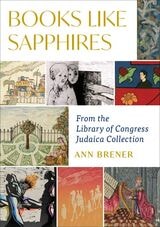
Books Like Sapphires
From the Library of Congress Judaica CollectionAnn Brener
Brandeis University Press, 2024
Books Like Sapphires showcases a wide range of Hebraic treasures from the storied collection at the Library of Congress, many of them for the first time. Tracing the history of Judaica collecting in the twentieth-century United States, the book illuminates varied works, telling their stories alongside vibrant color images. These include a unique manuscript about a betrothal scandal in Renaissance Crete, an illustrated Esther Scroll, a poem from 1477 celebrating the new technology of printing, amusing rhymed couplets in sixteenth-century Padua, and the Washington Haggadah. This book also tells the story of the patrons and collectors, first among them Jacob Schiff, as well as archivists and curators, who made the storied Judaica archive at the Library of Congress the precious resource that it is today.
By Words Alone
The Holocaust in LiteratureSidra DeKoven Ezrahi
University of Chicago Press, 1980
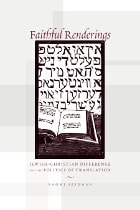
Faithful Renderings
Jewish-Christian Difference and the Politics of TranslationNaomi Seidman
University of Chicago Press, 2006
Bringing together central issues in translation studies with episodes in Jewish–Christian history, Naomi Seidman considers a range of texts, from the Bible to Elie Wiesel’s Night, delving into such controversies as the accuracy of various Bible translations, the medieval use of converts from Judaism to Christianity as translators, the censorship of anti-Christian references in Jewish texts, and the translation of Holocaust testimony. Faithful Renderings ultimately reveals that translation is not a marginal phenomenon but rather a crucial issue for understanding the relations between Jews and Christians and indeed the development of each religious community.

Israel in Exile
Jewish Writing and the DesertRanen Omer-Sherman
University of Illinois Press, 2006
In contrast to other ethnic and national representations, Jewish writers since antiquity have not constructed a neat antithesis between the desert and the city or nation; rather, the desert becomes a symbol against which the values of the city or nation can be tested, measured, and sometimes found wanting. This book examines how the ethical tension between the clashing Mosaic and Davidic paradigms of the desert still reverberate in secular Jewish literature and produce fascinating literary rewards. Omer-Sherman ultimately argues that the ancient encounter with the desert acquires a renewed urgency in response to the crisis brought about by national identities and territorial conflicts.
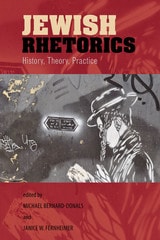
Jewish Rhetorics
History, Theory, PracticeEdited by Michael Bernard-Donals and Janice W. Fernheimer
Brandeis University Press, 2014
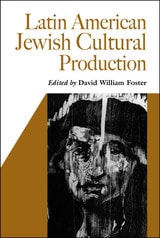
Latin American Jewish Cultural Production
David William Foster
Vanderbilt University Press, 2008
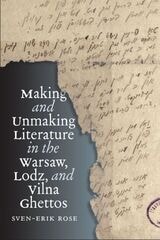
Making and Unmaking Literature in the Warsaw, Lodz, and Vilna Ghettos
Sven-Erik Rose
Brandeis University Press, 2025
A study of literature written by Jewish authors while interned in Nazi ghettos emphasizes how authors processed their horrific experiences through poetry and prose.
Published in Association with the United States Holocaust Memorial Museum
This is the first study devoted to how little known but essential authors grappled with the destitution of ghetto existence by writing within, at the limits of, and against an array of literary scenarios, tropes, plot lines, and generic conventions, including those of nature lyric, modernist interior monologue, the realist social novel, the detective story, and the gothic horror tale. Contending with starvation, disease, desperate housing conditions and the looming threat of being murdered, inhabitants of ghettos in Poland nonetheless made them sites of rich Jewish cultural production. Rose’s readings of these literary works reveal how authors asserted their humanity by insisting on writing works of literature. In such radically dehumanizing circumstances, however, their recourse to established literary genres was not naive. Rather, ghetto authors brilliantly meditated on the grotesque incongruities between established literary models and the extreme conditions of ghetto existence.
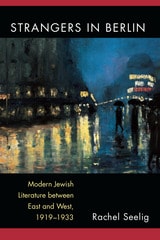
Strangers in Berlin
Modern Jewish Literature between East and West, 1919–1933Rachel Seelig
University of Michigan Press, 2016
Author Rachel Seelig portrays Berlin during the Weimar Republic as a “threshold” between exile and homeland in which national and artistic commitments were reexamined, reclaimed, and rebuilt. In the pulsating yet precarious capital of Germany’s first fledgling democracy, the collision of East and West engendered a broad spectrum of poetic styles and Jewish national identities.
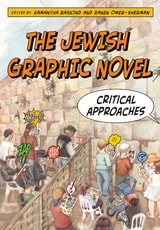
The Jewish Graphic Novel
Critical ApproachesEdited by Samantha Baskind and Ranen Omer-Sherman
Rutgers University Press, 2008
The Jewish Graphic Novel is a lively, interdisciplinary collection of essays that addresses critically acclaimed works in this subgenre of Jewish literary and artistic culture. Featuring insightful discussions of notable figures in the industryùsuch as Will Eisner, Art Spiegelman, and Joann Sfarùthe essays focus on the how graphic novels are increasingly being used in Holocaust memoir and fiction, and to portray Jewish identity in America and abroad
Featuring more than 85 illustrations, this collection is a compelling representation of a major postmodern ethnic and artistic achievement.
The Quest for Jewish Belief and Identity in the Graphic Novel
Stephen E. Tabachnick
University of Alabama Press, 2014
The creators of Superman (Jerry Siegel and Joe Shuster), Batman (Bob Kane and Bill Finger), and the Marvel superheroes (Stan Lee and Jack Kirby), were Jewish, as was the founding editor of Mad magazine (Harvey Kurtzman). They often adapted Jewish folktales (like the Golem) or religious stories (such as the origin of Moses) for their comics, depicting characters wrestling with supernatural people and events. Likewise, some of the most significant graphic novels by Jews or about Jewish subject matter deal with questions of religious belief and Jewish identity. Their characters wrestle with belief—or nonbelief—in God, as well as with their own relationship to the Jews, the historical role of the Jewish people, the politics of Israel, and other issues related to Jewish identity.
In The Quest for Jewish Belief and Identity in the Graphic Novel, Stephen E. Tabachnick delves into the vivid kaleidoscope of Jewish beliefs and identities, ranging from Orthodox belief to complete atheism, and a spectrum of feelings about identification with other Jews. He explores graphic novels at the highest echelon of the genre by more than thirty artists and writers, among them Harvey Pekar (American Splendor), Will Eisner (A Contract with God), Joann Sfar (The Rabbi’s Cat), Miriam Katin (We Are On Our Own), Art Spiegelman (Maus), J. T. Waldman (Megillat Esther), Aline Kominsky Crumb (Need More Love), James Sturm (The Golem’s Mighty Swing), Leela Corman (Unterzakhn), Ari Folman and David Polonsky (Waltz with Bashir), David Mairowitz and Robert Crumb’s biography of Kafka, and many more. He also examines the work of a select few non-Jewish artists, such as Robert Crumb and Basil Wolverton, both of whom have created graphic adaptations of parts of the Hebrew Bible.
Among the topics he discusses are graphic novel adaptations of the Bible; the Holocaust graphic novel; graphic novels about the Jews in Eastern and Western Europe and Africa, and the American Jewish immigrant experience; graphic novels about the lives of Jewish women; the Israel-centered graphic novel; and the Orthodox graphic novel. The book concludes with an extensive bibliography.
No study of Jewish literature and art today can be complete without a survey of the graphic novel, and scholars, students, and graphic novel fans alike will delight in Tabachnick’s guide to this world of thought, sensibility, and artfulness.
The Universal Jew
Masculinity, Modernity, and the Zionist MomentMikhal Dekel
Northwestern University Press, 2010
Such prototypical characters transform the symbol of the Jew from a racially or religiously defined minority subject to a "post-Jewish," particularuniversal, and fundamentally liberal majority subject. The Universal Jew situates the "Zionist moment" horizontally, within the various intellectual currents that make up the turn of the twentieth century: the discourse on modernity, the crisis in liberalism, Nietzsche’s critique of the Enlightenment, psychoanalysis, early feminism, and fin de siècle interrogation of sexual identities. The book examines the symbolic roles that Jews are assigned within these discourses and traces the ways in which Jewish literary citizens are shaped, both out of and in response to them. Beginning with an analysis of George Eliot’s construction of the character Deronda and its reception in Zionist circles, the Universal Jew ends with the self-fashioning of male citizens in fin de siècle and post-statehood Hebrew works, through the aesthetics oftragedy. Throughout her readings, Dekel analyzes the political meaning of these nascent images of citizens, uncovering in particular the gendered arrangements out of which they are born.