Results by title

6 books match the query 'Jewish philosophers'
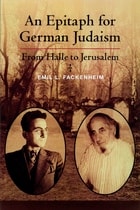
cover of An Epitaph for German Judaism: From Halle to Jerusalem

An Epitaph for German Judaism

From Halle to Jerusalem

Emil Fackenheim

University of Wisconsin Press, 2007

     Emil Fackenheim’s life work was to call upon the world at large—and on philosophers, Christians, Jews, and Germans in particular—to confront the Holocaust as an unprecedented assault on the Jewish people, Judaism, and all humanity. In this memoir, to which he was making final revisions at the time of his death, Fackenheim looks back on his life, at the profound and painful circumstances that shaped him as a philosopher and a committed Jewish thinker.
     Interned for three months in the Sachsenhausen concentration camp after Kristallnacht, Fackenheim was released and escaped to Scotland and then to Canada, where he lived in a refugee internment camp before eventually becoming a congregational rabbi and then, for thirty-five years, a professor of philosophy. He recalls here what it meant to be a German Jew in North America, the desperate need to respond to the crisis in Europe and to cope with its overwhelming implications for Jewish identity and community. His second great turning point came in 1967, as he saw Jews threatened with another Holocaust, this time in Israel. This crisis led him on a pilgrimage to Jerusalem and ultimately back to Germany, where he continued to grapple with the question, How can the Jewish faith—and the Christian faith—exist after the Holocaust?


“An ‘epoch-making’ autobiography.”—Arnold Ages, Jewish Tribune
 
[more]
cover of Don Isaac Abravanel: An Intellectual Biography

Don Isaac Abravanel

An Intellectual Biography

Cedric Cohen-Skalli

Brandeis University Press, 2020

Don Isaac Abravanel (1437–1508) was one of the great inventors of Jewish modernity. A merchant, banker, and court financier, a scholar versed in both Jewish and Christian writings, a preacher and exegete, a prominent political actor in royal entourages and Jewish communities, Abravanel was one of the greatest leaders and thinkers of Iberian Jewry in the aftermath of the expulsion of 1492. This book, the first new intellectual biography of Abravanel in twenty years, depicts his life in three cultural milieus—Portugal, Castile, and post-expulsion Italy—and analyzes his major literary accomplishments in each period. Abravanel was a traditionalist with innovative ideas, a man with one foot in the Middle Ages and the other in the Renaissance. An erudite scholar, author of a monumental exegetical opus that is still studied today, and an avid book collector, he was a transitional figure, defined by an age of contradictions. Yet, it is these very contradictions that make him such an important personality for understanding the dawn of Jewish modernity.
[more]
cover of Leo Strauss and the Politics of Exile: The Making of a Political Philosopher

Leo Strauss and the Politics of Exile

The Making of a Political Philosopher

Eugene Sheppard

Brandeis University Press, 2007
Born in rural Hesse, Germany, Leo Strauss (1899–1973) became an active Zionist and philosopher during the tumultuous and fractious Weimar Republic. As Eugene R. Sheppard demonstrates in this groundbreaking and engaging book, Strauss gravitated towards such thinkers as Franz Rosenzweig, Martin Heidegger, and Carl Schmitt as he sought to identify and overcome fundamental philosophical, political, and theological crises. The rise of Nazism impelled Strauss as a young Jewish émigré, first in Europe and then in America, to grapple with—and accommodate his thought to—the pressing challenges of exile. In confronting his own state of exile, Strauss enlisted premodern Jewish thinkers such as Moses Maimonides and Baruch Spinoza who earlier addressed the problem of reconciling their competing loyalties as philosophers and Jews. This is the first study to frame Strauss’s political philosophy around his critique of liberalism and the problem of exile. Sheppard follows Strauss from Europe to the United States, a journey of a conservative Weimar Jew struggling with modern liberalism and the existential and political contours of exile. Strauss sought to resolve the conflicts of a Jew unwilling to surrender loyalty to his ancestral community and equally unwilling to adhere to the strictures of orthodox observance. Strauss saw truth and wisdom as transcending particular religious and national communities, as well as the modern enlightened humanism in which he himself had been nurtured. In his efforts to navigate between the Jewish and the philosophical, the ancient and the modern, Berlin and New York, Strauss developed a distinctively programmatic way of reading and writing “between the lines.” Sheppard recaptures the complexity and intrigue of this project which has been ignored by those who both reject and claim Strauss’s legacy.
[more]
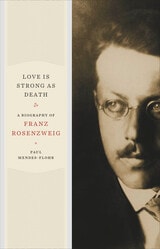
cover of Love Is Strong as Death: A Biography of Franz Rosenzweig

Love Is Strong as Death

A Biography of Franz Rosenzweig

Paul Mendes-Flohr

University of Chicago Press, 2026

A brilliant and engaging biography of one of the great modern Jewish thinkers.
 
Franz Rosenzweig (1886–1929) was one of the central figures of the Jewish cultural and intellectual renaissance in Weimar Germany. His masterwork, The Star of Redemption (1921), is a classic of existential thought and Jewish philosophy, and his considerable legacy also includes his collaboration with Martin Buber on a key translation of the Hebrew Bible into German and the establishment of an education center in Frankfurt that brought together the most important young German-Jewish intellectuals of its time.

Rosenzweig’s personal biography is no less fascinating than his ideas and accomplishments. Drawing on unprecedented access to Rosenzweig’s unpublished personal correspondence, Paul Mendes-Flohr skillfully weaves together the threads of Rosenzweig’s life to give us a moving portrait of this towering figure—from his near-conversion to Christianity to his tragic diagnosis with ALS. Mendes-Flohr also closely explores Rosenzweig’s relationship with Margrit Huessy, who was a vital intellectual partner for Rosenzweig, as well as a muse and lover. He worked out many of his ideas about love both in conversation and consort with her, and Mendes-Flohr shows the importance of intimacy—both romantic and platonic—in the development of Rosenzweig’s thought.
 
Love Is Strong as Death provides a unique and insightful look at one of the most important modern Jewish thinkers.
[more]
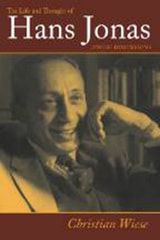
cover of The Life and Thought of Hans Jonas: Jewish Dimensions

The Life and Thought of Hans Jonas

Jewish Dimensions

Christian Wiese

University Press of New England, 2010

Hans Jonas (1903–1993) is one of the most important philosophers of the 20th century. Born in a German Jewish community in the Rhineland, Jonas’s mentors included Edmund Husserl, Martin Heidegger, and Rudolf Bultmann. The committed Zionist fled Germany in 1933 for Jerusalem, fought in the British Army against Hitler, and then left Israel for North America in 1949. Much of Jonas’s philosophy responds to contemporary historical and political challenges: mass society, totalitarianism, the Holocaust, “nuclearism,” environmental devastation (Chernobyl), and, later, the risks of genetic engineering. Wiese’s study examines how Jonas’s Jewish background influenced his intellectual development. Wiese shows how philosophical ethics and Jewish identity were two inseparable aspects of his thinking, with the fight against Nihilism as the most important link. Drawing on a wealth of unpublished material and exploring momentous encounters with major figures of 20th century life and letters like Gershom Scholem and Hannah Arendt, Wiese demonstrates how Jonas combined religious and philosophical elements in his thought, and offers new insights into the work of this eminent thinker.
[more]
cover of Toward Nationalism's End: An Intellectual Biography of Hans Kohn

Toward Nationalism's End

An Intellectual Biography of Hans Kohn

Adi Gordon

Brandeis University Press, 2017

This intellectual biography of Hans Kohn (1891–1971) looks at theories of nationalism in the twentieth century as articulated through the life and work of its leading scholar and activist. Hans Kohn was born in late nineteenth-century Prague, but his peripatetic life took him from the Revolutionary-era Russia to interwar-era Palestine under the British Empire to the United States during the Cold War. Bearing witness to dramatic reconfigurations of national and political identities, he spearheaded an intellectual revolution that fundamentally challenged assumptions about the “naturalness” and the immutability of nationalism. Reconstructing Kohn’s long and fascinating career, Gordon uncovers the multiple political and intellectual trends that intersected with and shaped his theories of nationalism. Throughout his life, Kohn was not simply a theorist but also a participant in multiple and often conflicting movements: Zionism and anti-Zionism, pacifism, liberalism, and military interventionism. His evolving theories thus drew from and reflected fierce debates about the nature of internationalism, imperialism, liberalism, collective security, and especially the Jewish Question. Kohn’s scholarship was not an abstraction but a product of his lived experience as a Habsburg Jew, an erstwhile cultural Zionist, and an American Cold Warrior. As a product of the times, his concepts of nationalism reflected the changing world around him and evolved radically over his lifetime. His intellectual biography thus offers a panorama of the dynamic intellectual cornerstones of the twentieth century.
[more]