Results by title
2 books match the query 'Jewish theater'
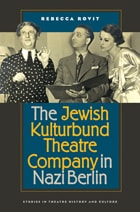
The Jewish Kulturbund Theatre Company in Nazi Berlin
Rebecca Rovit
University of Iowa Press, 2012
New laws enacted in the wake of Hitler’s ascent to power removed all Jews from their professional workplaces and banned Jewish artists from any collaboration with their fellow citizens. In the summer of 1933, Goebbels’s Prussian Theatre Commission approved an all-Jewish theatre as part of the Kulturbund Deutscher Juden, the Cultural Association of German Jewry. This network of Jewish cultural leagues and theatre ensembles across Germany coexisted with Nazi policies against Jews until the Gestapo dissolved the theatre in 1941. Revealing the complex interplay between history and human lives under conditions of duress, Rebecca Rovit focuses on the eight-year odyssey of the Berlin Kulturbund and its theatre.
Rovit draws upon a wealth of primary documents—correspondence between the theatre and the Reich Ministry of Propaganda and Enlightenment, actual playscripts and rolebooks, production reviews and photographs, letters and memoirs, and interviews with artists who survived the war—to show how the increasingly restrictive German reality forced Jewish artists to define and redefine their identity and culture under wrenching conditions of censorship, compromise, danger, and deception. Integrating play analysis with cultural history, she considers first the playscript itself, then the playscript adapted by the Kulturbund, then the best reconstruction possible of the actual performance against its backdrop of the Third Reich. Proceeding chronologically through the playing seasons, she focuses on the actual repertoire performed (and forbidden) over the life of the Berlin Kulturbund theatre, covering the theatre’s beginnings and its first two playing seasons, then on the playing seasons that led to the Reichskristallnacht, and finally on the ways that emigration and increased censorship affected the wartime theatre’s final days.
The Kulturbund’s directors were repeatedly caught between escalating demands from their Nazi overseers and from their own Jewish constituents. By examining why and how an all-Jewish repertory theatre could coexist with the Nazi regime, Rovit raises broader questions about the nature of art in an environment of coercion and isolation, artistic integrity and adaptability, and community and identity.
[more]
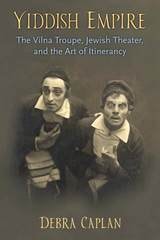
Yiddish Empire
The Vilna Troupe, Jewish Theater, and the Art of ItinerancyDebra Caplan
University of Michigan Press, 2018
Yiddish Empire tells the story of how a group of itinerant Jewish performers became the interwar equivalent of a viral sensation, providing a missing chapter in the history of the modern stage. During World War I, a motley group of teenaged amateurs, impoverished war refugees, and out- of- work Russian actors banded together to revolutionize the Yiddish stage. Achieving a most unlikely success through their productions, the Vilna Troupe (1915– 36) would eventually go on to earn the attention of theatergoers around the world. Advancements in modern transportation allowed Yiddish theater artists to reach global audiences, traversing not only cities and districts but also countries and continents. The Vilna Troupe routinely performed in major venues that had never before allowed Jews, let alone Yiddish, upon their stages, and operated across a vast territory, a strategy that enabled them to attract unusually diverse audiences to the Yiddish stage and a precursor to the organizational structures and travel patterns that we see now in contemporary theater. Debra Caplan’s history of the Troupe is rigorously researched, employing primary and secondary sources in multiple languages, and is engagingly written.
[more]