Results by title

8 books match the query 'Jews in the motion picture industry'
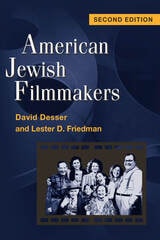
cover of American Jewish Filmmakers

American Jewish Filmmakers

David Desser and Lester D. Friedman

University of Illinois Press, 2003

Woody Allen, Mel Brooks, Sidney Lumet, and Paul Mazursky, all sons of East European Jews, remain among the most prominent contemporary American film directors. In this revised, updated second edition of American Jewish Filmmakers, David Desser and Lester D. Friedman demonstrate how the Jewish experience gives rise to an intimately linked series of issues in the films of these and other significant Jewish directors.
 
The effects of the Holocaust linger, both in gripping dramatic form (Mazursky's Enemies, a Love Story) and in black comedy (Brooks's The Producers). In his trilogy consisting of Serpico, Prince of the City, and Q&A, Lumet focuses on the failure of society's institutions to deliver social justice. Woody Allen portrays urban life and family relationships (Manhattan and Hannah and Her Sisters), sometimes with a nostalgic twist (Radio Days).
 
This edition concludes with a newly written discussion of the careers of other prominent Jewish filmmakers such as Steven Spielberg, Barry Levinson, Brian Singer, and Darren Aronofsky.
 
[more]
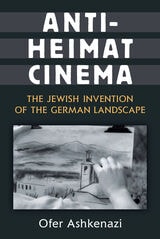
cover of Anti-Heimat Cinema: The Jewish Invention of the German Landscape

Anti-Heimat Cinema

The Jewish Invention of the German Landscape

Ofer Ashkenazi

University of Michigan Press, 2020
Anti-Heimat Cinema: The Jewish Invention of the German Landscape studies an overlooked yet fundamental element of German popular culture in the twentieth century. In tracing Jewish filmmakers’ contemplations of “Heimat”—a provincial German landscape associated with belonging and authenticity—it analyzes their distinctive contribution to the German identity discourse between 1918 and 1968. In its emphasis on rootedness and homogeneity Heimat seemed to challenge the validity and significance of Jewish emancipation. Several acculturation-seeking Jewish artists and intellectuals, however, endeavored to conceive a notion of Heimat that would rather substantiate their belonging. This book considers Jewish filmmakers’ contribution to this endeavor. It shows how they devised the landscapes of the German “Homeland” as Jews, namely, as acculturated, “outsiders within.” Through appropriation of generic Heimat imagery, the films discussed in the book integrate criticism of national chauvinism into German mainstream culture from World War One to the Cold War. Consequently, these Jewish filmmakers anticipated the anti-Heimat film of the ensuing decades, and functioned as an uncredited inspiration for the critical New German Cinema.
[more]
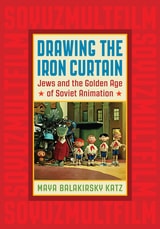
cover of Drawing the Iron Curtain: Jews and the Golden Age of Soviet Animation

Drawing the Iron Curtain

Jews and the Golden Age of Soviet Animation

Maya Balakirsky Katz

Rutgers University Press, 2016
In the American imagination, the Soviet Union was a drab cultural wasteland, a place where playful creative work and individualism was heavily regulated and censored. Yet despite state control, some cultural industries flourished in the Soviet era, including animation. Drawing the Iron Curtain tells the story of the golden age of Soviet animation and the Jewish artists who enabled it to thrive. 
 
Art historian Maya Balakirsky Katz reveals how the state-run animation studio Soyuzmultfilm brought together Jewish creative personnel from every corner of the Soviet Union and served as an unlikely haven for dissidents who were banned from working in other industries. Surveying a wide range of Soviet animation produced between 1919 and 1989, from cutting-edge art films like Tale of Tales to cartoons featuring “Soviet Mickey Mouse” Cheburashka, she finds that these works played a key role in articulating a cosmopolitan sensibility and a multicultural vision for the Soviet Union. Furthermore, she considers how Jewish filmmakers used animation to depict distinctive elements of their heritage and ethnic identity, whether producing films about the Holocaust or using fellow Jews as models for character drawings.  
 
Providing a copiously illustrated introduction to many of Soyuzmultfilm’s key artistic achievements, while revealing the tumultuous social and political conditions in which these films were produced, Drawing the Iron Curtain has something to offer animation fans and students of Cold War history alike. 
 
[more]
cover of Evolving Images: Jewish Latin American Cinema

Evolving Images

Jewish Latin American Cinema

Edited by Nora Glickman and Ariana Huberman

University of Texas Press, 2017

Jews have always played an important role in the generation of culture in Latin America, despite their relatively small numbers in the overall population. In the early days of cinema, they served as directors, producers, screenwriters, composers, and broadcasters. As Latin American societies became more religiously open in the later twentieth century, Jewish characters and themes began appearing in Latin American films and eventually achieved full inclusion. Landmark films by Jewish directors in Argentina, Mexico, and Brazil, which are home to the largest and most influential Jewish communities in Latin America, have enjoyed critical and popular acclaim.

Evolving Images is the first volume devoted to Jewish Latin American cinema, with fifteen critical essays by leading scholars from Latin America, the United States, Europe, and Israel. The contributors address transnational and transcultural issues of Jewish life in Latin America, such as assimilation, integration, identity, and other aspects of life in the Diaspora. Their discussions of films with Jewish themes and characters show the rich diversity of Jewish cultures in Latin America, as well as how Jews, both real and fictional, interact among themselves and with other groups, raising the question of how much their ethnicity may be adulterated when adopting a combined identity as Jewish and Latin American. The book closes with a groundbreaking section on the affinities between Jewish themes in Hollywood and Latin American films, as well as a comprehensive filmography.

[more]
cover of Hollywood's Unofficial Film Corps: American Jewish Moviemakers and the War Effort

Hollywood's Unofficial Film Corps

American Jewish Moviemakers and the War Effort

Michael Berkowitz

University of Wisconsin Press, 2025

It has long been known that Hollywood was actively involved in shaping US public opinion during World War II. Less well-documented are the ways in which Washington sought to work behind the scenes, subtly obliterating the boundaries between “studio” and “government” films. Michael Berkowitz studies the contributions of humorist and best-selling author Leo Rosten (The Joys of Yiddish, The Education of H*Y*M*A*N* K*A*P*L*A*N) and writer, producer, and screenwriter Budd Schulberg (On the Waterfront, A Face in the Crowd) in order to examine the elusive story of Jewish Hollywood’s role in World War II. 

Hollywood’s Unofficial Film Corps shows that Rosten, Schulberg, and others—including Garson Kanin, George Cukor, Stanley Kramer, and Jules Buck—created movies that were both entertaining and politically expeditious for US war aims. At the same time, in an effort to unify the American public, they avoided focusing on the fate of European Jews, even while addressing racism and antisemitism in the United States. Jewish themes were often downplayed, and Jewish directors, writers, and other contributors frequently went uncredited. As Berkowitz writes, “Rosten’s cohort changed feature films forever.” Thanks to his research, we now have a better understanding of how and why.
[more]
cover of Movie-Made Jews: An American Tradition

Movie-Made Jews

An American Tradition

Helene Meyers

Rutgers University Press, 2021

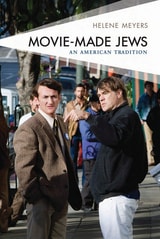
Movie-Made Jews focuses on a rich, usable American Jewish cinematic tradition. This tradition includes fiction and documentary films that make Jews through antisemitism, Holocaust indirection, and discontent with assimilation. It prominently features the unapologetic assertion of Jewishness, queerness, and alliances across race and religion. Author Helene Meyers shows that as we go to our local theater, attend a Jewish film festival, play a DVD, watch streaming videos, Jewishness becomes part of the multicultural mosaic rather than collapsing into a generic whiteness or being represented as a life apart. This engagingly-written book demonstrates that a Jewish movie is neither just a movie nor for Jews only.
 
With incisive analysis, Movie-Made Jews challenges the assumption that American Jewish cinema is a cinema of impoverishment and assimilation. While it’s a truism that Jews make movies, this book brings into focus the diverse ways movies make Jews. 
 
[more]
cover of The American Jewish Story through Cinema

The American Jewish Story through Cinema

By Eric A. Goldman

University of Texas Press, 2013

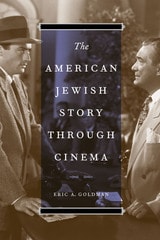
Like the haggadah, the traditional “telling” of the story of the Israelites’ exodus from Egypt that is read at the Passover seder, cinema offers a valuable text from which to gain an understanding of the social, political, and cultural realities of Jews in America. In an industry strongly influenced by Jewish filmmakers who made and continue to make the decisions as to which films are produced, the complex and evolving nature of the American Jewish condition has had considerable impact on American cinema and, in particular, on how Jews are reflected on the screen. This groundbreaking study analyzes select mainstream films from the beginning of the sound era to today to provide an understanding of the American Jewish experience over the last century.

In the first half of the twentieth century, Hollywood’s movie moguls, most of whom were Jewish, shied away from asserting a Jewish image on the screen for fear that they might be too closely identified with that representation. Over the next two decades, Jewish moviemakers became more comfortable with the concept of a Jewish hero and with an overpowered, yet heroic, Israel. In time, the Holocaust assumed center stage as the single event with the greatest effect on American Jewish identity. Recently, as American Jewish screenwriters, directors, and producers have become increasingly comfortable with their heritage, we are seeing an unprecedented number of movies that spotlight Jewish protagonists, experiences, and challenges.
[more]
cover of The Un-Americans: Jews, the Blacklist, and Stoolpigeon Culture

The Un-Americans

Jews, the Blacklist, and Stoolpigeon Culture

Joseph Litvak

Duke University Press, 2009

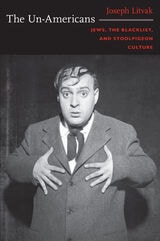
In a bold rethinking of the Hollywood blacklist and McCarthyite America, Joseph Litvak reveals a political regime that did not end with the 1950s or even with the Cold War: a regime of compulsory sycophancy, in which the good citizen is an informer, ready to denounce anyone who will not play the part of the earnest, patriotic American. While many scholars have noted the anti-Semitism underlying the House Un-American Activities Committee’s (HUAC’s) anti-Communism, Litvak draws on the work of Theodor W. Adorno, Hannah Arendt, Alain Badiou, and Max Horkheimer to show how the committee conflated Jewishness with what he calls “comic cosmopolitanism,” an intolerably seductive happiness, centered in Hollywood and New York, in show business and intellectual circles. He maintains that HUAC took the comic irreverence of the “uncooperative” witnesses as a crime against an American identity based on self-repudiation and the willingness to “name names.” Litvak proposes that sycophancy was (and continues to be) the price exacted for assimilation into mainstream American culture, not just for Jews, but also for homosexuals, immigrants, and other groups deemed threatening to American rectitude.

Litvak traces the outlines of comic cosmopolitanism in a series of performances in film and theater and before HUAC, performances by Jewish artists and intellectuals such as Zero Mostel, Judy Holliday, and Abraham Polonsky. At the same time, through an uncompromising analysis of work by informers including Jerome Robbins, Elia Kazan, and Budd Schulberg, he explains the triumph of a stoolpigeon culture that still thrives in the America of the early twenty-first century.

[more]