Results by title
4 books match the query 'Job security'
Labor in the New Economy
Edited by Katharine G. Abraham, James R. Spletzer, and Michael Harper
University of Chicago Press, 2010
As the structure of the economy has changed over the past few decades, researchers and policy makers have been increasingly concerned with how these changes affect workers. In this book, leading economists examine a variety of important trends in the new economy, including inequality of earnings and other forms of compensation, job security, employer reliance on temporary and contract workers, hours of work, and workplace safety and health.
In order to better understand these vital issues, scholars must be able to accurately measure labor market activity. Thus, Labor in the New Economy also addresses a host of measurement issues: from the treatment of outliers, imputation methods, and weighting in the context of specific surveys to evaluating the strengths and weaknesses of data from different sources. At a time when employment is a central concern for individuals, businesses, and the government, this volume provides important insight into the recent past and will be a useful tool for researchers in the future.
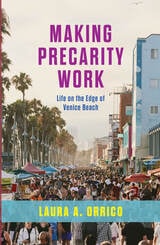
Making Precarity Work
Life on the Edge of Venice BeachLaura A. Orrico
University of Chicago Press, 2025
In Making Precarity Work, sociologist Laura A. Orrico shows how Los Angeles’s Venice Beach boardwalk, which is a magnet for tourists, is also a workplace, one that wouldn’t exist without the motley crew of people selling art, drinking, performing, using drugs, and working odd jobs who gather daily to engage in varied activities, from selling crafts to minding each other’s wares and asking for spare change.
Throughout the book, Orrico lifts up this workplace as a collective accomplishment, demonstrating how it can be a safety net to manage insecurity and inequality for those opting into its flexible and precarious structure, as well as how the LA government’s efforts to stabilize this work often disrupt the success of this collaborative and creative ecosystem. She also presents the ways this work can exacerbate those very inequalities. Sharing the personal stories of boardwalk workers, Orrico considers these juxtaposed realities and asks her audience to question how we can and should respond to a society whose best option for the disadvantaged is precarity.
On the Job
Is Long-Term Employment a Thing of the Past?David, editor Neumark
Russell Sage Foundation, 2000
Work, Inc.
A Philosophical InquiryEdmund F. Byrne
Temple University Press, 1992
Many workers today feel that the longstanding social contract between government, business, and labor has been broken. This book examines legal and philosophical problems that must be addressed if there is to be a new social contract that is fair to workers. Drawing on a wide variety of sources, from the popular press to technical philosophy, Edmund F. Byrne brings into focus ethical issues involved in corporate decisions to reorganize, relocate, or automate. In assessing the human costs of these decisions, he shows why, to a worker, "corporations are not reducible to their assets and liabilities any more than a government is merely its annual budget. That they are organizations, that these organizations do things, and that they are socially responsible for what they do."
In support of this assignment of responsibility, Byrne seeks to demythologize corporate hegemony by confronting a variety of intellectual "dragons" that guard the gates of the status quo. These include legal assumptions about corporate personhood and commodification, private property and eminent domain; management ideas about the autonomous employee and profit without payrolls; technocratic dreams of a dehumanized workplace: ideological belief in progress and competition; and philosophical arguments for libertarian freedom, liberal welfare, and global justice.
Because of these and other mainstream perspectives, workers today are widely perceived, in law and in common parlance, to be isolated atoms. But, Byrne emphasizes, work. including work done for a transnational corporation, is done in a community. Since corporate leaders make decisions that have an impact on people’s lives and on communities, involvement in such decisions must be not only corporate or governmental but community-based as well.