Results by title
7 books match the query 'John Paul II, Pope'
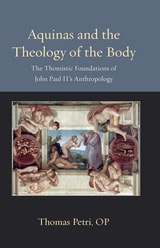
Aquinas and the Theology of the Body
Thomas Petri
Catholic University of America Press, 2016
Pope John Paul's Theology of the Body catecheses has garnered tremendous popularity in theological and catechetical circles. Students of the Theology of the Body have generally interpreted it as innovative not only in its presentation of the Church's teaching on marriage and sexuality, but also as radically advancing that teaching. Aquinas and the Theology of the Body offers a somewhat different interpretation. Fr. Thomas Petri argues that the philosophy and theology of Thomas Aquinas substantially contributed to John Paul's intellectual formation, which he never abandoned. A correct interpretation of the Theology of the Body requires, therefore, a thorough understanding of Thomistic anthropology and theology, which has been mostly lacking in commentaries on the pope's important contributions on the subject of marriage and sexuality.
[more]
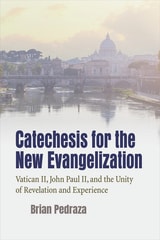
Catechesis for the New Evangelization
Vatican II, John Paul II, and the Unity of Revelation and ExperienceBrian Pedraza
Catholic University of America Press, 2020
Popes Francis, Benedict XVI, and John Paul II have called the present a time of New Evangelization for the Church and have stressed the importance of catechesis for this mission. John Paul II claimed that this renewal of the Church’s mission is grounded in the teachings of the Second Vatican Council. Nevertheless, approaches to catechesis in the conciliar and postconciliar era have varied greatly, as evidenced by the shifts in catechetical practice effected by the modern catechetical movement. Just as the dominant forms of theology changed from neo-scholastic to anthropological approaches so, too, did catechesis move from catechism-based approaches to more anthropological models based upon human experience.
In light of this context, Catechesis for the New Evangelization examines the theological foundations of catechesis in the Church’s understanding of divine revelation and its reception by the human person, especially as found in the conciliar constitutions, Dei Verbum and Gaudium et Spes. After drawing norms on divine revelation from these documents, it traces the history of the modern catechetical movement in order to compare this history with the conciliar norms, highlighting the renewal’s strengths and weaknesses.
These steps prepare the way for the main part of the book: an examination of the anthropology of Karol Wojtyła/Pope John Paul II. Ultimately, his anthropology provides an understanding of the person that can unite divine revelation and human experience in a way that takes what is best from the modern catechetical movement, while developing the ministry in a way that can be fruitful for the New Evangelization.
Pedraza’s book is not only an incisive look at modern catechetical history and theory. It also touches upon some of the most important theological topics of the past century, including the neo-scholastic crisis, the proper interpretation of the Council, the relationship of nature and grace, and the modern understanding of the imago dei, with the research and competency appropriate for scholarly interest and the accessibility needed for educated practitioners in catechesis.
[more]
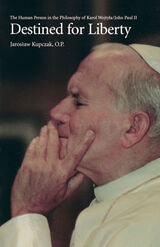
Destined for Liberty
The Human Person in the Philosophy of Karol Wojtyla/John Paul IIJaroslaw Kupczak, O.P.
Catholic University of America Press, 2000
In this compelling new work, Jaroslaw Kupczak, O.P., presents a complete introduction to John Paul II's theory of the human person
[more]
Gift and Communion
Jaroslaw Kupczak
Catholic University of America Press, 2014
Gift and Communion offers a critical presentation of John Paul II's theology of the body, understood in the light of Christian theological tradition. The main thesis of the book is that John Paul II's theology of the body forms a new, inspiring approach to Christian ethics and the theology of marriage and family, as well as to theological anthropology. A central thrust of Gift and Communion is to treat theology of the body - as it deserves - in all its philosophical and theological seriousness and to present it as an important stage in the historical development of Catholic theology
[more]
Intersexual Persons and Theology of the Body
A Limit Case for John Paul II's Theological AnthropologyBeth Zagrobelny Lofgren
Catholic University of America Press, 2026
Intersexual Persons and Theology of the Body offers an interpretation of John Paul II’s theology of the body that demonstrates how it can encompass intersexual bodies. Intersexuality has been used to challenge binary anthropologies, such as the late pope’s. Beth Zagrobelny Lofgren theorizes that John Paul II’s anthropology answers the “frequency dilemma,” by learning from male and female bodies while respecting the humanity of people with ambiguous bodies.
To argue this, Intersexual Persons and Theology of the Body offers biological, psychological, and theological literature on intersexuality (focusing on the anthropologies of Susannah Cornwall and Megan DeFranza), followed by the late pope’s anthropology (focusing on original solitude, the spousal meaning of the body, and the semiotic meanings of the body). This volume demonstrate that intersexual bodies have a spousal meaning, although obscured, and use original solitude to show that John Paul II attributes to the human body meaning not dependent on sexual difference: the first man learns from his solitary body that he is relational. This relationality is fundamental to the imago Dei and undergirds the imago Dei found in communion. Intersexual bodies share human nature and thus the bodily call to relationship.
Finally, Lofgren argues that John Paul II’s eschatology involves a transformation of humankind that fulfills the semiotic value of the body. The sign gives way to the mystery: the person fully realized as self-gift. Because the mystery does not depend on the sign, this vision includes intersexual bodies. This discussion leads to a brief consideration of celibacy and marriage for persons with intersexual conditions. This is currently the only application of John Paul II’s theology of the body to these complex situations.
[more]
Karol Wojtyla's Personalist Philosophy
Miguel Acosta
Catholic University of America Press, 2016
This work provides a clear guide to Karol Wojtyla's principal philosophical work, Person and Act, rigorously analyzing the meaning that the author intended in his exposition. An important feature of the work is that the authors rely on the original Polish text, Osoba i czyn, as well as the best translations into Italian and Spanish, rather than on a flawed and sometimes misleading English edition of the work.
[more]
The Priesthood, Mystery of Faith
Priestly Ministry in the Magisterium of John Paul IINilson Leal de Sa, CB
Catholic University of America Press, 2022
After almost twenty-seven years of his pontificate, what was John Paul II’s legacy regarding the ministerial priesthood? What answers did he give to the questions still surrounding this reality today? Nilson Leal de Sá, CB, examines the pontiff’s twenty-seven letters of Holy Thursday addressed annually to the priests. Unlike some papal documents, which are drafted by many hands, these letters to priests were born of a personal initiative, wherein the pope spoke ab imo pectore (from the depths of his heart), giving a little of himself and his thought. Cardinal Georges-Marie Cottier, theologian emeritus of the Pontifical House and a connoisseur of the texts of the Holy Father, has confirmed that “the Letters of Holy Thursday were written by John Paul II himself.”
Leal de Sá has sought in the diversity of the letters of Holy Thursday the major points of the thought of John Paul II on this important topic. The first chapter dwells on the sources of his teaching and emphasizes his use of the Word of God, Tradition, and the conciliar Magisterium. These foundations are the basis of the second chapter, which highlights the priestly identity in the life of the Church. Finally, the third chapter elucidates the specific mission of the priest.
The Priesthood, Mystery of Faith presents itself as a real and stimulating synthesis of John Paul II’s thought about the ministerial priesthood in a systematic way. It renews us in the appreciation of the inestimable gift that God makes to the whole Church through the sacrament of the Holy Orders.
[more]