Results by title
5 books match the query 'Johnson, Markes E.'
Atlas of Coastal Ecosystems in the Western Gulf of California
Tracking Limestone Deposits on the Margin of a Young SeaEdited by Markes E. Johnson and Jorge Ledesma-Vásquez
University of Arizona Press, 2009
With an emphasis on the intricate workings of the Gulf, a team of scientists led by Markes E. Johnson and Jorge Ledesma-Vázquez explores how marine invertebrates such as corals and bivalves, as well as certain algae, contribute to the operation of a vast “organic engine” that acts as a significant carbon trap. The Atlas reveals that the role of these organisms in the ecology of the Gulf was greatly underestimated in the past. The organisms that live in these environments (or provide the sediments for beaches and dunes) are mass producers of calcium carbonate. Until now, no book has considered the centrality of calcium carbonate production as it functions today across multiple ecosystems and how it has evolved over time.
An important work of scholarship that also evokes the region’s natural splendor, the Atlas will be of interest to a wide range of scientists, including geologists, paleontologists, marine biologists, ecologists, and conservation biologists.
Baja California's Coastal Landscapes Revealed
Excursions in Geologic Time and Climate ChangeMarkes E. Johnson
University of Arizona Press, 2021
Johnson reveals a geologic history that is outside the temporal framework of a human lifetime and scored by violent storms. We see how hurricanes have shaped coastal landscapes all along the peninsula’s inner coast, a fascinating story only possible by disassembling the rocks that on first appraisal seem incomprehensible.
Looking closely, Johnson shows us how geology not only helps us look backward but also forward toward an uncertain future. The landscape Johnson describes may be apart from the rest of Mexico, but his expert eye reveals how it is influenced by the unfolding drama of Planet Earth’s global warming.
Discovering the Geology of Baja California
Six Hikes on the Southern Gulf CoastMarkes E. Johnson
University of Arizona Press, 2009
For those who wish to unlock the mysteries of Baja California, geologist Markes Johnson offers the key. He has taken a body of technical research on the geology and paleontology of the region and made it accessible in plain language for anyone who visits the peninsula, whether for study or recreation. His book teaches general concepts in coastal geomorphology and tectonics, as well as the basic geological and natural history of the Gulf of California, in a conversive, intellectually stimulating fashion.
Johnson's guide takes the form of six day-long hikes in the area of Punta Chivato on the east coast of the southern Baja California peninsula. Punta Chivato is presented as a microcosm of the entire region; it can enable visitors to better understand major themes in the natural history of the Gulf of California and its geological past. All of the hikes begin at the southeast corner of the Punta Chivato promontory and loop out in different directions. Each circuit is designed to minimize overlap with adjacent hikes and to maximize the visitor's exposure to instructive variations in the landscape. Each chapter features additional reflections on a geologist of another time and place who has advanced the field in a way that elucidates the material covered in that chapter. Through these asides, readers will learn the basic lessons about how geologists read the secrets hidden in landscapes.
Discovering the Geology of Baja California invites visitors to these shores to explore not only rocks and fossils but also the continuum of past ecosystems with the ecology of the present. It offers both an unparalleled guide to a remote area and a new understanding of life caught in an endless cycle of change.
Geological Sciences in the Antebellum South
Edited by James X. Corgan
University of Alabama Press, 1982
Tracing the roots of earth science before the Civil War.
Geological Sciences in the Antebellum South by James Corgan offers a rich and revealing examination of the origins and development of geological inquiry in the American South during the decades (1796-1850s) leading up to the Civil War. At a time when scientific disciplines in the United States were still taking shape, Southern scholars, educators, and naturalists played a critical—if often overlooked—role in advancing geological knowledge. Corgan brings this history to life through a careful exploration of the people, institutions, and ideas that defined early earth science in the region.
From the study of mineral resources and soil composition to the broader effort to understand the region’s unique landscapes, geology intersected with agriculture, industry, and economic development in powerful ways. Corgan demonstrates how these scientific endeavors were shaped by—and in turn helped shape—the cultural and intellectual environment of the South. This book also highlights the contributions of key figures and institutions that fostered scientific inquiry, including early universities, state surveys, and learned societies. These networks connected Southern researchers to national and international scientific communities, positioning the region as an active participant in the broader expansion of 19th-century science. At the same time, the book addresses the challenges and limitations faced by Southern scientists, offering a nuanced perspective on how regional identity, resources, and social structures influenced the trajectory of scientific progress.
By situating geology within the broader context of antebellum history, Corgan provides readers with a deeper understanding of how scientific thought developed alongside—and in dialogue with—the political, economic, and cultural forces of the period. The result is a compelling interdisciplinary study that bridges the history of science and Southern history, shedding new light on a formative era in American intellectual life. Geological Sciences in the Antebellum South will appeal to historians, geologists, and scholars of American studies. It is an essential resource for anyone interested in the foundations of scientific inquiry in the United States and the enduring impact of geology on the development of the American South.
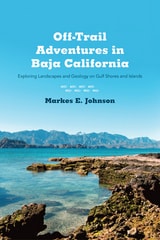
Off-Trail Adventures in Baja California
Exploring Landscapes and Geology on Gulf Shores and IslandsMarkes E. Johnson
University of Arizona Press, 2014
Off-Trail Adventures in Baja California describes—and maps and illustrates—nine hikes along outcrops on islands and peninsular shores where geography, geology, and ecology meet in singular ways. Each spot tells a story about the nature of the place—the cumulative effects of millions of years of natural forces at work. During the course of his long teaching career, Markes E. Johnson has hiked much of Baja California, often with students in tow. He brings a lifetime of study to his simple descriptions of the stories that are revealed by looking closely at natural phenomena framed by rocks and fossils.
This hiking guide offers a wealth of stories that seem to encompass everything, and can clearly communicate Johnson’s deep understanding of how our planet’s ecosystems function. Whether you like to hike with your boots on or from the comfort of your favorite chair, this book is a must-have for anyone who has visited or hopes to visit Baja California’s Gulf Coast.