Results by title
7 books match the query 'Johnston, Adrian'
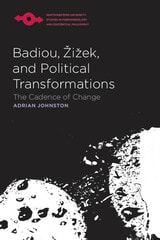
Badiou, Zizek, and Political Transformations
The Cadence of ChangeAdrian Johnston
Northwestern University Press, 2009
Alain Badiou and Slavoj Žižek together have emerged as two of Europe’s most significant living philosophers. In a shared spirit of resistance to global capitalism, both are committed to bringing philosophical reflection to bear upon present-day political circumstances. These thinkers are especially interested in asking what consequences the supposed twentieth-century demise of communism entails for leftist political theory in the early twenty-first century.
Badiou, Žižek, and Political Transformations examines Badiouian and Žižekian depictions of change, particularly as deployed at the intersection of philosophy and politics. The book details the origins of Badiou’s concept of the event and Žižek’s concept of the act as related theoretical visions of revolutionary happenings, delineating a number of difficulties arising from these similar concepts. Johnston finds that Badiou and Žižek tend to favor models of transformation that risk discouraging in advance precisely the efforts at changing the world of today that these uncompromising leftists so ardently desire. Badiou, Žižek, and Political Transformations will surely join Johnston’s Žižek’s Ontology as an instant classic in its field.
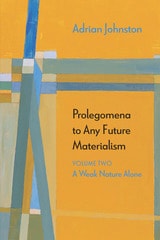
Prolegomena to Any Future Materialism
A Weak Nature AloneAdrian Johnston
Northwestern University Press, 2019
Adrian Johnston’s trilogy Prolegomena to Any Future Materialism aims to forge a thoroughly materialist yet antireductive theory of subjectivity. In this second volume, A Weak Nature Alone, Johnston focuses on the philosophy of nature required for such a theory. This volume is guided by a fundamental question: How must nature be rethought so that human minds and freedom do not appear to be either impossible or inexplicable within it? Asked differently: How must the natural world itself be structured such that sapient subjects in all their distinctive peculiarities emerged from and continue to exist within this world?
In A Weak Nature Alone, Johnston develops his transcendental materialist account of nature through engaging with and weaving together five main sources of inspiration: Hegelian philosophy, Marxist materialism, Freudian-Lacanian metapsychology, Anglo-American analytic neo-Hegelianism, and evolutionary theory and neurobiology. Johnston argues that these seemingly (but not really) strange bedfellows should be brought together so as to construct a contemporary ontology of nature. Through this ontology, nonnatural human subjects can be seen to arise in an immanent, bottom-up fashion from nature itself.
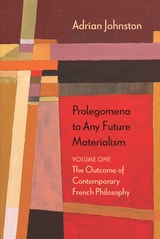
Prolegomena to Any Future Materialism
The Outcome of Contemporary French PhilosophyAdrian Johnston
Northwestern University Press, 2013
Adrian Johnston’s Prolegomena to Any Future Materialism, planned for three volumes, will lay the foundations for a new materialist theoretical apparatus, his “transcendental materialism.” In this first volume, Johnston clears an opening within contemporary philosophy and theory for his unique position. He engages closely with Lacan, Badiou, and Meillassoux, demonstrating how each of these philosophers can be seen as failing to forge an authentically atheistic materialism. Johnston builds a new materialism both profoundly influenced by these brilliant comrades of a shared cause as well as making up for the shortcomings of their own creative attempts to bring to realization the Lacanian vision of an Other-less, One-less ontology. The Outcome of Contemporary French Philosophy yields intellectual weapons suitable for deployment on multiple fronts simultaneously, effective against the mutually entangled spiritualist and scientistic foes of our post-Enlightenment, biopolitical era of nothing more than commodities and currencies.
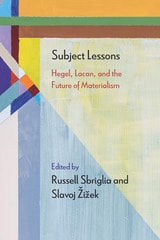
Subject Lessons
Hegel, Lacan, and the Future of MaterialismEdited by Russell Sbriglia and Slavoj Zizek
Northwestern University Press, 2020
Responding to the ongoing “objectal turn” in contemporary humanities and social sciences, the essays in Subject Lessons present a sustained case for the continued importance— indeed, the indispensability—of the category of the subject for the future of materialist thought.
Approaching matters through the frame of Hegel and Lacan, the contributors to this volume, including the editors, as well as Andrew Cole, Mladen Dolar, Nathan Gorelick, Adrian Johnston, Todd McGowan, Borna Radnik, Molly Anne Rothenberg, Kathryn Van Wert, and Alenka Zupančič—many of whom stand at the forefront of contemporary Hegel and Lacan scholarship—agree with neovitalist thinkers that material reality is ontologically incomplete, in a state of perpetual becoming, yet they maintain that this is the case not in spite of but, rather, because of the subject.
Incorporating elements of philosophy, psychoanalysis, and literary and cultural studies, Subject Lessons contests the movement to dismiss the subject, arguing that there can be no truly robust materialism without accounting for the little piece of the Real that is the subject.
The Book of Job and the Immanent Genesis of Transcendence
Davis Hankins
Northwestern University Press, 2014
Winner of the 2017 Manfred Lautenschlaeger Award for Theological Promise
Job is often understood to be a trite folktale about human limitation in the face of confounding and absolute transcendence. On the contrary, Hankins demonstrates that Job is a drama about the struggle to create a just and viable life in a material world that is ontologically incomplete and consequently open to radical, unpredictable transformation. Job’s abiding legacy for any future materialist theology becomes clear as Hankins analyzes Job’s dramatizations of a transcendence that is not externally opposed to but that emerges from an ontologically incomplete material world.
Time Driven
Metapsychology and the Splitting of the DriveAdrian Johnston
Northwestern University Press, 2005
Johnston draws on Jacques Lacan's oeuvre in conjunction with certain philosophical resources-elements from transcendental philosophy, structuralism, and phenomenology-to rectify the inconsistencies within the Freudian metapsychological model of drive. In doing so, he helps to answer a question haunting Freud at the end of his career: Why is humanity plagued by a perpetual margin of discontent, despite technological and cultural progress?
In Time Driven, Johnston is able to make sense of Freud's metapsychology both as a whole and in its historical development of Lacan's reinterpretation of Freud, and of the place of both Freud and Lacan in modern philosophy.
Zizek's Ontology
A Transcendental Materialist Theory of SubjectivityAdrian Johnston
Northwestern University Press, 2008
By taking this avowal seriously, Adrian Johnston finally clarifies the philosophical project underlying Žižek’s efforts. His book charts the interlinked ontology and theory of subjectivity constructed by Žižek at the intersection of German idealism and Lacanian theory. Johnston also uses Žižek’s combination of philosophy and psychoanalysis to address two perennial philosophical problems: the relationship of mind and body, and the nature of human freedom. By bringing together the past two centuries of European philosophy, psychoanalytic metapsychology, and cutting-edge work in the natural sciences, Johnston develops a transcendental materialist theory of subjectivity—in short, an account of how more-than-material forms of subjectivity can emerge from a corporeal being. His work shows how an engagement with Žižek’s philosophy can produce compelling answers to today’s most vexing and urgent questions as inherited from the history of ideas.