Results by title
66 books match the query 'Journey' and 8 start with a
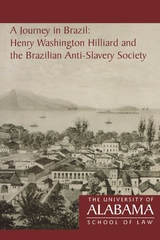
A Journey in Brazil
Henry Washington Hilliard and the Brazilian Anti-Slavery SocietyDavid I. Durham and Paul M. Pruitt Jr.
University of Alabama Press, 2008
Throughout a diverse career that spanned six decades, Hilliard’s personal challenges, moderated by his faith in Divine Providence, eventually allowed him to return to his ideological roots and find a sense of redemption late in life by becoming an unlikely spokesman for the Brazilian emancipation movement through his association with Joaquim Nabuco. In A Journey in Brazil, authors David I. Durham and Paul M. Pruitt Jr. establish context for Hilliard’s beliefs, document his journey in Brazil, and offer a variety of primary documents—selections from newspapers, transcripts of letters, translations of speeches, and other documents that have never before been published.
AboutOccasional Publications of the Bounds Law Library
This collection offers a series of edited documents that contribute to an understanding of the development of legal history, culture, or doctrine. Series editors Paul M. Pruitt Jr. and David I. Durham have selected a variety of materials—a lecture, diaries, letters, speeches, a ledger, commonplace books, a code of ethics, court reports—to illustrate unique examples of legal life and thought.

A Journey of Art and Conflict
Weaving Indra's NetDavid Oddie
Intellect Books, 2015
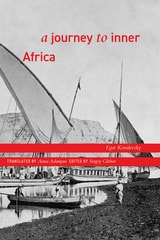
A Journey to Inner Africa
Egor Kovalevsky
Amherst College Press, 2020
Contributions by Egor Kovalevsky, Anna Aslanyan, Sergey Glebov, David Schimmelpenninck, Mukaram Hhana, and Michal Wasiucionek
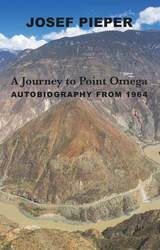
A Journey to Point Omega
Autobiography from 1964Josef Pieper
St. Augustine's Press, 2018
Themes with which the reader of his previous works would be well acquainted recur in this volume. The dedicated Catholic philosopher, who preferred his independence as a trainer of teachers to the less independent role of a professor in a Catholic university, was quite prepared to criticize developments in the Church which resulted from Vatican II. In his defense of the sacred, which he deemed threatened by popularizing trends in the Church, he criticized what he saw as the watered down language in modern German translations of Church liturgical texts; the growing preference for secular garb; and the compromising developments which saw the sacramental signs – surrounding baptism, for instance – being reduced to such an extent that they no longer had the power to signify their sacred meaning even to a well-intentioned congregation.
A great lover of the philosophy of Plato, Augustine, and Aquinas – among many others –, Pieper highlighted the need for living a life of truth. He did not consider truth to be merely something abstract but as something to be lived existentially. While he could explain his philosophy in clear rational terms, something which especially stood to him in his post-war lectures to eager students who were hungry for intellectual guidance and leadership, the great interest of his philosophy was, possibly, his preoccupation with mystery – that which impinges on our inner lives but frustrates all our attempts to account for it in purely rational terms.
As a philosopher – one might say a Christian philosopher – Pieper seems to have observed the traditional boundaries drawn between philosophy and theology. His generation was exposed to the modernist debates in the Church. It would have been deemed heretical to say that the Divine could be grasped by our purely human thought processes – access to the Divine being only possible through faith and grace. Pieper was no heretic. But he was also not altogether conservative. In fact, his philosophy, closely allied to existentialism – despite his care, for instance, to distance himself from the negative existentialism of Sartre – focused on the individual’s inner existential grasp of the most profound reality. Truth is to be found within us, even if it remains a mystery. What lies beyond death is, for the individual, the ultimate mystery.
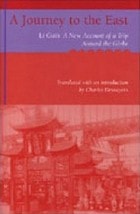
A Journey to the East
Li Gui's A New Account of a Trip Around the GlobeCharles Desnoyers
University of Michigan Press, 2004
A representative to the U.S. Centennial in Philadelphia, Li Gui went on to style himself as the first Chinese official to circle the globe, and his travel diary offers a revealing window into the Chinese view of the West in the late nineteenth century. As the first full-length English translation of this landmark excursion, A Journey to the East provides a welcome addition to primary source material on this time period.
Li Gui's experiences traveling through the United States offer a unique perspective on the newest technological and urban developments of the day in Philadelphia, New York, Washington, D.C., and other major U.S. cities. In his day, these observations on Japan, the United States, Great Britain, France, and their colonial possessions helped the Chinese government construct a more accurate picture of imperial power and statecraft abroad. Later, the diary became required reading for reformers and revolutionaries from Li Hongzhang to Mao Zedong.
Li's journal also provides rich material for exploring a number of theoretical issues stemming from the Sino-foreign encounter. He devotes considerable space to debunking the views of his colleagues regarding the importance of technology, finance, and communication. Most striking of all are his thoughts on gender and education, which place him within the ranks of "progressive" thinkers in any nineteenth-century society.
Undoubtedly important to China specialists, A Journey to the East will also appeal to anyone with an interest in American history, Asian studies, world history and Asian-American studies.
Charles Desnoyers is Associate Professor and Chair in the Department of History and Director of Asian Studies at La Salle University.
A New Map of Wonders
A Journey in Search of Modern MarvelsCaspar Henderson
University of Chicago Press, 2017
Henderson’s brilliant exploration borrows from the form of one of the oldest and most widely known sources of wonder: maps. Large, detailed mappae mundi invited people in medieval Europe to vividly imagine places and possibilities they had never seen before: manticores with the head of a man, the body of a lion, and the stinging tail of a scorpion; tribes of one-eyed men who fought griffins for diamonds; and fearsome Scythian warriors who drank the blood of their enemies from their skulls. As outlandish as these maps and the stories that went with them sound to us today, Henderson argues that our views of the world today are sometimes no less incomplete or misleading. Scientists are only beginning to map the human brain, for example, revealing it as vastly more complex than any computer we can conceive. Our current understanding of physical reality is woefully incomplete. A New Map of Wonders explores these and other realms of the wonderful, in different times and cultures and in the present day, taking readers from Aboriginal Australian landscapes to sacred sites in Great Britain, all the while keeping sight questions such as the cognitive basis of wonder and the relationship between wonder and science.
Beautifully illustrated and written with wit and moral complexity, this sequel to The Book of Barely Imagined Beings is a fascinating account of the power of wonder and an unforgettable meditation on its importance to our future.

Amy Biehl’s Last Home
A Bright Life, a Tragic Death, and a Journey of Reconciliation in South AfricaSteven D. Gish
Ohio University Press, 2018
In 1993, white American Fulbright scholar Amy Biehl was killed in a racially motivated attack near Cape Town, after spending months working to promote democracy and women’s rights in South Africa. The ironic circumstances of her death generated enormous international publicity and yielded one of South Africa’s most heralded stories of postapartheid reconciliation. Amy’s parents not only established a humanitarian foundation to serve the black township where she was killed, but supported amnesty for her killers and hired two of the young men to work for the Amy Biehl Foundation. The Biehls were hailed as heroes by Nelson Mandela, Desmond Tutu, and many others in South Africa and the United States—but their path toward healing was neither quick nor easy.
Granted unrestricted access to the Biehl family’s papers, Steven Gish brings Amy and the Foundation to life in ways that have eluded previous authors. He is the first to place Biehl’s story in its full historical context, while also presenting a gripping portrait of this remarkable young woman and the aftermath of her death across two continents.

Are You Two Sisters?
The Journey of a Lesbian CoupleSusan Krieger
Temple University Press, 2022
Authored by one of the most respected figures in the field of personal ethnographic narrative, this book serves as both a memoir and a sociological study, telling the story of one lesbian couple’s lifelong journey together.
Are You Two Sisters? is Susan Krieger’s candid, revealing, and engrossing memoir about the intimacies of a lesbian couple. Krieger explores how she and her partner confront both the inner challenges of their relationship and the invisibility of lesbian identity in the larger world.
Using a lively novelistic and autoethnographic approach that toggles back and forth in time, Krieger reflects on the evolution of her forty-year relationship. She describes building a life together, from sharing pets and travels to getting married. Are You Two Sisters? addresses not only questions of gender and sexuality, but also of disability, as Krieger explores how the couple adapts to her increasing blindness.
Krieger’s title comes from a question asked by a stranger outside a remote desert bar as she and her partner traveled in the Southwest. Her apprehension about answering that question suggests how, even after the legalization of gay marriage, lesbianism often remains hidden—an observation that makes Krieger’s poignant narrative all the more moving.