Results by title
4 books match the query 'Judge-made law'
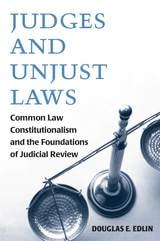
Judges and Unjust Laws
Common Law Constitutionalism and the Foundations of Judicial ReviewDouglas E. Edlin
University of Michigan Press, 2010
"With keen insight into the common law mind, Edlin argues that there are rich resources within the law for judges to ground their opposition to morally outrageous laws, and a legal obligation on them to overturn it, consequent on the general common law obligation to develop the law. Thus, seriously unjust laws pose for common law judges a dilemma within the law, not just a moral challenge to the law, a conflict of obligations, not just a crisis of conscience. While rooted firmly in the history of common law jurisprudence, Edlin offers an entirely fresh perspective on an age-old jurisprudential conundrum. Edlin's case for his thesis is compelling."
---Gerald J. Postema, Cary C. Boshamer Professor of Philosophy and Professor of Law, University of North Carolina at Chapel Hill, and author of Bentham and the Common Law Tradition
"Douglas Edlin builds a powerful historical, conceptual, and moral case for the proposition that judges on common law grounds should refuse to enforce unjust legislation. This is sure to be controversial in an age in which critics already excoriate judges for excessive activism when conducting constitutional judicial review. Edlin's challenge to conventional views is bold and compelling."
---Brian Z. Tamanaha, Chief Judge Benjamin N. Cardozo Professor of Law, St. John's University, and author of Law as a Means to an End: Threat to the Rule of Law
"Professor Edlin's fascinating and well-researched distinction between constitutional review and common law review should influence substantially both scholarship on the history of judicial power in the United States and contemporary jurisprudential debates on the appropriate use of that power."
---Mark Graber, Professor of Law and Government, University of Maryland, and author of Dred Scott and the Problem of Constitutional Evil
Is a judge legally obligated to enforce an unjust law?
In Judges and Unjust Laws, Douglas E. Edlin uses case law analysis, legal theory, constitutional history, and political philosophy to examine the power of judicial review in the common law tradition. He finds that common law tradition gives judges a dual mandate: to apply the law and to develop it. There is no conflict between their official duty and their moral responsibility. Consequently, judges have the authority---perhaps even the obligation---to refuse to enforce laws that they determine unjust. As Edlin demonstrates, exploring the problems posed by unjust laws helps to illuminate the institutional role and responsibilities of common law judges.
Douglas E. Edlin is Associate Professor of Political Science at Dickinson College.
Supreme Court and Judicial Choice
The Role of Provisional Review in a DemocracyPaul R. Dimond
University of Michigan Press, 1989
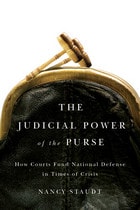
The Judicial Power of the Purse
How Courts Fund National Defense in Times of CrisisNancy Staudt
University of Chicago Press, 2011
Congress and the president are not the only branches that deal with fiscal issues in times of war. In this innovative book, Nancy Staudt focuses on the role of federal courts in fiscal matters during warfare and high-cost national defense emergencies. There is, she argues, a judicial power of the purse that becomes evident upon examining the budgetary effects of judicial decision making. The book provides substantial evidence that judges are willing—maybe even eager—to redirect private monies into government hands when the country is in peril, but when the judges receive convincing cues that ongoing wartime activities undermine the nation’s interests, they are more likely to withhold funds from the government by deciding cases in favor of private individuals and entities who show up in court.
In stark contrast with conventional legal, political, and institutional thought that privileges factors associated with individual preferences, The Judicial Power of the Purse sheds light on environmental factors in judicial decision making and will be an excellent read for students of judicial behavior in political science and law.
What Process is Due?
Courts and Science-Policy DisputesDavid M. O'Brien
Russell Sage Foundation, 1987