Results by title
28 books match the query 'Kafka, Franz'
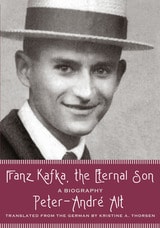
Franz Kafka, the Eternal Son
A BiographyPeter-André Alt, Translated from the German by Kristine A. Thorsen
Northwestern University Press, 2018
Franz Kafka remains one of the most influential writers of the twentieth century. His novels, stories, and letters are still regarded today as the epitome of the dark, fascinating, and uncanny, a model of the modernist aesthetic. Peter-André Alt’s landmark biography, Franz Kafka, the Eternal Son, recounts and explores Kafka’s life and literary work throughout the cultural and political upheavals of central Europe.
Alt’s biography explores Franz Kafka’s own view of life and writing as a unity that shaped his identity. He locates links and echoes among the author’s work, life, and surroundings, situating him within the traditions of Prague's German literature, modernity, psychoanalysis, and philosophy as well as within its Jewish culture, arts, theater, and intellectual tradition.
In this biographical tour de force, Kafka emerges as an observant flaneur and wistful loner, an anxious ascetic, an ecstatic and skeptic, a specialist in terror, and a master of irony. Alt masterfully illuminates Kafka's life not as source material but as a mirror of his literary genius. Readers begin to see Kafka’s unforgettable novels and stories as shards reflecting the life of their creator.
Franz Kafka
Narration, Rhetoric, and ReadingEdited by Jakob Lothe, Beatrice Sandberg, and Ronald Speirs
The Ohio State University Press, 2011
Franz Kafka: Narration, Rhetoric, and Reading presents essays by noted Kafka critics and by leading narratologists who explore Kafka’s original and innovative uses of narrative throughout his career. Collectively, these essays by Stanley Corngold, Anniken Greve, Gerhard Kurz, Jakob Lothe, J. Hillis Miller, Gerhard Neumann, James Phelan, Beatrice Sandberg, Ronald Speirs, and Benno Wagner examine a number of provocative questions that arise in narration and narratives in Kafka’s fiction. The arguments of the essays relate both to the peculiarities of Kafka’s story-telling and to general issues in narrative theory. They reflect, for example, the complexity of the issues surrounding the “somebody” doing the telling, the attitude of the narrator to what is told, the perceived purpose(s) of the telling, the implied or actual reader, the progression of events, and the progression of the telling. As the essays also demonstrate, Kafka’s narratives still present a considerable challenge to, as well as a great resource for, narrative theory and analysis.
Franz Kafka
Subversive DreamerMichael Löwy, translated by Inez Hedges
University of Michigan Press, 2016
Franz Kafka
The Ghosts in the MachineStanley Corngold
Northwestern University Press, 2011
Corngold and Wagner frame Kafka’s writings as cultural events, each work reflecting the economic and cultural discourses of his epoch. In pursuing Kafka’s avowed interest in the theory and practice of insurance, the authors view the two systems of his literary worlds—the official and the personal—as a “bundling” together of the various cultural accidents of Kafka’s time. The work of two of the leading scholars of the single most influential writer of literary modernity, Franz Kafka: The Ghosts in the Machine constitutes a breathtakingly original advance in the study of both the more famous and less well-known works of this enigmatic master.
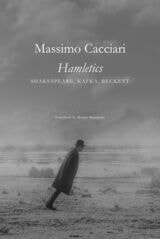
Hamletics
Shakespeare, Kafka, BeckettMassimo Cacciari
Seagull Books, 2023
During the dramatic course of the twentieth century, amid the clash of the titans which marked that era, humanity could still think in terms of partisan struggles in which large masses took sides against one another. The new millennium, by contrast, appears to have opened under the guise of generalized insecurity, which pertains not only to the historical and social situation, or to one’s personal psychological predicament, but to our very being. The Earth’s current faltering and the twilight of every convention that might govern it—where roles, images, and languages become confused by a lack of direction and distance—were already powerfully prophesied in Shakespeare’s Hamlet, and later in the works of Kafka and Beckett. In Hamletics, Massimo Cacciari, one of Italy’s foremost philosophers and leftist political figures, establishes a dialogue between these fateful authors, exploring the relationship between European nihilism and the aporias of action in the present.
Idling the Engine
Linguistic sSkepticism in and around Cortázar, Kafka, and JoyceE. Joseph Sharkey
Catholic University of America Press, 2006
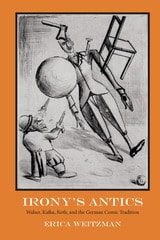
Irony's Antics
Walser, Kafka, Roth, and the German Comic TraditionErica Weitzman
Northwestern University Press, 2014
Combining theoretical breadth with close textual analysis, Erica Weitzman shows how irony, a key term for the German romantics, reemerged in the early twentieth century from a postromantic relegation to the nonsensical and the nihilistic in a way that both rethought romantic irony and dramatically extended its reach.
Through readings of works by Robert Walser, Franz Kafka, and Joseph Roth against the rich history of comic theory (particularly Hegel and Freud), Weitzman traces the development of a specifically comic irony in modern German-language literature and philosophy, a play with the irony that is itself the condition for all play. She thus provides a crucial reevaluation of German literary history and offers new insights into the significance of irony and the comic from the Enlightenment to the present day.

Kafka Goes to the Movies
Hanns Zischler
University of Chicago Press, 2002
Since many of Kafka's visits to the cinema occurred during bachelor trips with Max Brod, Zischler's research took him not only to Kafka's native Prague but to film archives in Munich, Milan, and Paris. Matching Kafka's cinematic references to reviews and stills from daily papers, Zischler hunted down rare films in collections all across Europe. A labor of love, then, by a true man of the cinema, Kafka Goes to the Movies brims with discoveries about the pioneering years of European film. With a wealth of illustrations, including reproductions of movie posters and other rare materials, Zischler opens a fascinating window onto movies that have been long forgotten or assumed lost.
But the real highlights of the book are those about Kafka himself. Long considered one of the most enigmatic figures in literature, the Kafka that emerges in this work is strikingly human. Kafka Goes to the Movies offers an absorbing look at a witty, passionate, and indulgently curious writer, one who discovered and used the cinema as a place of enjoyment and escape, as a medium for the ambivalent encounter with modern life, and as a filter for the changing world around him.
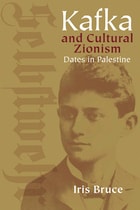
Kafka and Cultural Zionism
Dates in PalestineIris Bruce
University of Wisconsin Press, 2007
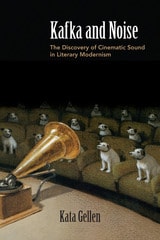
Kafka and Noise
The Discovery of Cinematic Sound in Literary ModernismKata Gellen
Northwestern University Press, 2019
Kafka and Noise offers a method for pursuing intermedial research in the humanities—namely, via the productive "misapplication" of theoretical tools, which exposes the contours, conditions, and expressive possibilities of the media in question. This book will be of interest to scholars of modernism, literature, cinema, and sound, as well as to anyone wishing to explore how artistic and technological media shape our experience of the world and the possibilities for representing it.
Kafka and Wittgenstein
The Case for an Analytic ModernismRebecca Schuman
Northwestern University Press, 2015
In Kafka and Wittgenstein, Rebecca Schuman undertakes the first ever book-length scholarly examination of Ludwig Wittgenstein’s philosophy of language alongside Franz Kafka’s prose fiction. In groundbreaking readings, she argues that although many readers of Kafka are searching for what his texts mean, in this search we are sorely mistaken. Instead, the problems and illusions we portend to uncover, the im-portant questions we attempt to answer—Is Josef K. guilty? If so, of what? What does Gregor Samsa’s transformed body mean? Is Land-Surveyor K. a real land surveyor?— themselves presuppose a bigger delusion: that such questions can be asked in the first place. Drawing deeply on the entire range of Wittgenstein’s writings, Schuman can-nily sheds new light on the enigmatic Kafka.
Kafka's Ethics of Interpretation
Between Tyranny and DespairJennifer L. Geddes
Northwestern University Press, 2016
Geddes explores the interpretation that takes place within, and in response to, Kafka's writings, and pairs Kafka's works with readings of Sigmund Freud, Pierre Bourdieu, Tzvetan Todorov, Emmanuel Levinas, and others. She argues that Kafka explores interpretation as a mode of power and violence, but also as a mode of engagement with the world and others. Kafka, she argues, challenges us to rethink the ways we read texts, engage others, and navigate the world through our interpretations of them.
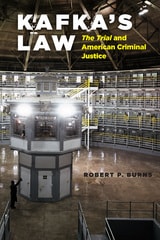
Kafka's Law
"The Trial" and American Criminal JusticeRobert P. Burns
University of Chicago Press, 2014
With Kafka’s Law, Robert P. Burns shows how The Trial provides an uncanny lens through which to consider flaws in the American criminal justice system today. Burns begins with the story, at once funny and grim, of Josef K., caught in the Law’s grip and then crushed by it. Laying out the features of the Law that eventually destroy K., Burns argues that the American criminal justice system has taken on many of these same features. In the overwhelming majority of contemporary cases, police interrogation is followed by a plea bargain, in which the court’s only function is to set a largely predetermined sentence for an individual already presumed guilty. Like Kafka’s nightmarish vision, much of American criminal law and procedure has become unknowable, ubiquitous, and bureaucratic. It, too, has come to rely on deception in dealing with suspects and jurors, to limit the role of defense, and to increasingly dispense justice without the protection of formal procedures. But, while Kennedy may be correct in his grim assessment, a remedy is available in the tradition of trial by jury, and Burns concludes by convincingly arguing for its return to a more central place in American criminal justice.
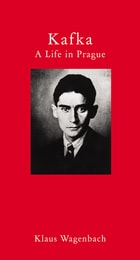
Kafka's Prague
Klaus Wagenbach
Haus Publishing, 2020
Drawing from a range of documents and historical materials, this is the first book specifically dedicated to the relationship between Kafka and Prague. Klaus Wagenbach’s account of Kafka’s life in the city is a meticulously researched insight into the author’s family background, his education and employment, his attitude toward the town of his birth, his literary influences, and his relationships with women. The result is a fascinating portrait of the twentieth century’s most enigmatic writer and the city that provided him with so much inspiration. W. G. Sebald recognized that “literary and life experience overlap” in Kafka’s works, and the same is true of this book.
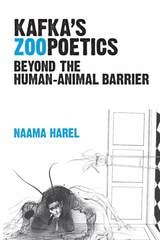
Kafka's Zoopoetics
Beyond the Human-Animal BarrierNaama Harel
University of Michigan Press, 2020
Nonhuman figures are ubiquitous in the work of Franz Kafka, from his early stories down to his very last one. Despite their prominence throughout his oeuvre, Kafka’s animal representations have been considered first and foremost as mere allegories of intrahuman matters. In recent years, the allegorization of Kafka’s animals has been poetically dismissed by Kafka’s commentators and politically rejected by posthumanist scholars. Such critique, however, has yet to inspire either an overarching or an interdiscursive account. This book aims to fill this lacuna. Positing animal stories as a distinct and significant corpus within Kafka’s entire poetics, and closely examining them in dialogue with both literary and posthumanist analysis, Kafka’s Zoopoetics critically revisits animality, interspecies relations, and the very human-animal contradistinction in the writings of Franz Kafka.
Kafka’s animals typically stand at the threshold between humanity and animality, fusing together human and nonhuman features. Among his liminal creatures we find a human transformed into vermin (in “The Metamorphosis”), an ape turned into a human being (in “A Report to an Academy”), talking jackals (in “Jackals and Arabs”), a philosophical dog (in “Researches of a Dog”), a contemplative mole-like creature (in “The Burrow”), and indiscernible beings (in “Josefine, the Singer or the Mouse People”). Depicting species boundaries as mutable and obscure, Kafka creates a fluid human-animal space, which can be described as “humanimal.” The constitution of a humanimal space radically undermines the stark barrier between human and other animals, dictated by the anthropocentric paradigm. Through denying animalistic elements in humans, and disavowing the agency of nonhuman animals, excluding them from social life, and neutralizing compassion for them, this barrier has been designed to regularize both humanity and animality. The contextualization of Kafka's animals within posthumanist theory engenders a post-anthropocentric arena, which is simultaneously both imagined and very real.
Kafka
Toward a Minor LiteratureGilles Deleuze
University of Minnesota Press, 1986
Kafka’s Blues
Figurations of Racial Blackness in the Construction of an AestheticMark Christian Thompson
Northwestern University Press, 2016
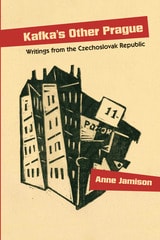
Kafka’s Other Prague
Writings from the Czechoslovak RepublicAnne Jamison
Northwestern University Press, 2018
Franz Kafka was born in Prague, a bilingual city in the Habsburg Empire. He died a citizen of Czechoslovakia. Yet Kafka was not Czech in any way he himself would have understood. He could speak Czech, but, like many Prague Jews, he was raised and educated and wrote in German. Kafka critics to date have had little to say about the majority language of his native city or its “minor literature,” as he referred to it in a 1913 journal entry. Kafka’s Other Prague explains why Kafka’s later experience of Czech language and culture matters.
Bringing to light newly available archival material, Anne Jamison’s innovative study demonstrates how Czechoslovakia’s founding and Kafka’s own dramatic political, professional, and personal upheavals altered his relationship to this “other Prague.” It destabilized Kafka’s understanding of nationality, language, gender, and sex—and how all these issues related to his own writing.
Kafka’s Other Prague juxtaposes Kafka’s German-language work with Czechoslovak Prague’s language politics, intellectual currents, and print culture—including the influence of his lover and translator, the journalist Milena Jesenská—and shows how this changed cultural and linguistic landscape transformed one of the great literary minds of the last century.
Loser Sons
Politics and AuthorityAvital Ronell
University of Illinois Press, 2013
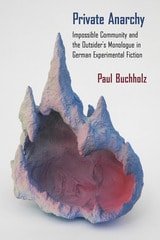
Private Anarchy
Impossible Community and the Outsider’s Monologue in German Experimental FictionPaul Buchholz
Northwestern University Press, 2018
Buchholz suggests that in their experimental prose Gustav Landauer, Franz Kafka, Thomas Bernhard, and Wolfgang Hilbig each considered how the "void" of mass society could be the precondition for a new, anarchic form of community that would rest not on any assumptions of shared origins or organic unity but on an experience of extreme emptiness that blurs the boundaries of the self and enables intimacy between total strangers. This community, Buchholz argues, is created through the verbal form most closely associated with alienation and isolation: the monologue.
By showing how these authors engaged with the idea of community and by relating these contributions to an extended intellectual genealogy of nihilism, Private Anarchy illustrates the distinct philosophical and sociopolitical stakes of German experimental writing in the twentieth century.
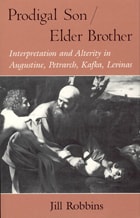
Prodigal Son/Elder Brother
Interpretation and Alterity in Augustine, Petrarch, Kafka, LevinasJill Robbins
University of Chicago Press, 1991
"Through a creative reading of the prodigal son parable, Jill Robbins demonstrates the hermeneutical impasse of the Christian exegete who must and yet cannot incorporate the Old Testament. Having disclosed the aporia at the heart of Christian hermeneutics, she proposes an alternative approach to the Hebrew Bible and new interpretations of Augustine, Petrarch, Kafka, and Levinas. Robbins brilliantly integrates the discourses of biblical texts, literary works, and critical analysis."—Mark C. Taylor, Williams College
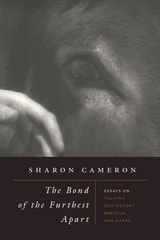
The Bond of the Furthest Apart
Essays on Tolstoy, Dostoevsky, Bresson, and KafkaSharon Cameron
University of Chicago Press, 2017
Whether exploring Bresson’s efforts to reassess the limits of human reason and will, Dostoevsky’s subversions of Christian conventions, Tolstoy’s incompatible beliefs about death, or Kafka’s focus on creatures neither human nor animal, Cameron illuminates how the repeated juxtaposition of disparate, even antithetical, phenomena carves out new approaches to defining the essence of being, one where the very nature of fixed categories is brought into question. An innovative look at a classic French auteur and three giants of European literature, The Bond of the Furthest Apart will interest scholars of literature, film, ethics, aesthetics, and anyone drawn to an experimental venture in critical thought.
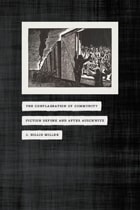
The Conflagration of Community
Fiction before and after AuschwitzJ. Hillis Miller
University of Chicago Press, 2011
“After Auschwitz to write even a single poem is barbaric.” The Conflagration of Community challenges Theodor Adorno’s famous statement about aesthetic production after the Holocaust, arguing for the possibility of literature to bear witness to extreme collective and personal experiences. J. Hillis Miller masterfully considers how novels about the Holocaust relate to fictions written before and after it, and uses theories of community from Jean-Luc Nancy and Derrida to explore the dissolution of community bonds in its wake.
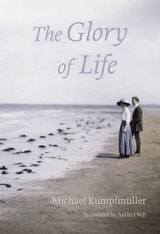
The Glory of Life
Michael Kumpfmüller
Haus Publishing, 2014
In July 1923, Kafka is convalescing by the Baltic Sea when he meets Diamant and they fall in love. He is forty years old and dying of tuberculosis; she is twenty-five and seems to him the essence of life. After a tentative first meeting, the indecisive Kafka moves with Diamant to Berlin, a city in the throes of political upheaval, rising anti-Semitism, and the turmoil of Weimar-era hyperinflation. As his tuberculosis advances, they are forced to leave the city for the Kierling Sanatorium near Vienna, a move that threatens the paradise they have created.
The first of Kumpfmüller’s novels to appear in English after his acclaimed The Adventures of a Bed Salesman, The Glory of Life is a meticulously researched and poignant portrait of one of the most enduring authors in world literature. Beautifully crafted, this book is an evocative rumination on the power of love and friendship.

Three Sons
Franz Kafka and the Fiction of J. M. Coetzee, Philip Roth, and W. G. SebaldDaniel L. Medin
Northwestern University Press, 2010

Today in the Taxi
Sean Singer
Tupelo Press, 2022
—Laurie Sheck
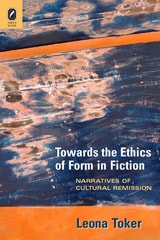
Towards the Ethics of Form in Fiction
Narratives of Cultural RemissionLeona Toker
The Ohio State University Press, 2010
Toker is especially interested in cultural remissions such as the carnivalesque—that is, the inverting of standard cultural hierarchies or the blurring of boundaries between normally separated social groups, actors and audiences, self and other. She argues that cultural remissions have the potential not simply to provide a break from the determinacies of our quotidian existence but also to return us to that existence with some alteration of our perceptions, beliefs, and values. Toker contends that the ethical consequences of reading fiction result from features of its aesthetics, particularly what she calls, following the semiotician Louis Hjemslev, “the form of the content”—the patterns arising from the artistic deployment of narrative details. In addition to addressing the carnivalesque discourse of Bakhtin as well as the theory of oppositionality developed by de Certeau and Chambers, she puts theory into practice through detailed analyses of canonical texts by Fielding, Sterne, Austen, Hawthorne, Dickens, Conrad, Joyce, and other writers.

Universal Grammar and Narrative Form
David Herman
Duke University Press, 1995
Following an extensive historical overview of theories about universal grammar, Herman examines Joyce’s Ulysses, Kafka’s The Trial, and Woolf’s Between the Acts as case studies of modernist literary narratives that encode grammatical principles which were (re)fashioned in logic, linguistics, and philosophy during the same period. Herman then uses the interpretation of universal grammar developed via these modernist texts to explore later twentieth-century cultural phenomena. The problem of citation in the discourses of postmodernism, for example, is discussed with reference to syntactic theory. An analysis of Peter Greenaway’s The Cook, The Thief, His Wife, and Her Lover raises the question of cinematic meaning and draws on semantic theory. In each case, Herman shows how postmodern narratives encode ideas at work in current theories about the nature and function of language.
Outlining new directions for the study of language in literature, Universal Grammar and Narrative Form provides a wealth of information about key literary, linguistic, and philosophical trends in the twentieth century.