Results by title
5 books match the query 'Kaiser, David'
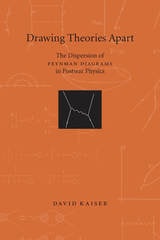
Drawing Theories Apart
The Dispersion of Feynman Diagrams in Postwar PhysicsDavid Kaiser
University of Chicago Press, 2005
Winner of the 2007 Pfizer Prize from the History of Science Society.
Feynman diagrams have revolutionized nearly every aspect of theoretical physics since the middle of the twentieth century. Introduced by the American physicist Richard Feynman (1918-88) soon after World War II as a means of simplifying lengthy calculations in quantum electrodynamics, they soon gained adherents in many branches of the discipline. Yet as new physicists adopted the tiny line drawings, they also adapted the diagrams and introduced their own interpretations. Drawing Theories Apart traces how generations of young theorists learned to frame their research in terms of the diagrams—and how both the diagrams and their users were molded in the process.
Drawing on rich archival materials, interviews, and more than five hundred scientific articles from the period, Drawing Theories Apart uses the Feynman diagrams as a means to explore the development of American postwar physics. By focusing on the ways young physicists learned new calculational skills, David Kaiser frames his story around the crafting and stabilizing of the basic tools in the physicist's kit—thus offering the first book to follow the diagrams once they left Feynman's hands and entered the physics vernacular.
Drawing on rich archival materials, interviews, and more than five hundred scientific articles from the period, Drawing Theories Apart uses the Feynman diagrams as a means to explore the development of American postwar physics. By focusing on the ways young physicists learned new calculational skills, David Kaiser frames his story around the crafting and stabilizing of the basic tools in the physicist's kit—thus offering the first book to follow the diagrams once they left Feynman's hands and entered the physics vernacular.
[more]
Einstein and the Quantum Revolutions
Alain Aspect
University of Chicago Press, 2024
A Nobel laureate offers a brief lesson on physics’ biggest mystery, accessibly explaining the two quantum revolutions that changed our understanding of reality.
At the start of the twentieth century, the first quantum revolution upset our vision of the world. New physics offered surprising realities, such as wave-particle duality, and led to major inventions: the transistor, the laser, and today’s computers. Less known is the second quantum revolution, arguably initiated in 1935 during a debate between giants Albert Einstein and Niels Bohr. This revolution is still unfolding. Its revolutionaries—including the author of this short accessible book, Nobel Prize–winning physicist Alain Aspect—explore the notion of entangled particles, able to interact at seemingly impossible distances. Aspect’s research has helped to show how entanglement may both upend existing technologies, like cryptography, and usher in entirely new ones, like quantum computing. Explaining this physics of the future, this work tells a story of how philosophical debates can shape new realities.
At the start of the twentieth century, the first quantum revolution upset our vision of the world. New physics offered surprising realities, such as wave-particle duality, and led to major inventions: the transistor, the laser, and today’s computers. Less known is the second quantum revolution, arguably initiated in 1935 during a debate between giants Albert Einstein and Niels Bohr. This revolution is still unfolding. Its revolutionaries—including the author of this short accessible book, Nobel Prize–winning physicist Alain Aspect—explore the notion of entangled particles, able to interact at seemingly impossible distances. Aspect’s research has helped to show how entanglement may both upend existing technologies, like cryptography, and usher in entirely new ones, like quantum computing. Explaining this physics of the future, this work tells a story of how philosophical debates can shape new realities.
[more]
Groovy Science
Knowledge, Innovation, and American CountercultureEdited by David Kaiser and W. Patrick McCray
University of Chicago Press, 2016
In his 1969 book The Making of a Counterculture, Theodore Roszak described the youth of the late 1960s as fleeing science “as if from a place inhabited by plague,” and even seeking “subversion of the scientific worldview” itself. Roszak’s view has come to be our own: when we think of the youth movement of the 1960s and early 1970s, we think of a movement that was explicitly anti-scientific in its embrace of alternative spiritualities and communal living.
Such a view is far too simple, ignoring the diverse ways in which the era’s countercultures expressed enthusiasm for and involved themselves in science—of a certain type. Rejecting hulking, militarized technical projects like Cold War missiles and mainframes, Boomers and hippies sought a science that was both small-scale and big-picture, as exemplified by the annual workshops on quantum physics at the Esalen Institute in Big Sur, or Timothy Leary’s championing of space exploration as the ultimate “high.” Groovy Science explores the experimentation and eclecticism that marked countercultural science and technology during one of the most colorful periods of American history.
Such a view is far too simple, ignoring the diverse ways in which the era’s countercultures expressed enthusiasm for and involved themselves in science—of a certain type. Rejecting hulking, militarized technical projects like Cold War missiles and mainframes, Boomers and hippies sought a science that was both small-scale and big-picture, as exemplified by the annual workshops on quantum physics at the Esalen Institute in Big Sur, or Timothy Leary’s championing of space exploration as the ultimate “high.” Groovy Science explores the experimentation and eclecticism that marked countercultural science and technology during one of the most colorful periods of American history.
[more]
Quantum Legacies
Dispatches from an Uncertain WorldDavid Kaiser
University of Chicago Press, 2024
A series of engaging essays that explore iconic moments of discovery and debate in physicists’ ongoing quest to understand the quantum world.
The ideas at the root of quantum theory remain stubbornly, famously bizarre: a solid world reduced to puffs of probability; particles that tunnel through walls; cats suspended in zombielike states, neither alive nor dead; and twinned particles that share entangled fates. For more than a century, physicists have grappled with these conceptual uncertainties while enmeshed in the larger uncertainties of the social and political worlds around them, a time pocked by the rise of fascism, cataclysmic world wars, and a new nuclear age.
In Quantum Legacies, David Kaiser introduces readers to iconic episodes in physicists’ still-unfolding quest to understand space, time, and matter at their most fundamental. In a series of vibrant essays, Kaiser takes us inside moments of discovery and debate among the great minds of the era—Albert Einstein, Erwin Schrödinger, Stephen Hawking, and many more who have indelibly shaped our understanding of nature—as they have tried to make sense of a messy world.
Ranging across space and time, the episodes span the heady 1920s, the dark days of the 1930s, the turbulence of the Cold War, and the peculiar political realities that followed. In those eras as in our own, researchers’ ambition has often been to transcend the vagaries of here and now, to contribute lasting insights into how the world works that might reach beyond a given researcher’s limited view. In Quantum Legacies, Kaiser unveils the difficult and unsteady work required to forge some shared understanding between individuals and across generations, and in doing so, he illuminates the deep ties between scientific exploration and the human condition.
[more]
Science and the American Century
Readings from "Isis"Edited and with an Introduction by Sally Gregory Kohlstedt and David Kaiser
University of Chicago Press, 2013
The twentieth century was one of astonishing change in science, especially as pursued in the United States. Against a backdrop of dramatic political and economic shifts brought by world wars, intermittent depressions, sporadic and occasionally massive increases in funding, and expanding private patronage, this scientific work fundamentally reshaped everyday life. Science and the American Century offers some of the most significant contributions to the study of the history of science, technology, and medicine during the twentieth century, all drawn from the pages of the journal Isis.
Fourteen essays from leading scholars are grouped into three sections, each presented in roughly chronological order. The first section charts several ways in which our knowledge of nature was cultivated, revealing how scientific practitioners and the public alike grappled with definitions of the “natural” as they absorbed and refracted global information. The essays in the second section investigate the changing attitudes and fortunes of scientists during and after World War II. The final section documents the intricate ways that science, as it advanced, became intertwined with social policies and the law.
[more]