Results by title
5 books match the query 'Karamanski, Theodore J.'
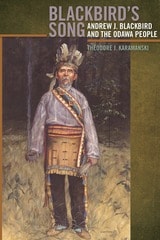
Blackbird's Song
Andrew J. Blackbird and the Odawa PeopleTheodore J. Karamanski
Michigan State University Press, 2012
For much of U.S. history, the story of native people has been written by historians and anthropologists relying on the often biased accounts of European-American observers. Though we have become well acquainted with war chiefs like Pontiac and Crazy Horse, it has been at the expense of better knowing civic-minded intellectuals like Andrew J. Blackbird, who sought in 1887 to give a voice to his people through his landmark book History of the Ottawa and Chippewa People. Blackbird chronicled the numerous ways in which these Great Lakes people fought to retain their land and culture, first with military resistance and later by claiming the tools of citizenship. This stirring account reflects on the lived experience of the Odawa people and the work of one of their greatest advocates.
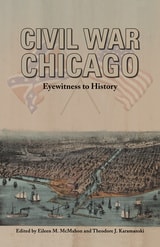
Civil War Chicago
Eyewitness to HistoryTheodore J. Karamanski
Ohio University Press, 2014
The American Civil War was a crucial event in the development of Chicago as the metropolis of the heartland. Not only did Chicagoans play an important role in the politics of the conflict, encouraging emancipation and promoting a “hard war” policy against Southern civilians, but they supported the troops materially through production of military supplies and foodstuffs as well as morally and spiritually through patriotic publications and songs. The Civil War transformed Chicago from a mere commercial center to an industrial power as well as the nation’s railroad hub and busiest port. The war also divided Chicago, however, between Lincoln supporters and Copperheads, whites and blacks, workers and owners, natives and newcomers.
The city played a key role in elevating Abraham Lincoln to the Republican presidential nomination in 1860, yet only four years later a Chicago politician’ s influence was key in declaring the war a failure and promoting a platform of peace with the Confederacy. Using seldom seen or newly uncovered sources, this book tells the story of the Civil War through the eyes of those who lived that history. Photographs throughout the book effectively convey the geography of events in this pivotal period of Chicago’s history, and the editors have provided a useful driving guide to Civil War sites in and around the city.
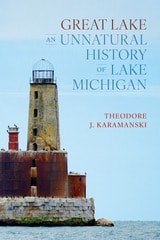
Great Lake
An Unnatural History of Lake MichiganTheodore J. Karamanski
University of Michigan Press, 2026
Great Lake is a comprehensive survey of the manifold ways Americans, from the first Native American communities to the present age, have abused, nurtured, loved, and neglected this massive freshwater resource. Extending 307 miles from north to south, the lake cuts across climatic, environmental, and physiographic zones, from the prairies of Illinois to the boreal forests of the north. Bordered by large cities like Chicago and Milwaukee as well as smaller Wisconsin resorts and northern Michigan mines and mill towns, the lake touches people in urban centers and countryside. Thus, the history of Lake Michigan combines the history of frontier resource extraction, agricultural abundance, industrialization, and dense urbanization in the American heartland. Great Lake is the story of the ever-escalating and divergent demands Americans have placed on Lake Michigan, how the lake’s ecosystem responded to those changes, and how together they have shaped the modern American Midwest.
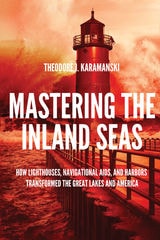
Mastering the Inland Seas
How Lighthouses, Navigational Aids, and Harbors Transformed the Great Lakes and AmericaTheodore J. Karamanski
University of Wisconsin Press, 2020
Karamanski explores both the navigational and sailing tools of First Nations peoples and the dismissive and foolhardy attitude of early European maritime sailors. He investigates the role played by commercial boats in the Underground Railroad, as well as how the federal development of crucial navigational resources exacerbated sectionalism in the antebellum United States. Ultimately Mastering the Inland Sea shows the undeniable environmental impact of technologies used by the modern commercial maritime industry. This expansive story illuminates the symbiotic relationship between infrastructure investment in the region's interconnected waterways and North America's lasting economic and political development.
North Woods River
The St. Croix River in Upper Midwest HistoryEileen M. McMahon and Theodore J. Karamanski
University of Wisconsin Press, 2009
North Woods River is a thoughtful biography of the river over the course of more than three hundred years. Eileen McMahon and Theodore Karamanski track the river’s social and environmental transformation as newcomers changed the river basin and, in turn, were changed by it. The history of the St. Croix revealed here offers larger lessons about the future management of beautiful and fragile wild waters.