Results by title
4 books match the query 'Karl, Rebecca E.'
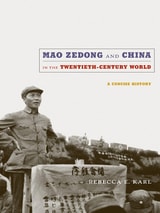
Mao Zedong and China in the Twentieth-Century World
A Concise HistoryRebecca E. Karl
Duke University Press, 2010
Throughout this lively and concise historical account of Mao Zedong’s life and thought, Rebecca E. Karl places the revolutionary leader’s personal experiences, social visions and theory, military strategies, and developmental and foreign policies in a dynamic narrative of the Chinese revolution. She situates Mao and the revolution in a global setting informed by imperialism, decolonization, and third worldism, and discusses worldwide trends in politics, the economy, military power, and territorial sovereignty. Karl begins with Mao’s early life in a small village in Hunan province, documenting his relationships with his parents, passion for education, and political awakening during the fall of the Qing dynasty in late 1911. She traces his transition from liberal to Communist over the course of the next decade, his early critiques of the subjugation of women, and the gathering force of the May 4th movement for reform and radical change. Describing Mao’s rise to power, she delves into the dynamics of Communist organizing in an overwhelmingly agrarian society, and Mao’s confrontations with Chiang Kaishek and other nationalist conservatives. She also considers his marriages and romantic liaisons and their relation to Mao as the revolutionary founder of Communism in China. After analyzing Mao’s stormy tenure as chairman of the People’s Republic of China, Karl concludes by examining his legacy in China from his death in 1976 through the Beijing Olympics in 2008.
[more]
Revolution and Its Narratives
China's Socialist Literary and Cultural Imaginaries, 1949-1966Cai Xiang
Duke University Press, 2016
Published in China in 2010, Revolution and Its Narratives is a historical, literary, and critical account of the cultural production of the narratives of China's socialist revolution. Through theoretical, empirical, and textual analysis of major and minor novels, dramas, short stories, and cinema, Cai Xiang offers a complex study that exceeds the narrow confines of existing views of socialist aesthetics. By engaging with the relationship among culture, history, and politics in the context of the revolutionary transformation of Chinese society and arts, Cai illuminates the utopian promise as well as the ultimate impossibility of socialist cultural production. Translated, annotated, and edited by Rebecca E. Karl and Xueping Zhong, this translation presents Cai's influential work to English-language readers for the first time.
[more]
Staging the World
Chinese Nationalism at the Turn of the Twentieth CenturyRebecca E. Karl
Duke University Press, 2002
In Staging the World Rebecca E. Karl rethinks the production of nationalist discourse in China during the late Qing period, between China’s defeat in the Sino-Japanese War in 1895 and the proclamation of the Republic in 1911. She argues that at this historical moment a growing Chinese identification with what we now call the Third World first made the modern world visible as a totality and that the key components of Chinese nationalist discourse developed in reference to this worldview.
The emergence of Chinese nationalism during this period is often portrayed as following from China’s position vis-à-vis Japan and the West. Karl has mined the archives of the late Qing period to discern the foci of Chinese intellectuals from 1895 to 1911 to assert that even though the China/Japan/West triangle was crucial, it alone is an incomplete—and therefore flawed—model of the development of nationalism in China. Although the perceptions and concerns of these thinkers form the basis of Staging the World, Karl begins by examining a 1904 Shanghai production of an opera about a fictional partition of Poland and its modern reincarnation as an ethno-nation. By focusing on the type of dialogue this opera generated in China, Karl elucidates concepts such as race, colonization, globalization, and history. From there, she discusses how Chinese conceptions of nationalism were affected by the “discovery” of Hawai’i as a center of the Pacific, the Philippine revolution against the United States, and the relationship between nationality and ethnicity made apparent by the Boer War in South Africa.
The emergence of Chinese nationalism during this period is often portrayed as following from China’s position vis-à-vis Japan and the West. Karl has mined the archives of the late Qing period to discern the foci of Chinese intellectuals from 1895 to 1911 to assert that even though the China/Japan/West triangle was crucial, it alone is an incomplete—and therefore flawed—model of the development of nationalism in China. Although the perceptions and concerns of these thinkers form the basis of Staging the World, Karl begins by examining a 1904 Shanghai production of an opera about a fictional partition of Poland and its modern reincarnation as an ethno-nation. By focusing on the type of dialogue this opera generated in China, Karl elucidates concepts such as race, colonization, globalization, and history. From there, she discusses how Chinese conceptions of nationalism were affected by the “discovery” of Hawai’i as a center of the Pacific, the Philippine revolution against the United States, and the relationship between nationality and ethnicity made apparent by the Boer War in South Africa.
[more]
The Magic of Concepts
History and the Economic in Twentieth-Century ChinaRebecca E. Karl
Duke University Press, 2017
In The Magic of Concepts Rebecca E. Karl interrogates "the economic" as concept and practice as it was construed historically in China in the 1930s and again in the 1980s and 1990s. Separated by the Chinese Revolution and Mao's socialist experiments, each era witnessed urgent discussions about how to think about economic concepts derived from capitalism in modern China. Both eras were highly cosmopolitan and each faced its own global crisis in economic and historical philosophy: in the 1930s, capitalism's failures suggested that socialism offered a plausible solution, while the abandonment of socialism five decades later provoked a rethinking of the relationship between history and the economic as social practice. Interweaving a critical historiography of modern China with the work of the Marxist-trained economist Wang Yanan, Karl shows how "magical concepts" based on dehistoricized Eurocentric and capitalist conceptions of historical activity that purport to exist outside lived experiences have erased much of the critical import of China's twentieth-century history. In this volume, Karl retrieves the economic to argue for a more nuanced and critical account of twentieth-century Chinese and global historical practice.
[more]