Results by title
3 books match the query 'Kennerly, Michele'
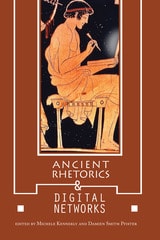
Ancient Rhetorics and Digital Networks
Edited by Michele Kennerly and Damien Smith Pfister
University of Alabama Press, 2018
What can ancient rhetorical theory possibly tell us about the role of new digital media technologies in contemporary public culture? Some central issues we currently deal with—making sense of information abundance, persuading others in our social network, navigating new media ecologies, and shaping broader cultural currents—also pressed upon the ancients.
Ancient Rhetorics and Digital Networks makes this connection explicit, reexamining key figures, texts, concepts, and sensibilities from ancient rhetoric in light of the glow of digital networks, or, ordered conversely, surveying the angles and tangles of digital networks from viewpoints afforded by ancient rhetoric. By providing an orientation grounded in ancient rhetorics, this collection simultaneously historicizes contemporary developments and reenergizes ancient rhetorical vocabularies.
Contributors engage with a variety of digital phenomena including remix, big data, identity and anonymity, memes and virals, visual images, decorum, and networking. Taken together, the essays in Ancient Rhetorics and Digital Networks help us to understand and navigate some of the fundamental communicative issues we deal with today.
Automated Athens
Ancient Greek Ideals in the Early Age of AutomationMichele Kennerly
University of Chicago Press, 2026
A critical history of the recurring idea that technology will free us from work and bring about a truly democratic society.
In popular thought, ancient Athens endures as a place ahead of its time—the birthplace of democracy, a cultural center, and a model toward which modern societies should strive. In Automated Athens, Michele Kennerly examines the many and frequent appeals to this nostalgic vision of the ancient city-state throughout the early age of computerized automation. In the mid-twentieth century, people hoped that automation would free us from mindless, dehumanizing work so that we could attend to creative and communal pursuits. Proponents appealed to ancient Athens, saying automated systems and machines would stand in for the craftsmen, enslaved people, and subordinated women who performed the undesirable work that enabled that city-state’s flourishing. Automated Athens scrutinizes this appeal as it moves chronologically into present debates about the promise of automation and AI. For Kennerly, our inability to settle debates about where accelerating automation may take us, especially politically, reveals a deeper cultural indecisiveness about how to live well and live well together.
The Practice of Rhetoric
Poetics, Performance, PhilosophyEdited by Debra Hawhee and Vessela Valiavitcharska
University of Alabama Press, 2022
Essays that show what a broad conception of rhetoric means and does in relation to practice
Rhetoric is the art of emphasis, in the ancient sense of bringing to light or obscuring in shadow, and it is both a practice and a theory about that practice. In recent decades, scholars of rhetoric have turned to approaches that braid together poetics, performance, and philosophy into a “practical art.” The Practice of Rhetoric: Poetics, Performance, Philosophy presents just such an account of rhetoric that presumes and incorporates theoretical approaches, offering a collection of principles assembled in the heat and trials of public practice. The essays gathered in this volume are inspired by the capacious conception of rhetoric put forth by historian of rhetoric Jeffrey Walker, who is perhaps best known for stressing rhetoric’s educational mission and its investments in both theory and practice.
The book extends that vision through the prisms of poetics, performance, and philosophy of argument. Poetics shows rhetoric’s meaning making in all its verbal possibilities and material manifestations, in contexts ranging from mouse-infested medieval fields to the threat of toxin-ridden streams in the twentieth century. Performance puts what is created into the heat of public life, tapping out the rhythms of Byzantine prose or using collage to visually depict the beliefs and convictions of Martin Luther King Jr. Philosophy of argument enacts the mutually constitutive relationship between rhetoric and dialectic, offering new insights on and contexts for old tools like stasis and disputation, while keeping the focus on usefulness and teachability.
Ranging across centuries and contexts, the essays collected here demonstrate the continued need to attend carefully to the cooperation of descriptive language and normative reality, conceptual vocabulary and material practice, public speech and moral self-shaping. This volume will rekindle long-standing conversations about the public, world-making practice of rhetoric, thereby enlivening anew its civic mission.