Results by title
10 books match the query 'Kierkegaard, Søren'
Kierkegaard And The Ends Of Language
Geoffrey A. Hale
University of Minnesota Press, 2002
A timely and original intervention in our understanding of this major philosopher through the lens of his influence on others
What do we read when we read Kierkegaard? How do we know? Insisting that Kierkegaard remains a far more enigmatic and paradoxical writer than is often assumed, Geoffrey A. Hale argues that the best way to approach Kierkegaard’s work and understand its significance for our own thought is to retrace its formative influence on major intellectuals of the early twentieth century.
In mutually reflective readings of Kierkegaard’s foundational texts through the work of three pivotal authors—Franz Kafka, Theodor Adorno, and Rainer Maria Rilke—Hale shows how each of these writers draws attention to the unwavering sense of human finitude that pervades all of Kierkegaard’s work and, with it, the profoundly unsettling indeterminacy in which it results. It is the very limitations of language, Hale argues, that hold it open to meaning, to interpretation, and thus to freedom. Resisting clear circumscription in this way, Kierkegaard’s work becomes all the more fruitful to us—and all the more challenging—to the extent that it resists our understanding.
Kierkegaard as Phenomenologist
An ExperimentJeffrey Hanson
Northwestern University Press, 2010
In Kierkegaard as Phenomenologist: An Experiment, Jeffrey Hanson embarks on a project to locate Kierkegaard within the current phenomenological discussion. This work is an experiment inasmuch as the plausibility of the undertaking itself will be determined only by the outcome. Some of the contributors clearly regard it as possible to read Kierkegaard as a phenomenologist. Others plainly do not and will contest the very hypothesis that forms the basis of this experiment.
As with any experiment, the larger discussion will determine its success, but Kierkegaard as Phenomenologist lays the groundwork for two exciting possibilities: first, that Kierkegaard scholarship will be renewed, and second, that the meaning of phenomenology itself will be reconsidered.
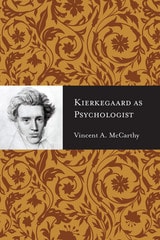
Kierkegaard as Psychologist
Vincent A. McCarthy
Northwestern University Press, 2015
Kierkegaard, Literature, and the Arts
Edited by Eric Ziolkowski
Northwestern University Press, 2018
The essays in Kierkegaard, Literature, and the Arts, contextualized with an insightful introduction by Eric Ziolkowski, explore Kierkegaard’s relationship to literature (poetry, prose, and storytelling), the performing arts (theater, music, opera, and dance), and the visual arts, including film. The collection is rounded out with a comparative section that considers Kierkegaard in juxtaposition with a romantic poet (William Blake), a modern composer (Arnold Schoenberg), and a contemporary singer‑songwriter (Bob Dylan). Kierkegaard was as much an aesthetic thinker as a philosopher, and his philosophical writings are complemented by his literary and music criticism.
Kierkegaard, Literature, and the Arts will offer much of interest to scholars concerned with Kierkegaard as well as teachers, performers, and readers in the various aesthetic fields discussed.
CONTRIBUTORS: Christopher B. Barnett, Martijn Boven, Anne Margrete Fiskvik, Joakim Garff, Ronald M. Green, Peder Jothen, Ragni Linnet, Jamie A. Lorentzen, Edward F. Mooney, George Pattison, Nils Holger Petersen, Howard Pickett, Marcia C. Robinson, James Rovira
Kierkegaard
Construction of the AestheticTheodor Adorno
University of Minnesota Press, 1989
Meaning and Mortality in Kierkegaard and Heidegger
Origins of the Existential Philosophy of DeathAdam Buben
Northwestern University Press, 2016
The Chattering Mind
A Conceptual History of Everyday TalkSamuel McCormick
University of Chicago Press, 2020
From Plato’s contempt for “the madness of the multitude” to Kant’s lament for “the great unthinking mass,” the history of Western thought is riddled with disdain for ordinary collective life. But it was not until Kierkegaard developed the term chatter that this disdain began to focus on the ordinary communicative practices that sustain this form of human togetherness.
The Chattering Mind explores the intellectual tradition inaugurated by Kierkegaard’s work, tracing the conceptual history of everyday talk from his formative account of chatter to Heidegger’s recuperative discussion of “idle talk” to Lacan’s culminating treatment of “empty speech”—and ultimately into our digital present, where small talk on various social media platforms now yields big data for tech-savvy entrepreneurs.
In this sense, The Chattering Mind is less a history of ideas than a book in search of a usable past. It is a study of how the modern world became anxious about everyday talk, figured in terms of the intellectual elites who piqued this anxiety, and written with an eye toward recent dilemmas of digital communication and culture. By explaining how a quintessentially unproblematic form of human communication became a communication problem in itself, McCormick shows how its conceptual history is essential to our understanding of media and communication today.
The Essential Supernatural
A Dialogical Study in Kierkegaard and BlondelMaurice Ashley Agbaw-Ebai
St. Augustine's Press, 2022
Like these philosophers who have preceded him, Agbaw-Ebai exhorts us to never allow the sense of our relation to the supernatural as a settled matter. The philosophy of religion we have inherited does not protect us from having to confront our own subjectivity with autonomy: to be God without God and against God, or to be God with and through God.
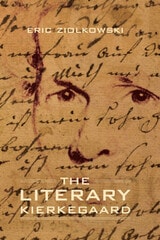
The Literary Kierkegaard
Eric Ziolkowski
Northwestern University Press, 2011
Yet Kierkegaard signals the essentially literary as opposed to strictly theological or philosophical nature of his writings. Ziolkowski first considers the notions of aesthetics and the aesthetic as Kierkegaard adapted them, and then his posture as a poet, as interrelated contexts of his selfconception as “a weed in literature.” After next taking account of the history of the critical recognition of Kierkegaard as a literary artist, he looks at an important characteristic of his literary craft that has received relatively little attention: the manner by which he and his pseudonyms read and quote other authors. Ziolkowski then explores the connections between the philosopher’s writings and those of other literary masters by whom he was directly influenced, such as Aristophanes, Cervantes, and Shakespeare; or of those who, while they did not directly influence him, gave paradigmatic expression to some of the same aspects of aesthetic, ethical, and religious existence that Kierkegaard and his pseudonyms portray. Ziolkowski’s seminal study will be of interest to Kierkegaard scholars, philosophers, and comparative literature scholars alike.
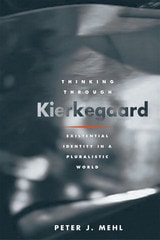
Thinking through Kierkegaard
Existential Identity in a Pluralistic WorldPeter J. Mehl
University of Illinois Press, 2010
Contrary to Kierkegaard's ideal of moral personhood and orthodox Christian identity, Mehl aims to acknowledge the possibility of pluralism in existential identities. By demanding sensitivity to the deep ways social and cultural context influences human perception, interpretation and self?representation, Mehl argues that Kierkegaard is not simply discovering but also participating in a cultural construction of the human being.
Drawing on accounts of what it is to be a person by prominent philosophers outside of Kierkegaard scholarship, including Charles Taylor, Owen Flanagan, Alasdair MacIntyre, and Thomas Nagel, Mehl also works to bridge the analytic and continental traditions and reestablishes Kierkegaard as a rich resource for situating moral and spiritual identity. This reexamination of Kierkegaard is recommended for anyone interested in what it means to be a person.