Results by title
5 books match the query 'Kimmel, Michael'

Manhood Before Masculinity
Gender, Class, and Urban Social Space in the Early 20th Century CityLeonard Ellis
Rutgers University Press, 2027
At the turn of the twentieth century, American men—especially white men—were confronted by a rapidly-changing world that threatened to disrupt systems they had known all their lives. In the face of these social and economic transformations, men from varied class and ethnic backgrounds formed groups in which they found support, companionship, and camaraderie. This story has typically been told through the eyes of middle-class men, but historian-sociologist Len Ellis adopts a different perspective in this revealing work, instead training his lens on the experiences of working-class and elite men in major cities such as New York, Boston, and Philadelphia. Exploring street corners, pool halls, saloons, boys’ schools, college fraternities, and elite social clubs, this book illuminates largely-forgotten worlds that are surprisingly analogous to elements of our own moment.
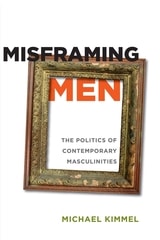
Misframing Men
The Politics of Contemporary MasculinitiesKimmel, Michael
Rutgers University Press, 2010
This past decade has witnessed an extraordinary transformation in men's lives. For years, wave after wave of the women's movement, a movement that reshaped every aspect of American life, produced nary a ripple among men. But suddenly men are in the spotlight.
Yet, the public discussions often seem strained, silly, and sometimes flat-out wrong. The spotlight itself seems to obscure as much as it illuminates. Old tired clichTs about men's resistance to romantic commitment or reluctance to be led to the marriage altar seem perennially recyclable in advice books and on TV talk shows, but these days the laughter feels more forced, the defensiveness more pronounced. Pop biologists avoid careful confrontation with serious scientific research in their quest to find anatomical or evolutionary bases for promiscuity or porn addiction, hoping that by fiat, one can pronounce that "boys will be boys" and render it more than a flaccid tautology. And political pundits wring their hands about the feminization of American manhood, as if gender equality has neutered these formerly proud studs. Misframing Men, a collection of Michael Kimmel's commentaries on contemporary debates about masculinity, argues that the media have largely misframed this debate.
Kimmel, among the world's best-known scholars in gender studies, discusses political moments such as the Virginia Military Institute and Citadel cases that reached the Supreme Court (he participated as expert witness for the Justice Department) along with Promise Keepers rallies, mythopoetic gatherings, and white supremacists. He takes on antifeminists as the real male bashers, questions the unsubstantiated assertions that men suffer from domestic violence to the same degree as women, and examines the claims made by those who want to rescue boys from the "misandrous" reforms initiated by feminism.
In writings both solidly grounded and forcefully argued, Kimmel pushes the boundaries of today's modern conversation about men and masculinity.

Revolution
A Sociological InterpretationMichael Kimmel
Temple University Press, 1990
The Politics of Manhood
Profeminist Men Respond to the Mythopoetic Men's Movement (And the Mythopoetic Leaders Answer)edited by Michael S. Kimmel
Temple University Press, 1995
The Sexual Self
The Construction of Sexual ScriptsMichael Kimmel
Vanderbilt University Press, 2007