Results by title
7 books match the query 'Kingship'
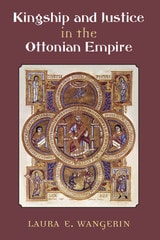
Kingship and Justice in the Ottonian Empire
Laura E. Wangerin
University of Michigan Press, 2019
Scholars have recognized the importance of ritual and symbolic behaviors in the Ottonian political sphere, while puzzling over the apparent lack of administrative organization, a contradiction between what we know about the Ottonians as successful rulers and their traditional characterization as rulers of a disorganized polity. Trying to account for the apparent disparity between their political and military achievements, cultural and artistic efflorescence, and relative dynastic stability, which seemingly accompanied a disinterest in writing law or creating a centralized hierarchical administration, is a tension that persists in the scholarship. This book argues that far from being accidental successes or employing primitive methods of governance, the Ottonians were shrewd rulers and administrators who exploited traditional methods of conflict resolution and delegated jurisdictional authority to keep control over their vast empire. Thus, one of the important things that this book aims to accomplish is to challenge our preconceived notions of what successful government looks like.
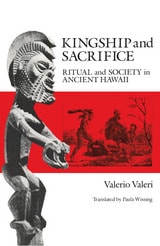
Kingship and Sacrifice
Ritual and Society in Ancient HawaiiValerio Valeri
University of Chicago Press, 1985
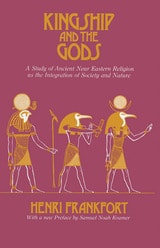
Kingship and the Gods
A Study of Ancient Near Eastern Religion as the Integration of Society and NatureHenri Frankfort
University of Chicago Press, 1948
Frank's superb work, first published in 1948 and now supplemented with a preface by Samuel Noah Kramer, demonstrates how the Egyptian and Mesopotamian attitudes toward nature related to their concept of kingship. In both countries the people regarded the king as their mediator with the gods, but in Mesopotamia the king was only the foremost citizen, while in Egypt the ruler was a divine descendant of the gods and the earthly representative of the God Horus.
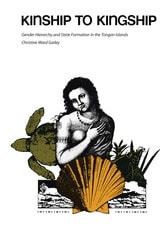
Kinship to Kingship
Gender Hierarchy and State Formation in the Tongan IslandsBy Christine Ward Gailey
University of Texas Press, 1987
Have women always been subordinated? If not, why and how did women’s subordination develop? Kinship to Kingship was the first book to examine in detail how and why gender relations become skewed when classes and the state emerge in a society.
Using a Marxist-feminist approach, Christine Ward Gailey analyzes women’s status in one society over three hundred years, from a period when kinship relations organized property, work, distribution, consumption, and reproduction to a class-based state society. Although this study focuses on one group of islands, Tonga, in the South Pacific, the author discusses processes that can be seen through the neocolonial world.
This ethnohistorical study argues that evolution from a kin-based society to one organized along class lines necessarily entails the subordination of women. And the opposite is also held to be true: state and class formation cannot be understood without analyzing gender and the status of women. Of interest to students of anthropology, political science, sociology, and women’s studies, this work is a major contribution to social history.
Law and Kingship in Thailand During the Reign of King Chulalongkorn
David M. Engel
University of Michigan Press, 1975
The Inner Conflict of Tradition
Essays in Indian Ritual, Kingship, and SocietyJ. C. Heesterman
University of Chicago Press, 1985
Writing, Law, and Kingship in Old Babylonian Mesopotamia
Dominique Charpin
University of Chicago Press, 2010
Ancient Mesopotamia, the fertile crescent between the Tigris and Euphrates rivers in what is now western Iraq and eastern Syria, is considered to be the cradle of civilization—home of the Babylonian and Assyrian empires, as well as the great Code of Hammurabi. The Code was only part of a rich juridical culture from 2200–1600 BCE that saw the invention of writing and the development of its relationship to law, among other remarkable firsts.
Though ancient history offers inexhaustible riches, Dominique Charpin focuses here on the legal systems of Old Babylonian Mesopotamia and offers considerable insight into how writing and the law evolved together to forge the principles of authority, precedent, and documentation that dominate us to this day. As legal codes throughout the region evolved through advances in cuneiform writing, kings and governments were able to stabilize their control over distant realms and impose a common language—which gave rise to complex social systems overseen by magistrates, judges, and scribes that eventually became the vast empires of history books. Sure to attract any reader with an interest in the ancient Near East, as well as rhetoric, legal history, and classical studies, this book is an innovative account of the intertwined histories of law and language.