Results by title
3 books match the query 'Kling, Dwayne'
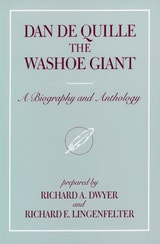
Dan de Quille
Dwayne Kling
University of Nevada Press, 1990
A biography and anthology of William Wright (1829–1898), better known by the pen name Dan DeQuille or Dan De Quille, an American author, journalist, and humorist. He was best known for his written accounts of the people, events, and silver mining operations on the Comstock Lode at Virginia City, Nevada, including his non-fiction book History of the Big Bonanza (American Publishing Company, 1876).
DeQuille was on the staff of the (Virginia City) Territorial Enterprise for over thirty years, and his writings were also printed in other publications throughout the country and abroad. Highly regarded for his knowledge of silver mining techniques and his ability to explain them in simple terms, he was also appreciated for his humor, similar in style to that of his associate and friend Mark Twain, and of a type very popular in the United States at that time, now referred to as the Sagebrush School literary genre.

Sagebrush Trilogy
Dwayne Kling
University of Nevada Press, 1990
A comprehensive treatise on the life and works of Idah Meacham Strobridge, an American writer and bookbinder known primarily for a trio of works about the Great Basin.
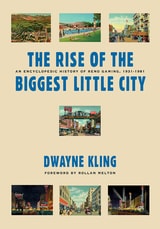
The Rise Of The Biggest Little City
An Encyclopedic History Of Reno Gaming, 1931-1981Dwayne Kling
University of Nevada Press, 2010
The history of Reno during the first half century is to a great degree the history of Reno’s gaming industry. Between 1931 and 1981, the economy, skyline, and lifestyle of “the Biggest Little City in the World” were strongly influenced by the city’s casinos and the people who created and operated them. In The Rise of the Biggest Little City, longtime Reno gaming executive Dwayne Kling records the fruits of his fourteen years of research into the history of Reno’s casinos, from the backroom (and often illegal) dives of the industry’s beginnings to the elegant casino-hotels of today. Arranged in encyclopedic form with historic photographs (many never before published), the book offers the stories of such famous establishments as Harolds Club, the Cal-Neva, the Sands, and Harrah’s, as well as defunct clubs like the Cedars, the Silver Spur, and the Bank Club. We also find the stories of the men and women who created Reno’s gaming industry—such as James McKay and Bill Graham, who came from the rough-and-tumble saloons of boom-town Tonopah and developed a chain of illegal gambling clubs and brothels into Reno’s first major casino, the Bank Club; the Smith family—Raymond I. “Pappy,” Harold Sr., Raymond A., and Harold Jr.—whose Harolds Club was a prime downtown attraction for over fifty years and brought Reno national fame as a destination for fun and gambling; Bill Bailey, an African-American whose Harlem Club—one of the first integrated casinos in Reno—attracted such show-business luminaries as Louis Armstrong and Pearl Bailey (his cousin) for late-night jam sessions; William Harrah, who parleyed a string of small bingo parlors into a major gaming empire; and Jack Douglass, a slot-route operator in the early days of legal gaming who became a major figure in Reno’s modern casino industry. There are more. Kling records the stories of hundreds of gaming establishments, most of them long forgotten, stretching geographically from the Mount Rose Highway to the north end of town, from Verdi to Sparks; and of dozens of men and women who shaped the industry, for better and for worse. We learn from that Reno was the true pioneer of the gambling industry. It was here that big-name entertainment was first offered in a casino setting; that elegant hotel rooms and fine dining were first offered as amenities of the casino experience; that a casino corporation first traded its stock on the New York Stock Exchange; that ethnic minorities first owned and operated casinos, and first integrated them. The Rise of the Biggest Little City will engage readers with its authoritative account of the rise of modern Reno and of the colorful history that lies beneath today’s neon and glitz.