Results by title
6 books match the query 'Kritik der Urteilskraft'
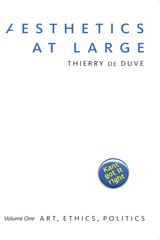
Aesthetics at Large
Volume 1: Art, Ethics, PoliticsThierry de Duve
University of Chicago Press, 2019
Central to de Duve’s re-reading of the Critique of Judgment is Kant’s idea of sensus communis, ultimately interpreted as the mere yet necessary idea that human beings are capable of living in peace with one another. De Duve pushes Kant’s skepticism to its limits by submitting the idea of sensus communis to various tests leading to questions such as: Do artists speak on behalf of all of us? Is art the transcendental ground of democracy? Or, Was Adorno right when he claimed that no poetry could be written after Auschwitz?
Loaded with de Duve’s trademark blend of wit and erudition and written without jargon, these essays radically renew current approaches to some of the most burning issues raised by modern and contemporary art. They are indispensable reading for anyone with a deep interest in art, art history, or philosophical aesthetics.
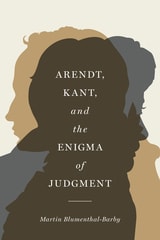
Arendt, Kant, and the Enigma of Judgment
Martin Blumenthal-Barby
Northwestern University Press, 2023
A nuanced extrapolation of Hannah Arendt’s theory of judgment through her highly provocative reading of Immanuel Kant
More than a half century after it was first published, Hannah Arendt’s Origins of Totalitarianism rose to the top of best-seller lists as readers grappled with the triumph of Trumpism. Arendt, Kant, and the Enigma of Judgment directs our attention to her later thought, the posthumously published and highly provocative Lectures on Kant’s Political Philosophy. Martin Blumenthal-Barby puts this work in dialogue with Arendt’s other writings, including her notes on Kant’s Critique of Judgment, to outline her own theory of judgment for the twentieth century. In an era of post-truths and artificial intelligence, the idea that authentic judgment—for example, the ability to distinguish right from wrong—is incommensurable with abstract, automated processes lies at the center of Arendt’s late work and at the fore of our collective reckoning.
Rather than presenting us with a fixed account, Blumenthal-Barby suggests, Arendt’s drawing and redrawing of conceptual distinctions is itself an enactment of judgment, a process that challenges and complicates what she says at every turn. In so doing, Arendt, in thoroughly Kantian fashion, establishes judgment as a performative category that can never be taught but only demonstrated. As sharp as it is timely, this incisive book reminds us why a shared reality matters in a time of intense political polarization and why the democratic project, vulnerable as it may appear today, crucially depends on it.
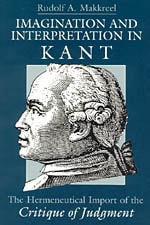
Imagination and Interpretation in Kant
The Hermeneutical Import of the Critique of JudgmentRudolf A. Makkreel
University of Chicago Press, 1990
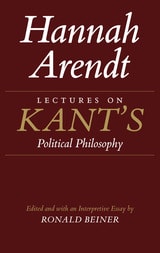
Lectures on Kant's Political Philosophy
Hannah Arendt
University of Chicago Press, 1982
The Genesis of Kant's Critique of Judgment
John H. Zammito
University of Chicago Press, 1992
The austerity and grandeur of Kant's philosophical writings sometimes make it hard to recognize them as the products of a historical individual situated in the particular constellation of his time and society. Here Kant emerges as a concrete historical figure struggling to preserve the achievements of cosmopolitan Aufkl-rung against challenges in natural science, religion, and politics in the late 1780s. More specifically Zammito suggests that Kant's Third Critique was animated throughout by a fierce personal rivalry with Herder and by a strong commitment to traditional Christian ideas of God and human moral freedom.
"A work of extraordinary erudition. Zammito's study is both comprehensive and novel, connecting Kant's work with the aesthetic and religious controversies of the late eighteenth century. He seems to have read everything. I know of no comparable historical study of Kant's Third Critique."-Arnulf Zweig, translator and editor of Kant's ;IPhilosophical Correspondence, 1759-1799;X
"An intricate, subtle, and exciting explanation of how Kant's thinking developed and adjusted to new challenges over the decade from the first edition of the Critique of Pure Reason to the appearance of the Critique of Judgment."—John W. Burbidge, Review of Metaphysics
"There has been for a long time a serious gap in English commentary on Kant's Critique of Judgment; Zammito's book finally fills it. All students and scholars of Kant will want to consult it."—Frederick Beiser, Times Literary Supplement
The Powers of Pure Reason
Kant and the Idea of Cosmic PhilosophyAlfredo Ferrarin
University of Chicago Press, 2015
Ferrarin blows the dust off of two egregiously overlooked sections of the First Critique—the Transcendental Dialectic and the Doctrine of Method. There he discovers what he argues is the Critique’s greatest achievement: a conception of the unity of reason and an exploration of the powers it has to reach beyond itself and legislate over the world. With this in mind, Ferrarin dismantles the common vision of Kant as a philosopher writing separately on epistemology, ethics, and aesthetics and natural teleology, showing that the three Critiques are united by this underlying theme: the autonomy and teleology of reason, its power and ends. The result is a refreshing new view of Kant, and of reason itself.