Results by title

2 books match the query 'Labor Activism'
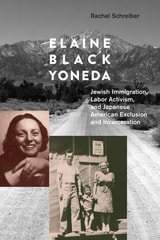
cover of Elaine Black Yoneda: Jewish Immigration, Labor Activism, and Japanese American Exclusion and Incarceration

Elaine Black Yoneda

Jewish Immigration, Labor Activism, and Japanese American Exclusion and Incarceration

Rachel Schreiber

Temple University Press, 2022

During World War II, Elaine Black Yoneda, the daughter of Russian Jewish immigrants, spent eight months in a concentration camp—not in Europe, but in California. She did this voluntarily and in solidarity, insisting on accompanying her husband, Karl, and their son, Tommy, when they were incarcerated at the Manzanar Relocation Center. Surprisingly, while in the camp, Elaine and Karl publicly supported the United States’ decision to exclude Japanese Americans from the coast.

Elaine Black Yoneda is the first critical biography of this pioneering feminist and activist. Rachel Schreiber deftly traces Yoneda’s life as she became invested in radical politics and interracial and interethnic activism. In her work for the International Labor Defense of the Communist Party, Yoneda rose to the rank of vice president. After their incarceration, Elaine and Karl became active in the campaigns to designate Manzanar a federally recognized memorial site, for redress and reparations to Japanese Americans, and in opposition to nuclear weapons.

Schreiber illuminates the ways Yoneda’s work challenged dominant discourses and how she reconciled the contradictory political and social forces that shaped both her life and her family’s. Highlighting the dangers of anti-immigrant and anti-Asian xenophobia, Elaine Black Yoneda recounts an extraordinary life.
[more]
cover of Women and Change at the U.S.–Mexico Border: Mobility, Labor, and Activism

Women and Change at the U.S.–Mexico Border

Mobility, Labor, and Activism

Edited by Doreen J. Mattingly and Ellen R. Hansen

University of Arizona Press, 2006

There’s no denying that the U.S.–Mexico border region has changed in the past twenty years. With the emergence of the North American Free Trade Agreement (NAFTA), the curtailment of welfare programs, and more aggressive efforts by the United States to seal the border against undocumented migrants, the prospect of seeking a livelihood—particularly for women—has become more tenuous in the twenty-first century. In the face of the ironic juxtaposition of free trade and limited mobility, this book takes a new look at women on both sides of the border to portray them as active participants in the changing structures of life, often engaging in political struggles. The contributions—including several chapters by Mexican as well as U.S. scholars—examine environmental and socioeconomic conditions on the border as they shape and are shaped by both daily life at the local level and the global economy. The contributors focus on issues related to migration, both short- and long-term; empowerment, especially reflecting shifts in women’s consciousness in the workplace; and political and social activism in border communities. The chapters consider a broad range of topics, such as the changing gender composition of the maquiladora work force over the past decade and border women’s non-governmental organizations and political activism.In most of the studies, both sides of the border are considered to provide insights into differences created by an international boundary and similarities produced by cross-border interactions. Together, these chapters show the border region to be a dynamic social, economic, cultural, and political context in which women face both obstacles and opportunities for change—and make clear the vital role that women play in shaping the border region and their own lives. This collection builds on Susan Tiano and Vicki Ruiz’s groundbreaking volume Women on the U.S.–Mexico Border by continuing to show the human face of changes wrought by manufacturing and militarization. By illustrating the current state of social science research on gender and women’s lives in the region, it offers fresh perspectives on the material reality of women’s daily lives in this culturally and historically rich region.
[more]