Results by title
11 books match the query 'Labor laws and legislation'
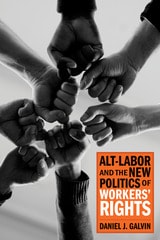
Alt-Labor and the New Politics of Workers' Rights
Daniel J. Galvin
Russell Sage Foundation, 2024
Alt-labor groups have long offered their members services and organizing opportunities to contest their unfair treatment on the job. But many groups have grown frustrated by the limited impact of these traditional strategies and have turned to public policy to scale up their work. They have successfully led campaigns to combat wage theft, raise the minimum wage, improve working conditions, strengthen immigrants’ rights, and more. These successes present something of a puzzle: relative to their larger, wealthier, and better-connected opponents, alt-labor groups are small, poor, and weak. Their members are primarily low-wage immigrant workers and workers of color who are often socially, economically, and politically marginalized. With few exceptions, the groups lack large dues-paying memberships and are dependent on philanthropic foundations and other unpredictable sources of funding. How, given their myriad challenges, have alt-labor groups managed to make gains for their members?
Galvin reveals that alt-labor groups are leveraging their deep roots in local communities, their unique position in the labor movement, and the flexibility of their organizational forms to build their collective power and extend their reach. A growing number of groups have also become more politically engaged and have set out to alter their political environments by cultivating more engaged citizens, influencing candidate selection processes, and expanding government capacities. These efforts seek to enhance alt-labor groups’ probabilities of success in the near term while incrementally shifting the balance of power over the long term.
Alt-Labor and the New Politics of Workers’ Rights comprehensively details alt-labor’s turn to policy and politics, provides compelling insights into the dilemmas the groups now face, and illuminates how their efforts have both invigorated and complicated the American labor movement.
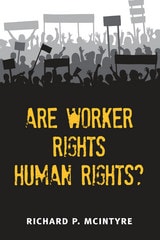
Are Worker Rights Human Rights?
Richard P. McIntyre
University of Michigan Press, 2008
"In a much-needed intervention, Ric McIntyre recasts the debate about globalization and labor rights and speeds us to the heart of the matter: the battle between transnational corporations who distance themselves from responsibility for the fate of workers, and labor activists who seek to reestablish bonds of accountability and moral obligation. The stakes in this struggle are enormous, and Dr. McIntyre provides crucial insight into the economic and political dynamics that define it."
---Scott Nova, Executive Director, Worker Rights Consortium, Washington, DC
"This book presents an insightful, powerful corrective to the contemporary debate over worker rights. McIntyre identifies the limitations of thinking of worker rights as individualized human rights and challenges us instead to examine how rights are defined through conventional thinking and class interest. The product is rich and compelling: McIntyre's investigation demands of us that we be far more attentive to the contradictory effects of ‘rights talk.' I recommend this book enthusiastically to all those who advocate for a just economic order the world over."
---George DeMartino, Associate Professor of Political Economy, the Josef Korbel School of International Studies, University of Denver
"An important contribution to the interdisciplinary study of labor. McIntyre's book will challenge the debate over labor rights on all fronts."
---Michael Hillard, Professor of Economics, University of Southern Maine
"A timely examination of our modern 'sweating system' . . . essential reading for all workers who hope for greater dignity in the workplace and greater fairness in society."
---Janet Knoedler, Associate Professor of Economics, Bucknell University
"Ric McIntyre convincingly shows how local actions, regulations changes, and international norms can combine to establish collective rights for workers."
---Gilles Raveaud, Assistant Professor in Economics, University of Saint-Denis, France, and cofounder of the "post-autistic economics movement"
"An important, timely, and needed contribution to our understanding of worker rights."
---Patrick McHugh, Associate Professor of Management, George Washington University
"Workers of the world, unite!" Karl Marx's famous call to action still promises an effective means of winning human rights in the modern global economy, according to economist Richard P. McIntyre. Currently, the human rights movement insists upon a person's right to life, freedom, and material necessities. In democratic, industrial nations such as the United States, the movement focuses more specifically on a person's civil rights and equal opportunity.
The movement's victories since WWII have come at a cost, however. The emphasis on individual rights erodes collective rights---the rights that disadvantaged peoples need to assert their most basic human rights. This is particularly true for workers, McIntyre argues. By reintroducing Marxian and Institutional analysis, he reveals the class relations and power structures that determine the position of workers in the global economy. The best hope for achieving workers' rights, he concludes, lies in grassroots labor organizations that claim the right of association and collective bargaining.
At last, an economist offers a vision for human rights that takes both moral questions and class relations seriously.
Richard P. McIntyre is Director of the University Honors Program and Professor of Economics at the University of Rhode Island.
Broken Promise
The Subversion Of U.S. Labor RelationsJames A. Gross
Temple University Press, 2003
The Wagner Act of 1935 (later the Wagner-Taft-Hartley Act of 1947) was intended to democratize vast numbers of American workplaces: the federal government was to encourage worker organization and the substitution of collective bargaining for employers' unilateral determination of vital work-place matters. Yet this system of industrial democracy was never realized; the promise was "broken." In this rare inside look at the process of government regulation over the last forty-five years, James A. Gross analyzes why the promise of the policy was never fulfilled.
Gross looks at how the National Labor Relations Board's (NLRB) policy-making has been influenced by the President, the Congress, the Supreme Court, public opinion, resistance by organized employers, the political and economic strategies of organized labor, and the ideological dispositions of NLRB appointees. This book provides the historical perspective needed for a reevaluation of national labor policy. It delineates where we are now, how we got here, and what fundamental questions must be addressed if policy-makers are to make changes consistent with the underlying principles of democracy.
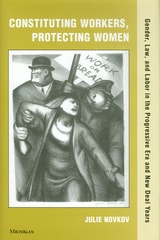
Constituting Workers, Protecting Women
Gender, Law and Labor in the Progressive Era and New Deal YearsJulie Novkov
University of Michigan Press, 2001
During the Progressive Era and New Deal, courts often invalidated generalized protective legislation, but frequently upheld measures that limited women's terms and conditions of labor. The book explores the reasoning in such cases that were decided between 1873 and 1937. By analyzing all reported opinion on the state and federal level, as well as materials from the women's movement and briefs filed in the U.S. Supreme Court, the study demonstrates that considerations of cases involving women's measures ultimately came to drive the development of doctrine.
The study combines historical institutionalism and feminism to address constitutional interpretation, showing that an analysis of conflict over the meaning of legal categories provides a deeper understanding of constitutional development. In doing so, it rejects purely political interpretations of the so-called Lochner era, in which the courts invalidated many legislative efforts to ameliorate the worst effects of capitalism. By addressing the dynamic interactions among interested laypersons, attorneys, and judges, it demonstrates that no individuals or institutions have complete control over the generation of constitutional meaning.
Julie Novkov is Assistant Professor of Political Science, University of Oregon
England's Great Transformation
Law, Labor, and the Industrial RevolutionMarc W. Steinberg
University of Chicago Press, 2016
Building his argument on three case studies—the Hanley pottery industry, Hull fisheries, and Redditch needlemakers—Steinberg employs both local and national analyses to emphasize the ways in which these master-servant laws allowed employers to use the criminal prosecutions of workers to maintain control of their labor force. Steinberg provides a fresh perspective on the dynamics of labor control and class power, integrating the complex pathways of Marxism, historical institutionalism, and feminism, and giving readers a subtle yet revelatory new understanding of workplace control and power during England’s Industrial Revolution.
Labor Justice across the Americas
Leon Fink, Juan Palacio
University of Illinois Press, 2018
Law and Employment
Lessons from Latin America and the CaribbeanEdited by James J. Heckman and Carmen Pages
University of Chicago Press, 2004
Numerous labor regulations that were introduced or reformed in Latin America in the past thirty years have had important economic consequences. Nobel Prize-winning economist James J. Heckman and Carmen Pagés document the behavior of firms attempting to stay in business and be competitive while facing the high costs of complying with these labor laws. They challenge the prevailing view that labor market regulations affect only the distribution of labor incomes and have little or no impact on efficiency or the performance of labor markets. Using new micro-evidence, this volume shows that labor regulations reduce labor market turnover rates and flexibility, promote inequality, and discriminate against marginal workers.
Along with in-depth studies of Colombia, Peru, Brazil, Argentina, Chile, Uruguay, Jamaica, and Trinidad, Law and Employment provides comparative analysis of Latin American economies against a range of European countries and the United States. The book breaks new ground by quantifying not only the cost of regulation in Latin America, the Caribbean, and in the OECD, but also the broader impact of this regulation.
Legalized Inequalities
Immigration and Race in the Low-wage WorkplaceKati L. Griffith
Russell Sage Foundation, 2025
Drawing on interviews with over three hundred low-wage Haitian and Central American workers and worker advocates, Griffith, Gleeson, Dubuisson, and Campos-Medina reveal how U.S. policies produce and sustain job instability and insecurity. Together, contemporary U.S. labor and employment law, immigration policy, and enduring racial inequality work in tandem to keep workers’ wages low, lock them into substandard working conditions, and minimize opportunities to push for change. Workplace regulations meant to protect workers are weak and underenforced, privileging employers over workers. At-will employment policies, which allow employers to terminate employees without cause, discourage workers from bargaining for better jobs or holding employers accountable for even the most egregious mistreatment. Federal immigration policy further disempowers workers by deputizing employers to act as immigration enforcement agents through immigration status verification requirements. Undocumented workers often believe they must endure maltreatment or risk deportation. Anti-immigrant sentiment—encouraged by U.S. policy—impacts workers across all status groups. Additionally, despite a proliferation of civil rights legislation, racial disparities remain in the workplace. Workers of color are often paid less, forced to complete more dangerous and demeaning tasks, and subjected to racial harassment.
While these workers face formidable barriers to fighting for their rights, they are not entirely powerless. Some low-wage workers filed formal complaints with government agencies. Others, on their own or collectively, confronted their employers to demand fair and dignified treatment. Some even quit in protest of their poor working conditions. The authors argue that reforming labor and employment law, immigration law, and Civil Rights law is necessary to reshape the low-wage workplace. They suggest increasing funding for workers’ rights enforcement agencies, removing the mandate for employers to verify a worker’s immigration status, and making it easier to prove that employment discrimination has occurred, among other policy proposals, to help empower and protect low-wage immigrant workers of color.
Legalized Inequalities not only highlights the crushing consequences of U.S. policy on low-wage immigrant workers of color but showcases their resilience in the face of these obstacles.
The Assault on American Labor Law
Unions Before the Supreme Court, 1965–2025Roger C. Hartley
University of Massachusetts Press, 2025
Reviewing the dismantling of American labor law in more than 100 Supreme Court cases
The National Labor Relations Act (NLRA), signed into law by Franklin Delano Roosevelt in 1935, guarantees the right of private sector employees to organize into trade unions, engage in collective bargaining, and take collective action such as strikes. Since its passage, the NLRA has functioned as the foundational statute of United States labor law. Opposed by conservatives and members of the Republican Party from the beginning, its provisions were largely upheld by the Supreme Court until the 1960s. In the latter part of the twentieth century and into the twenty-first, however, the Court began to erode the protections of the NLRA. While some cases have received widespread attention from commentators and scholars, such as Starbucks Corp. v. McKinney (2024), there have been numerous detrimental rulings that are little discussed. Taken as a whole, the Supreme Court’s efforts to undermine the NLRA appear sustained and systematic.
In The Assault on American Labor Law, distinguished labor law professor Roger C. Hartley collects and carefully reviews every Supreme Court decision concerning the NLRA over the past sixty years. By examining approximately 100 cases, Hartley demonstrates that the Court has often operated more like a legislature than a judicial body, effectively amending the NLRA’s collectivist policy underpinnings in favor of the interests of individuals and businesses. These judicial decisions create staggering obstacles for American workers to collectively organize and force them to face globalization, deindustrialization, and technological change individually, without the negotiating leverage provided by union representation. While scholars have suggested individual reforms to re-establish the efficacy of the NLRA, Hartley’s thorough study illuminates how the current crisis in US labor law evolved—a comprehensive view that is necessary to help restore the rights of workers to unionize.
The Gospel of Progressivism
Moral Reform and Labor War in Colorado, 1900-1930R. Todd Laugen
University Press of Colorado, 2010
Sharing enemies like the party boss and corporate lobbyist who undermined honest and responsive government, Progressive leaders were determined to root out selfish political action with public exposure. Labor unions defied bosses and rallied for government protection of workers. Women's clubs appealed to other women as mothers, calling for social welfare, economic justice, and government responsiveness. Protestant church congregations formed a core of support for moral reform. Labor relations experts struggled to prevent the outbreak of violence through mediation between corporate employers and organized labor. Persevering through World War I, Colorado reformers faced their greatest challenge in the 1920s, when leaders of the Ku Klux Klan drew upon the rhetoric of Protestant Progressives and manipulated reform tools to strengthen their own political machine. Once in power, Klan legislators turned on Progressive leaders in the state government.
A story of promising alliances never fully realized, zealous crusaders who resisted compromise, and reforms with unexpected consequences, The Gospel of Progressivism will appeal to those interested in Progressive Era reform, Colorado history, labor relations, and women's activism.
The Labor Board Crew
Remaking Worker-Employer Relations from Pearl Harbor to the Reagan EraRonald W. Schatz
University of Illinois Press, 2021
Schatz argues that the Labor Board vets, who saw themselves as disinterested technocrats, were in truth utopian reformers aiming to transform the world. Beginning in the 1970s stagflation era, they faced unforeseen opposition, and the cooperative relationships they had fostered withered. Yet their protégé George Shultz used mediation techniques learned from his mentors to assist in the integration of Southern public schools, institute affirmative action in industry, and conduct Cold War negotiations with Mikhail Gorbachev.