Results by title
7 books match the query 'Lakoff, George'
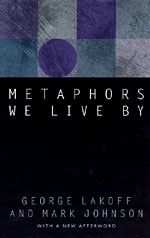
Metaphors We Live By
George Lakoff and Mark Johnson
University of Chicago Press, 1981
The now-classic Metaphors We Live By changed our understanding of metaphor and its role in language and the mind. Metaphor, the authors explain, is a fundamental mechanism of mind, one that allows us to use what we know about our physical and social experience to provide understanding of countless other subjects. Because such metaphors structure our most basic understandings of our experience, they are "metaphors we live by"—metaphors that can shape our perceptions and actions without our ever noticing them.
In this updated edition of Lakoff and Johnson's influential book, the authors supply an afterword surveying how their theory of metaphor has developed within the cognitive sciences to become central to the contemporary understanding of how we think and how we express our thoughts in language.
In this updated edition of Lakoff and Johnson's influential book, the authors supply an afterword surveying how their theory of metaphor has developed within the cognitive sciences to become central to the contemporary understanding of how we think and how we express our thoughts in language.
[more]
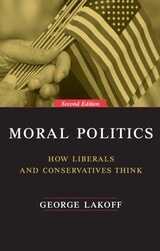
Moral Politics
How Liberals and Conservatives Think, Second EditionGeorge Lakoff
University of Chicago Press, 2002
In this classic text, the first full-scale application of cognitive science to politics, George Lakoff analyzes the unconscious and rhetorical worldviews of liberals and conservatives, discovering radically different but remarkably consistent conceptions of morality on both the left and right. For this new edition, Lakoff adds a preface and an afterword extending his observations to major ideological conflicts since the book's original publication, from the impeachment of Bill Clinton to the 2000 presidential election and its aftermath.
[more]
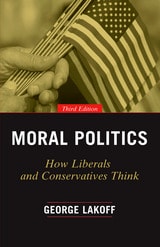
Moral Politics
How Liberals and Conservatives Think, Third EditionGeorge Lakoff
University of Chicago Press, 2016
When Moral Politics was first published two decades ago, it redefined how Americans think and talk about politics through the lens of cognitive political psychology. Today, George Lakoff’s classic text has become all the more relevant, as liberals and conservatives have come to hold even more vigorously opposed views of the world, with the underlying assumptions of their respective worldviews at the level of basic morality. Even more so than when Lakoff wrote, liberals and conservatives simply have very different, deeply held beliefs about what is right and wrong.
Lakoff reveals radically different but remarkably consistent conceptions of morality on both the left and right. Moral worldviews, like most deep ways of understanding the world, are unconscious—part of our “hard-wired” brain circuitry. When confronted with facts that don’t fit our moral worldview, our brains work automatically and unconsciously to ignore or reject these facts, and it takes extraordinary openness and awareness of this phenomenon to pay critical attention to the vast number of facts we are presented with each day. For this new edition, Lakoff has added a new preface and afterword, extending his observations to major ideological conflicts since the book's original publication, from the Affordable Care Act to the wars in Iraq and Afghanistan, the recent financial crisis, and the effects of global warming. One might have hoped such massive changes would bring people together, but the reverse has actually happened; the divide between liberals and conservatives has become stronger and more virulent.
To have any hope of bringing mutual respect to the current social and political divide, we need to clearly understand the problem and make it part of our contemporary public discourse. Moral Politics offers a much-needed wake-up call to both the left and the right.
[more]
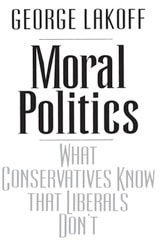
Moral Politics
What Conservatives Know That Liberals Don'tGeorge Lakoff
University of Chicago Press, 1996
Moral Politics takes a fresh look at how we think and talk about political and moral ideas. George Lakoff analyzed recent political discussion to find that the family—especially the ideal family—is the most powerful metaphor in politics today. Revealing how family-based moral values determine views on diverse issues as crime, gun control, taxation, social programs, and the environment, George Lakoff looks at how conservatives and liberals link morality to politics through the concept of family and how these ideals diverge. Arguing that conservatives have exploited the connection between morality, the family, and politics, while liberals have failed to recognized it, Lakoff explains why conservative moral position has not been effectively challenged. A wake up call to political pundits on both the left and the right, this work redefines how Americans think and talk about politics.
[more]
More than Cool Reason
A Field Guide to Poetic MetaphorGeorge Lakoff and Mark Turner
University of Chicago Press, 1989
A classic account of how metaphor works in literature--and what we can draw from that for everyday life--from two of the leading scholars of language
We usually think of the language of poetry, the metaphors that poets use to express their intentions, as far removed from ordinary life. But in More than Cool Reason, George Lakoff and Mark Turner show how understanding how metaphor works in poetry, the tasks it takes on and the ways it shapes our patterns of thought, can be hugely helpful to seeing and understanding how we think in all manner of other fields and areas of life. Metaphor, they show, is a tool so familiar, so everyday, that we fail to notice it. Lakoff and Turner correct that failure here, helping us see how richly metaphorical our language and thought are, and what that means for not only reading and enjoying poetry and literature, but also for linguistics, philosophy, psychology, anthropology, cognitive science, and more.
We usually think of the language of poetry, the metaphors that poets use to express their intentions, as far removed from ordinary life. But in More than Cool Reason, George Lakoff and Mark Turner show how understanding how metaphor works in poetry, the tasks it takes on and the ways it shapes our patterns of thought, can be hugely helpful to seeing and understanding how we think in all manner of other fields and areas of life. Metaphor, they show, is a tool so familiar, so everyday, that we fail to notice it. Lakoff and Turner correct that failure here, helping us see how richly metaphorical our language and thought are, and what that means for not only reading and enjoying poetry and literature, but also for linguistics, philosophy, psychology, anthropology, cognitive science, and more.
[more]
The Neural Mind
How Brains ThinkGeorge Lakoff and Srini Narayanan
University of Chicago Press, 2025
Offers an expansive, unified theory of thought that brings together the vast resources of neuroscience, computation, and cognitive linguistics.
What is an idea, and where does it come from? We experience thought as if it were abstract, but every thought is actually a physical thing, carried out by the neural systems of our brains. Thought does not occur neuron-by-neuron; it happens when neurons come together to form circuits and when simple circuits combine to form complex ones. Thoughts, then, derive their structures from the circuitry we also use for vision, touch, and hearing. This circuitry is what allows simple thoughts to come together into complex concepts, making meaning, creating metaphors, and framing our social and political ideas.
With The Neural Mind, George Lakoff, a pioneering cognitive linguist, and computer scientist Srini Narayanan deftly combine insights from cognitive science, computational modeling, and linguistics to show how thoughts arise from the neural circuitry that runs throughout our bodies. They answer key questions about the ways we make meaning: How does neural circuitry create the conceptual “frames” through which we understand our social lives? What kind of neural circuitry characterizes metaphorical thought, in which ideas are understood in terms of other ideas with similar structures? Lively and accessible, the book shows convincingly that the “metaphors we live by”—to use Lakoff’s famous phrase—aren’t abstractions but deeply embodied neural constructs.
The Neural Mind is the first book of its kind, bringing together the ideas of multiple disciplines to offer a unified, accessible theory of thought. A field-defining work, Lakoff and Narayanan’s book will be of interest not just to linguists and cognitive scientists but also to psychologists, philosophers, anthropologists, journalists, sociologists, and political scientists—and anyone who wants to understand how we really think.
[more]
Women, Fire, and Dangerous Things
What Categories Reveal about the MindGeorge Lakoff
University of Chicago Press, 1987
The groundbreaking work that Language journal said no linguist could afford to neglect
In Women, Fire, and Dangerous Things, George M. Lakoff takes on the classical theory of categorization, which argues that the classes into which our minds and language group things and people are clearly defined and have strict boundaries. Lakoff argues instead that the mind and language build categories around protoypical examples, and that categories then radiate out from those central types. The book argues for embodied cognition and makes a powerful case that meaning cannot be reduced to abstract symbols or removed from the physical experiences of human perception.
In Women, Fire, and Dangerous Things, George M. Lakoff takes on the classical theory of categorization, which argues that the classes into which our minds and language group things and people are clearly defined and have strict boundaries. Lakoff argues instead that the mind and language build categories around protoypical examples, and that categories then radiate out from those central types. The book argues for embodied cognition and makes a powerful case that meaning cannot be reduced to abstract symbols or removed from the physical experiences of human perception.
[more]