Results by title

3 books match the query 'Lamberti, Christopher'
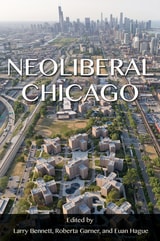
cover of Neoliberal Chicago

Neoliberal Chicago

Edited by Larry Bennett, Roberta Garner, and Euan Hague

University of Illinois Press, 2017
The neoliberal philosophy of fiscal austerity aligned with reduced regulation has transformed Chicago. As pursued by mayor Rahm Emanuel and his predecessor Richard M. Daley, neoliberalism led officials to privatize everything from parking meters to schools, gut regulations and social services, and promote gentrification wherever possible. The essayists in Neoliberal Chicago explore an essential question: how does neoliberalism work on the ground in today's Chicago? Contextual chapters explore race relations, physical development, and why Chicago embraced neoliberalism. Other contributors delve into aspects of the neoliberal vision, neoliberalism's impact on three iconic city spaces, and how events like the 2008 foreclosure crisis and the bid to attract the Olympic Games reveal the workings of neoliberalism. Contributors: Stephen Alexander, Larry Bennett, Michael Bennett, Carrie Breitbach, Sean Dinces, Kenneth Fidel, Roberta Garner, Euan Hague, Black Hawk Hancock, Christopher Lamberti, Michael J. Lorr, Martha Martinez, Brendan McQuade, Alex G. Papadopoulos, Rajiv Shah, Costas Spirou, Carolina Sternberg, and Yue Zhang.
[more]
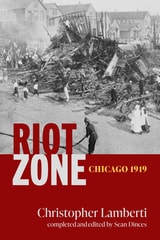
cover of Riot Zone: Chicago 1919

Riot Zone

Chicago 1919

Christopher Lamberti, completed and edited by Sean Dinces

Temple University Press, 2027

Riot Zone presents a compelling forensic microhistory of the racial violence that exploded in Chicago starting on July 27, 1919, when a Black teenager named Eugene Williams drowned in Lake Michigan after white beachgoers attacked him as he swam with friends. In the days that followed, white gang members terrorized African Americans on the city’s South Side and Black Chicagoans armed and defended themselves in response. By the end of the first week of August, when the rioting finally ended, thirty-eight Chicagoans lay dead and hundreds nursed injuries as a result of what became known as America’s “Red Summer.”

The late Christopher Lamberti, with the help of editor Sean Dinces, recounts this sobering history using GIS software to map what occurred. The authors revisit and debunk ideas about the role race and ethnicity played in the riot and its aftermath, showing how the politics of housing and racial conflicts over residential space set the stage for the riots that ensued.

With insights that echo in today’s conflicts, Riot Zone proves that there is still plenty to learn about the history of America’s ongoing struggle with urban and racial violence.
[more]
cover of Rooting for the Home Team

Rooting for the Home Team

Edited by Daniel A. Nathan

University of Illinois Press, 2013

Rooting for the Home Team examines how various American communities create and maintain a sense of collective identity through sports. Looking at large cities such as Chicago, Baltimore, and Los Angeles as well as small rural towns, suburbs, and college towns, the contributors consider the idea that rooting for local athletes and home teams often symbolizes a community's preferred understanding of itself, and that doing so is an expression of connectedness, public pride and pleasure, and personal identity.
 
Some of the wide-ranging essays point out that financial interests also play a significant role in encouraging fan bases, and modern media have made every seasonal sport into yearlong obsessions. Celebrities show up for big games, politicians throw out first pitches, and taxpayers pay plenty for new stadiums and arenas. The essays in Rooting for the Home Team cover a range of professional and amateur athletics, including teams in basketball, football, baseball, and even the phenomenon of no-glove softball.
 
Contributors are Amy Bass, Susan Cahn, Mark Dyreson, Michael Ezra, Elliott J. Gorn, Christopher Lamberti, Allison Lauterbach, Catherine M. Lewis, Shelley Lucas, Daniel A. Nathan, Michael Oriard, Carlo Rotella, Jaime Schultz, Mike Tanier, David K. Wiggins, and David W. Zang.

[more]