Results by title
6 books match the query 'Landforms'
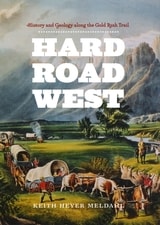
Hard Road West
History and Geology along the Gold Rush TrailKeith Heyer Meldahl
University of Chicago Press, 2007
In 1848 news of the discovery of gold in California triggered an enormous wave of emigration toward the Pacific. Lured by the promise of riches, thousands of settlers left behind the forests, rain, and fertile soil of the eastern United States in favor of the rough-hewn lands of the American West. The dramatic terrain they struggled to cross is so familiar to us now that it is hard to imagine how frightening—even godforsaken—its sheer rock faces and barren deserts seemed to our forebears.
Hard Road West brings their perspective vividly to life, weaving together the epic overland journey of the covered wagon trains and the compelling story of the landscape they encountered. Taking readers along the 2,000-mile California Trail, Keith Meldahl uses the diaries and letters of the settlers themselves—as well as the countless hours he has spent following the trail—to reveal how the geology and geography of the West directly affected our nation’s westward expansion. He guides us through a corrugated landscape of sawtooth mountains, following the meager streams that served as lifelines through an arid land, all the way to California itself, where colliding tectonic plates created breathtaking scenery and planted the gold that lured travelers west in the first place.
“Alternates seamlessly between vivid accounts of the 19th-century journey and lucid explanations of the geological events that shaped the landscape traveled. . . . The reader comes away with both an appreciation for the arduous cross-continental wagon journey and an understanding of the events that created such a vast and difficult landscape.”—Library Journal
“Alternates seamlessly between vivid accounts of the 19th-century journey and lucid explanations of the geological events that shaped the landscape traveled. . . . The reader comes away with both an appreciation for the arduous cross-continental wagon journey and an understanding of the events that created such a vast and difficult landscape.”—Library Journal
“[Meldahl] draws on his professional knowledge to explain the geology of the West, showing how centuries of geological activity had a direct effect on the routes taken by the travelers. . . . Meldahl provides a novel account of the largest overland migration since the Crusades.”—Science News
[more]
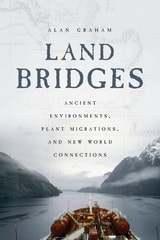
Land Bridges
Ancient Environments, Plant Migrations, and New World ConnectionsAlan Graham
University of Chicago Press, 2018
Land bridges are the causeways of biodiversity. When they form, organisms are introduced into a new patchwork of species and habitats, forever altering the ecosystems into which they flow; and when land bridges disappear or fracture, organisms are separated into reproductively isolated populations that can evolve independently. More than this, land bridges play a role in determining global climates through changes to moisture and heat transport and are also essential factors in the development of biogeographic patterns across geographically remote regions.
In this book, paleobotanist Alan Graham traces the formation and disruption of key New World land bridges and describes the biotic, climatic, and biogeographic ramifications of these land masses’ changing formations over time. Looking at five land bridges, he explores their present geographic setting and climate, modern vegetation, indigenous peoples (with special attention to their impact on past and present vegetation), and geologic history. From the great Panamanian isthmus to the boreal connections across the North Atlantic and North Pacific Oceans that allowed exchange of organisms between North America, Europe, and Asia, Graham’s sweeping, one-hundred-million-year history offers new insight into the forces that shaped the life and land of the New World.
In this book, paleobotanist Alan Graham traces the formation and disruption of key New World land bridges and describes the biotic, climatic, and biogeographic ramifications of these land masses’ changing formations over time. Looking at five land bridges, he explores their present geographic setting and climate, modern vegetation, indigenous peoples (with special attention to their impact on past and present vegetation), and geologic history. From the great Panamanian isthmus to the boreal connections across the North Atlantic and North Pacific Oceans that allowed exchange of organisms between North America, Europe, and Asia, Graham’s sweeping, one-hundred-million-year history offers new insight into the forces that shaped the life and land of the New World.
[more]

Landforms of Iowa
Jean C. Prior
University of Iowa Press, 1991
Here is a captivating, authoritative guide to the Hawkeye State's landscape features and their geologic ingredients. The clearly presented text and superb full-color photographs and maps will inspire all visitors to read and enjoy the story of Iowa's landscape.
[more]
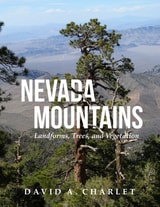
Nevada Mountains
Landforms, Trees, and VegetationDavid Alan Charlet
University of Utah Press, 2020
Nevada is one of the most mountainous states in the US. Yet mapping out exactly where one range begins and another ends has never been done—until now. In this volume David Charlet provides maps and descriptions for all 319 mountain ranges in the state.
Divided into three parts, the book presents a simple system recognizing the primary landscape features of Nevada. Part I describes the methods used to define the boundaries of the ranges and divides the state into meaningful landforms. Part II describes the ecological life zones and their vegetation types. Part III describes the individual mountain ranges. Each mountain range entry contains a descriptive narrative and a data summary that includes the county or counties in which the range occurs, whether the author has visited and collected plants there, the highest point, the base elevation, a brief discussion of the geology, any historic settlements or post offices located in the range, the distribution of life zones, and a list of all conifers and flowering trees.
The result of over thirty years of exploration and study throughout the state, this is a long-overdue compendium of Nevada’s mountains and associated flora. This book is a required reference for anyone venturing out into the Nevada wilds.
[more]
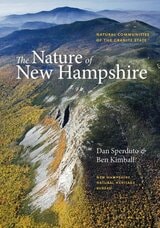
The Nature of New Hampshire
Natural Communities of the Granite StateDan Sperduto
University of New Hampshire Press, 2011
This illuminating and instructive book explores New Hampshire's stunning mosaic of natural communities. In photos, drawings, and accessible text, The Nature of New Hampshire takes you on a tour of landscapes as varied as alpine meadows, tidal marshes, riverbanks, forests, ponds, dunes, and cliffs. Readers will gain a new understanding and appreciation for the state's exceptional natural heritage. Natural communities are recurring associations of plants and animals found in particular physical environments. They are the dynamic habitats in which native species live. Based on more than twenty years of ecological research, the New Hampshire Natural Heritage Bureau developed the classification of the nearly 200 natural community types presented in this essential guide. The communities are organized into eight categories: alpine and subalpine, rocky ground, forests, peatlands, swamps, marshes, river channels and floodplains, and seacoast.
With gorgeous photographs, informative text, and recommended places to visit, The Nature of New Hampshire provides an important common language for conservation planning and informed land stewardship. Whether used as a field guide or an at-home resource, this book will help readers reconnect with their surroundings, and understand the places they value.
With gorgeous photographs, informative text, and recommended places to visit, The Nature of New Hampshire provides an important common language for conservation planning and informed land stewardship. Whether used as a field guide or an at-home resource, this book will help readers reconnect with their surroundings, and understand the places they value.
[more]
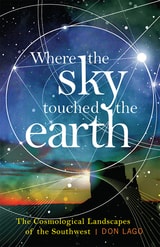
Where the Sky Touched the Earth
The Cosmological Landscapes of the SouthwestDon Lago
University of Nevada Press, 2017
The landscapes of the American Southwest—the Grand Canyon, Monument Valley, the Sedona red rocks—have long filled humans with wonder about nature. This is the home of Lowell Observatory, where astronomers first discovered evidence that the universe is expanding; Meteor Crater, where Apollo astronauts trained for the moon; and Native American tribes with their own ancient, rich ways of relating to the cosmos. With the personal, poetic style of the very best literary nature writing, Don Lago explores how these landscapes have offered humans a deeper sense of connection with the universe. While most nature writing never leaves the ground, Lago is one of the few writers who has applied it to the universe, seeking ties between humans and the astronomical forces that gave us birth.
Nowhere else in the world is the link between earth and sky so powerful. Lago witnesses a solar eclipse over the Grand Canyon, climbs primeval volcanos, and sees the universe in tree rings. Through ageless Native American ceremonies, modern telescopes, and even dreams of flying saucers, Lago, who is not only a poet but a true philosopher of science, strives to find order and meaning in the world and brings out the Southwest’s beauty and mystery.
Nowhere else in the world is the link between earth and sky so powerful. Lago witnesses a solar eclipse over the Grand Canyon, climbs primeval volcanos, and sees the universe in tree rings. Through ageless Native American ceremonies, modern telescopes, and even dreams of flying saucers, Lago, who is not only a poet but a true philosopher of science, strives to find order and meaning in the world and brings out the Southwest’s beauty and mystery.
[more]