Results by title
3 books match the query 'Language Use'

Arenas of Language Use
Herbert H. Clark
University of Chicago Press, 1993
According to Clark, in order for one person to understand another, there must be a "common ground" of knowledge between them. He shows how people infer this "common ground" from their past conversations, their immediate surroundings, and their shared cultural background. Clark also discusses the means by which speakers design their utterances for particular audiences and coordinate their use of language with other participants in a language arena. He argues that language use in conversation is a collaborative process, where speaker and listener work together to establish that the listener understands the speaker's meaning. Since people often use words to mean something quite different from the dictionary definitions of those words, Clark offers a realistic perspective on how speakers and listeners coordinate on the meanings of words.
This collection presents outstanding examples of Clark's pioneering work on the pragmatics of language use and it will interest psychologists, linguists, computer scientists, and philosophers.
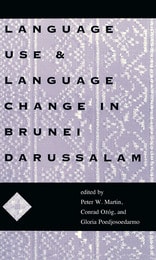
Language Use and Language Change in Brunei Darussalam
Mis Sea#100Peter W. Martin
Ohio University Press, 1996
The oil-rich sultanate of Brunei Darussalam is located on the northern coast of Borneo between the two Malaysian states of Sarawak and Sabah. Though the country is small in size and in population, the variety of language use there provides a veritable laboratory for linguists in the fields of Austronesian linguistics, bilingual studies, and sociolinguistic studies, particularly those dealing with language shift.
This useful reference is divided into three sections: one on varieties of the Malay language used in the country, one on other indigenous languages, and one on the role and form of the English used there. Contributors to the collection include Bruneian scholars as well as established experts in the fields of Austronesian linguistics, sociolinguistics studies, and the description of new varieties of English.
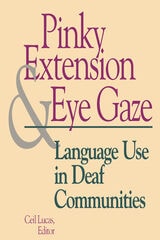
Pinky Extension and Eye Gaze
Language Use in Deaf CommunitiesCeil Lucas
Gallaudet University Press, 1998
The Sociolinguistics in Deaf Communities Series continues its detailed exploration of language dynamics among deaf people in the fourth entry, Pinky Extension and Eye Gaze: Language Use in Deaf Communities. This volume’s ten meticulously prepared chapters reflect the refinements of research in six major sociolinguistics areas. Rob Hoopes’ work, “A Preliminary Examination of Pinky Extension: Suggestions Regarding Its Occurrence, Constraints, and Function,” commences Part One: Variation with a sound explanation of this American Sign Language (ASL) phonological characteristic. Part Two: Languages in Contact includes findings by Jean Ann on contact between Taiwanese Sign Language and written Taiwanese.
Priscilla Shannon Gutierrez considers the relationship of educational policy with language and cognition in deaf children in Part Three: Language in Education, and in Part Four: Discourse Analysis, Melanie Metzger discusses eye gaze and pronominal reference in ASL. Part Five: Second-Language Learning presents the single chapter “An Acculturation Model for ASL Learners,” by Mike Kemp. Sarah E. Burns defines Irish Sign Language as Ireland’s second minority language after Gaelic, in Part Six: Language Attitudes, the final area of concentration in this rigorously researched volume. These studies and the others by the respected scholars featured in Pinky Extension and Eye Gaze make it an outstanding and eminently valuable addition to this series.