Results by title

5 books match the query 'Language and languages in literature'
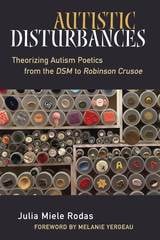
cover of Autistic Disturbances: Theorizing Autism Poetics from the DSM to Robinson Crusoe

Autistic Disturbances

Theorizing Autism Poetics from the DSM to Robinson Crusoe

Julia Miele Rodas

University of Michigan Press, 2018
While research on autism has sometimes focused on special talents or abilities, autism is typically characterized as impoverished or defective when it comes to language. Autistic Disturbances reveals the ways interpreters have failed to register the real creative valence of autistic language and offers a theoretical framework for understanding the distinctive aesthetics of autistic rhetoric and semiotics. Reinterpreting characteristic autistic verbal practices such as repetition in the context of a more widely respected literary canon, Julia Miele Rodas argues that autistic language is actually an essential part of mainstream literary aesthetics, visible in poetry by Walt Whitman and Gertrude Stein, in novels by Charlotte Brontë and Daniel Defoe, in life writing by Andy Warhol, and even in writing by figures from popular culture. Autistic Disturbances pursues these resonances and explores the tensions of language and culture that lead to the classification of some verbal expression as disordered while other, similar expression enjoys prized status as literature. It identifies the most characteristic patterns of autistic expression-repetition, monologue, ejaculation, verbal ordering or list-making, and neologism-and adopts new language to describe and reimagine these categories in aesthetically productive terms. In so doing, the book seeks to redress the place of verbal autistic language, to argue for the value and complexity of autistic ways of speaking, and to invite recognition of an obscured tradition of literary autism at the very center of Anglo-American text culture.
[more]
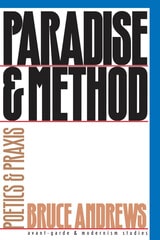
cover of Paradise and Method: Poetry and Praxis

Paradise and Method

Poetry and Praxis

Bruce Andrews

Northwestern University Press, 1996

Paradise & Method: Poetics and Praxis collects nearly two decades of work on poetics by one of the pioneers of the "language poetry" movement.

Addressing poetics from a poet's perspective, Andrews focuses on the ways in which meaning is produced and challenged. His essays aim "to map out opportunities for making sense (or making noise)--both in reading and writing contemporary literature. At the center has been a desire to explore language, as up close as possible, as a material and social medium for restagings of meaning and power." Andrews analyzes poetics and the production of meaning; alternative traditions and canons; and innovative contemporary poetry, particularly its break with many of the premises and constraints of even the most forward-looking modernisms.
[more]
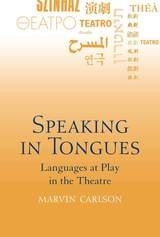
cover of Speaking in Tongues: Languages at Play in the Theatre

Speaking in Tongues

Languages at Play in the Theatre

Marvin Carlson

University of Michigan Press, 2010

Speaking in Tongues presents a unique account of how language has been employed in the theatre, not simply as a means of communication but also as a stylistic and formal device, and for a number of cultural and political operations. The use of multiple languages in the contemporary theatre is in part a reflection of a more globalized culture, but it also calls attention to how the mixing of language has always been an important part of the functioning of theatre.

The book begins by investigating various "levels" of language-high and low style, prose and poetry-and the ways in which these have been used historically to mark social positions and relationships. It next considers some of the political and historical implications of dialogue theatre, as well as theatre that literally employs several languages, from classical Greek examples to the postmodern era. Carlson treats with special attention the theatre of the postcolonial world, and especially the triangulation of the local language, the national language, and the colonial language, drawing on examples of theatre in the Caribbean, Africa, Australia, and New Zealand. Finally, Carlson considers the layering of languages in the theatre, such as the use of supertitles or simultaneous signing.

Speaking in Tongues draws important social and political conclusions about the role of language in cultural power, making a vital contribution to the fields of theatre and performance.

Marvin Carlson is Sidney E. Cohn Professor of Theatre and Comparative Literature, CUNY Graduate Center. He is author of Performance: A Critical Introduction; Theories of the Theatre: A Historical and Critical Survey, from the Greeks to the Present; and The Haunted Stage: The Theatre as Memory Machine, among many other books.
[more]
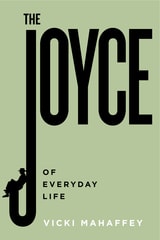
cover of The Joyce of Everyday Life

The Joyce of Everyday Life

Vicki Mahaffey

Bucknell University Press, 2024

Winner of the American Conference on Irish Studies’ Robert Rhodes Prize for Books on Literature

Part of James Joyce’s genius was his ability to find the poetry in everyday life. For Joyce, even a simple object like a table becomes magical, “a board that was of the birchwood of Finlandy and it was upheld by four dwarfmen of that country but they durst not move more for enchantment.” How might we learn to regain some of the childlike play with language and sense of delight in the ordinary that come so naturally to Joyce?   
 
The Joyce of Everyday Life teaches us how to interpret seemingly mundane objects and encounters with openness and active curiosity in order to attain greater self-understanding and a fuller appreciation of others. Through a close examination of Joyce's joyous, musical prose, this book shows how language provides us with the means to revitalize daily experience and social interactions across a huge, diverse, and everchanging world.
 
Acclaimed Joyce scholar Vicki Mahaffey demonstrates how his writing might prompt us to engage in a different kind of reading, treating words and fiction as tools for expanding the boundaries of the self with humor and feeling. A book for everyone who loves language, The Joyce of Everyday Life is a lyrical romp through quotidian existence.
 

[more]
cover of The Rose and Geryon

The Rose and Geryon

Gabriella I. Baika

Catholic University of America Press, 2014

The Rose and Geryon examines patterns of verbal behavior in works by Jean de Meun and Dante (with a focus on the Romance of the Rose and the Divine Comedy) in relationship with the most influential systems of verbal sins in the Middle Ages, systems elaborated by William Peraldus, Thomas Aquinas, Domenico Cavalca, and Laurent of Orléans. The book begins with a presentation of these four systems, and from there proceeds to analyze Jean de Meun's Testament as a possible source of influence for the Divine Comedy and take a closer look at Dante's prose works in search for a comprehensive theory of sinful speech. Furthermore Baika discusses verbal transgressions such as flattery, evil counsel, double talk, sowing of discord, and falsifying of words, under the heading Lingua dolosa "The Guileful Tongue," and the relationship between violence and the poetic discourse. The myriad ways in which the two iconic poets of medieval France and Italy absorb the tradition of peccata linguae in their works prove that abusive speech was not the exclusive sphere of interest of the ecclesiastical writers; secular poetry in the vernacular enriched in original ways the medieval debate on verbal vices. The Rose and Geryon addresses scholars and students of French and Italian literatures, as well as readers interested in ethics and women's studies.
[more]