Results by title

10 books match the query 'Languages in contact'

cover of An Other Tongue: Nation and Ethnicity in the Linguistic Borderlands

An Other Tongue

Nation and Ethnicity in the Linguistic Borderlands

Alfred Arteaga

Duke University Press, 1994

As our millennium draws to a close, we find ourselves in the midst of great and rapid global changes with nations and political systems dissolving all around us and the world becoming one of shifting identities--of peoples unified and divided by such distinctions as nationality, ethnicity, race, religion, and colonial status. The articulation and construction of these distinctions, the very language of difference, is the subject of An Other Tongue. This collection of essays by a group of distinguished scholars, including Norma Alarcón, Gayatri Spivak, Tzvetan Todorov, and Gerald Vizenor, explores the interconnections between language and identity.
The Chicanos, the U.S./Mexico borderland polyglots whose sense of history, nationality, and race is as mixed as their language, are the book's prime example. But the authors recognize that border zones, like diasporas and post-colonial relations, occur globally, and their discussion of hybrid or mestizo identities ranges from the United States to the Caribbean to South Asia to Ireland. Drawing on personal experience, readings of poetry and fiction, and cultural theory, the authors detail the politics of being human through the mediation of language. What does "shadow" mean to the Native American Indian, or diaspora to the East Indian immigrant? How does British colonialism yet affect Irish and Indian nationalist literary production? Why is the split between Eastern and Western European language use necessarily schizophrenic? So much of our sense of difference today is constructed as we speak, and An Other Tongue speaks with eloquence to this phenomenon and will be of great interest to those concerned with the discourse of post-colonial studies, critical theory, and the remapping of world literature.

Contributors. Norma Alarcón, Alfred Arteaga, Juan Bruce-Novoa, Cordelia Chávez Candelaria, Michael G. Cooke, Edmundo Desnoes, Eugene C. Eoyang, David Lloyd, Lydie Moudileno, Jean-Luc Nancy, Tejaswini Niranjana, Ada Savin, Gayatri Chakravorty Spivak, Michael Smith, Tzvetan Todorov, Luis A. Torres, Gerald Vizenor

[more]
cover of Contact, Structure, and Change: A Festschrift in Honor of Sarah G. Thomason

Contact, Structure, and Change

A Festschrift in Honor of Sarah G. Thomason

Edited by Anna M. Babel and Mark A. Sicoli

Michigan Publishing Services, 2021
Contact, Structure, and Change addresses the classic problem of how and why languages change over time through the lens of two uniquely productive and challenging perspectives: the study of language contact and the study of Indigenous American languages. Each chapter in the volume draws from a distinct theoretical positioning, ranging from documentation and description, to theoretical syntax, to creole languages and sociolinguistics. This volume acts as a Festschrift honoring Sarah G. Thomason, a long-time professor at the University of Michigan, whose career spans the disciplines of historical linguistics, contact linguistics, and Native American studies. This conversation among distinguished scholars who have been influenced by Thomason extends and in some cases refracts the questions her work addresses through a collection of studies that speak to the enduring puzzles of language change.
[more]
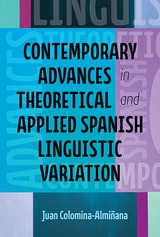
cover of Contemporary Advances in Theoretical and Applied Spanish Linguistic Variation

Contemporary Advances in Theoretical and Applied Spanish Linguistic Variation

Juan J. Colomina-Almiñana

The Ohio State University Press, 2017

Contemporary Advances in Theoretical and Applied Spanish Linguistic Variation by Juan J. Colomina-Almiñana, reframes the understanding of language variation and change as an intimate interplay between both linguistic features and social factors always occurring in unison in the same historical process. Its ten chapters, divided into four parts, provide both a synchronic and a diachronic view of Hispanic sociolinguistics, focusing not only on the historical development of Spanish as a Romance language, but also analyzing certain idiosyncratic elements of non-standard Spanish varieties across multiple regions, nations, and diasporas. In addition, the volume offers an enchronic perspective of this phenomenon by analyzing how certain sustained cultural practices may drive concrete linguistic developments.
 
This volume makes three major contributions to Hispanic sociolinguistics. First, it covers variation in less commonly studied varieties, which are new areas of interest in a broader world where certain minorities and their languages are crucial. Second, it offers recent and innovative approaches to variation coming from formal theories in order to spark a debate about methodology that is more comprehensive of the diverse approaches to variation currently practiced in the field. Finally, it includes chapters that combine quantitative and qualitative analysis of different linguistic variables.
 
[more]
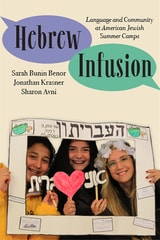
cover of Hebrew Infusion: Language and Community at American Jewish Summer Camps

Hebrew Infusion

Language and Community at American Jewish Summer Camps

Sarah Bunin Benor, Jonathan B. Krasner, and Sharon Avni

Rutgers University Press, 2019

Winner of the 2020 National Jewish Book Award in Education and Jewish Identity

Each summer, tens of thousands of American Jews attend residential camps, where they may see Hebrew signs, sing and dance to Hebrew songs, and hear a camp-specific hybrid language register called Camp Hebraized English, as in: “Let’s hear some ruach (spirit) in this chadar ochel (dining hall)!” Using historical and sociolinguistic methods, this book explains how camp directors and staff came to infuse Hebrew in creative ways and how their rationales and practices have evolved from the early 20th century to today.  Some Jewish leaders worry that Camp Hebraized English impedes Hebrew acquisition, while others recognize its power to strengthen campers’ bonds with Israel, Judaism, and the Jewish people. Hebrew Infusion explores these conflicting ideologies, showing how hybrid language can serve a formative role in fostering religious, diasporic communities. The insightful analysis and engaging descriptions of camp life will appeal to anyone interested in language, education, or American Jewish culture.
[more]
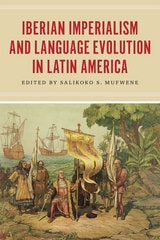
cover of Iberian Imperialism and Language Evolution in Latin America

Iberian Imperialism and Language Evolution in Latin America

Edited by Salikoko S. Mufwene

University of Chicago Press, 2014

As rich as the development of the Spanish and Portuguese languages has been in Latin America, no single book has attempted to chart their complex history. Gathering essays by sociohistorical linguists working across the region, Salikoko S. Mufwene does just that in this book. Exploring the many different contact points between Iberian colonialism and indigenous cultures, the contributors identify the crucial parameters of language evolution that have led to today’s state of linguistic diversity in Latin America.
           
The essays approach language development through an ecological lens, exploring the effects of politics, economics, cultural contact, and natural resources on the indigenization of Spanish and Portuguese in a variety of local settings. They show how languages adapt to new environments, peoples, and practices, and the ramifications of this for the spread of colonial languages, the loss or survival of indigenous ones, and the way hybrid vernaculars get situated in larger political and cultural forces. The result is a sophisticated look at language as a natural phenomenon, one that meets a host of influences with remarkable plasticity.  
[more]
cover of Language Use and Language Change in Brunei Darussalam: Mis Sea#100

Language Use and Language Change in Brunei Darussalam

Mis Sea#100

Peter W. Martin

Ohio University Press, 1996

The oil-rich sultanate of Brunei Darussalam is located on the northern coast of Borneo between the two Malaysian states of Sarawak and Sabah. Though the country is small in size and in population, the variety of language use there provides a veritable laboratory for linguists in the fields of Austronesian linguistics, bilingual studies, and sociolinguistic studies, particularly those dealing with language shift.

This useful reference is divided into three sections: one on varieties of the Malay language used in the country, one on other indigenous languages, and one on the role and form of the English used there. Contributors to the collection include Bruneian scholars as well as established experts in the fields of Austronesian linguistics, sociolinguistics studies, and the description of new varieties of English.
[more]
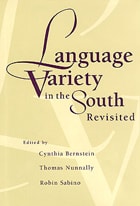
cover of Language Variety in the South Revisited

Language Variety in the South Revisited

Cynthia Bernstein

University of Alabama Press, 1994

Top linguists from diverse fields address language varieties in the South.
 
Language Variety in the South Revisited is a comprehensive collection of new research on southern United States English by foremost scholars of regional language variation. Like its predecessor, Language Variety in the South: Perspectives in Black and White (The University of Alabama Press, 1986), this book includes current research into African American vernacular English, but it greatly expands the scope of investigation and offers an extensive assessment of the field. The volume encompasses studies of contact involving African and European languages; analysis of discourse, pragmatic, lexical, phonological, and syntactic features; and evaluations of methods of collecting and examining data. The 38 essays not only offer a wealth of information about southern language varieties but also serve as models for regional linguistic investigation.
[more]
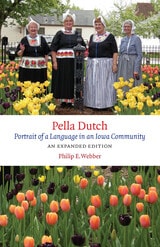
cover of Pella Dutch: Portrait of a Language in an Iowa Community, An Expanded Edition

Pella Dutch

Portrait of a Language in an Iowa Community, An Expanded Edition

Philip E. Webber

University of Iowa Press, 1988

Founded in 1847 by religious separatists, the town of Pella in central Iowa is the state’s oldest Dutch American colony, and its crafts, architecture, and celebrations reflect and perpetuate the Dutch heritage of its earlier residents. Through his intriguing blend of sociolinguistic research, regional history, and interviews with current speakers of Pella Dutch, Philip Webber examines the town’s rich cultural and linguistic traditions.
 
Drawing upon formal and informal interviews and conversations with more than 150 speakers of Pella Dutch, Webber uses the methods of language research to trace the vestiges of Dutch heritage left on the English spoken by local residents; to explain attitudes toward language and ethnicity that emerged in the twentieth century; and to document the vocabulary, linguistic forms, humor, and conversational patterns that characterize contemporary Pella Dutch. In addition, desiring to let his informants speak for themselves, he includes the playful jokes, proverbial observations, folk wisdom, children’s rhymes, riddles, and puzzles influenced by Pella Dutch.
 
Webber’s introduction to this expanded paperback edition provides new photographs, updated information about recent research and publications, examples of how Dutch continues to be spoken, and descriptions of the ways in which Pella continues to commemorate its linguistic and cultural heritage. Linguists, anthropologists, and historians—as well as all those who enjoy Pella’s Tulip Time festival, its summertime fair or kermis, the Dutch letters in its bakeries, and the early winter visit of Sinterklaas—will appreciate Webber’s informed and engaging study of this unique Iowa community.
[more]
cover of The Alchemy of English: The Spread, Functions, and Models of Non-native Englishes

The Alchemy of English

The Spread, Functions, and Models of Non-native Englishes

Braj Kachru

University of Illinois Press, 1990

       "What emerges from Kachru's fine work is the potential demarcation
        of an entire field, rather than merely the fruitful exploration of a topic.
        . . . [Kachru] is to be congratulated for having taken us as far as he
        already has and for doing so in so stimulating and so productive a fashion."
        -- World Englishes
      "A potent addition to theoretical, sociolinguistic, attitudinal
        and methodological explorations vis-à-vis the spread and functions
        of, and innovations in, English from the viewpoint of a non-Western scholar."
        -- The Language Teacher
      
      Winner of the Joint First Prize, Duke of Edinburgh English Language
        Book Competition of the English-Speaking Union of the Commonwealth, 1987
     
 
[more]
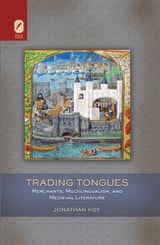
cover of Trading Tongues: Merchants, Multilingualism, and Medieval Literature

Trading Tongues

Merchants, Multilingualism, and Medieval Literature

Jonathan Hsy

The Ohio State University Press, 2013

Trading Tongues offers fresh approaches to the multilingualism of major early English authors like Geoffrey Chaucer, John Gower, Margery Kempe, and William Caxton, and lesser-known figures like French lyricist Charles d’Orléans. Juxtaposing literary works with contemporaneous Latin and French civic records, mixed-language merchant miscellanies, and bilingual phrasebooks, Jonathan Hsy illustrates how languages commingled in late medieval and early modern cities. Chaucer, a customs official for the Port of London, infused English poetry with French and Latin merchant jargon, and London merchants incorporated Latin and vernacular verse forms into trilingual account books.
 
Hsy examines how writers working in English, Latin, and French (and combinations thereof) theorized the rich contours of polyglot identity. In a range of genres—from multilingual lyrics, poems about urban life, and autobiographical narratives—writers found venues to consider their own linguistic capacities and to develop new modes of conceiving language contact and exchange. Interweaving close readings of medieval texts with insights from sociolinguistics and postcolonial theory, Trading Tongues not only illuminates how multilingual identities were expressed in the past; it generates new ways of thinking about cultural contact and language crossings in our own time.
[more]