Results by title
8 books match the query 'Last'
Changing Unjust Laws Justly
Pro-Life Solidarity with "The Last and Least"Colin Harte
Catholic University of America Press, 2005
The Last of 'The Waltz Across Texas' and Other Stories
Jo Carson
Ohio University Press, 1993
Published in 1993 by Gnomon Press
The Last of 'The Waltz Across Texas' and Other Stories marks Jo Carson’s debut fiction collection. Across its pages, her keen imagination and sharp humor bring to life well-drawn characters navigating family, friends, and community.
The Last of His Mind, Second Edition
A Year in the Shadow of Alzheimer’sJohn Thorndike
Ohio University Press, 2021
The Last of His Mind
A Year in the Shadow of Alzheimer’sJohn Thorndike
Ohio University Press, 2011

The Last of the Great Observatories
Spitzer and the Era of Faster, Better, Cheaper at NASAGeorge H. Rieke
University of Arizona Press, 2006
George Rieke played a key role in Spitzer and now relates the story of how that observatory was built and launched into space. Telling the story of this single mission within the context of NASA space science over two turbulent decades, he describes how, after a tortuous political trail to approval, Spitzer was started at the peak of NASA’s experiment with streamlining and downsizing its mission development process, termed “faster better cheaper.” Up to its official start and even afterward, Spitzer was significant not merely in terms of its scientific value but because it stood at the center of major changes in space science policy and politics. Through interviews with many of the project participants, Rieke reconstructs the political and managerial process by which space missions are conceived, approved, and developed. He reveals that by the time Spitzer had been completed, a number of mission failures had undermined faith in “faster-better-cheaper” and a more conservative approach was imposed. Rieke examines in detail the premises behind “faster better cheaper,” their strengths and weaknesses, and their ultimate impact within the context of NASA’s continuing search for the best way to build future missions.
Rieke’s participant’s perspective takes readers inside Congress and NASA to trace the progress of missions prior to the excitement of the launch, revealing the enormously complex and often disheartening political process that needs to be negotiated. He also shares some of the new observations and discoveries made by Spitzer in just its first year of operation. As the only book devoted to the Spitzer mission, The Last of the Great Observatories is a story at the nexus of politics and science, shedding new light on both spheres as it contemplates the future of mankind’s exploration of the universe.
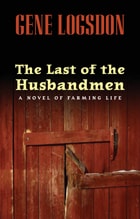
The Last of the Husbandmen
A Novel of Farming LifeGene Logsdon
Ohio University Press, 2008
“Nan turned to see Ben’s face turn as hard and white as a sauerkraut crock. When he did not respond, Nan figured that he was just going to back off as he usually did, the shy and retiring husbandman. She did not know her history. She did not know that shy and retiring husbandmen have been known to revolt against oppression with pitchforks drawn.”
—The Last of the Husbandmen
In The Last of the Husbandmen, Gene Logsdon looks to his own roots in Ohio farming life to depict the personal triumphs and tragedies, clashes and compromises, and abiding human character of American farming families and communities. From the Great Depression, when farmers tilled the fields with plow horses, to the corporate farms and government subsidy programs of the present, this novel presents the complex transformation of a livelihood and of a way of life.
Two friends, one rich by local standards, and the other of more modest means, grow to manhood in a lifelong contest of will and character. In response to many of the same circumstances—war, love, moonshining, the Klan, weather, the economy—their different approaches and solutions to dealing with their situations put them at odds with each other, but we are left with a deeper understanding of the world that they have inherited and have chosen.
Part morality play and part personal recollection, The Last of the Husbandmen is both a lighthearted look at the past and a profound statement about the present state of farming life. It is also a novel that captures the spirit of those who have chosen to work the land they love.
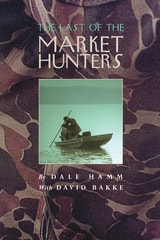
The Last of the Market Hunters
Dale Hamm with David Bakke
Southern Illinois University Press, 1996
Duck hunting has changed greatly since the days of unlimited duck kills, as the limit of fifty ducks a day established in 1902 has fallen to the present three. A legitimate hunter now, Dale Hamm learned the art of market hunting—taking waterfowl out of season and selling them to restaurants—from his father during the l920s. During the l930s and l940s, he kept his family alive by market hunting. At the peak of his career, Hamm poached every private hunting club along the Illinois River from Havana to Beardstown.
After market hunting died out, Hamm became a legendary and almost respected—albeit controversial—character on the Illinois backwaters. He was eventually invited to hunt on the same clubs from which he had once been chased at the point of a shotgun. He hunted with judges, sheriffs, and the head of undercover operations for the Illinois Department of Conservation, all of whom knew of his reputation. He passed on to these hunting partners a lifetime of outdoor knowledge gained from slogging through mud, falling through ice, hunting ducks at three o’clock in the morning, dodging game wardens, and running the world’s only floating tavern.
"I always said if anyone ever cut open one of us Hamms, all they’d find was duck or fish," Hamm once said of his family. Now in his eighties, Hamm still carries a pellet from a shotgun in his chin to remind him of a shotgun blast that ricocheted off the water and into his face. Bakke notes that it is appropriate that a man who spent his life with a shotgun in his hands should carry a bit of buckshot wherever he goes.
Everyone who ever met Dale Hamm has a story about him. His own story is that of a one-of-a-kind character who, in his later years, used his considerable outdoor savvy to conserve the natural resources he once savaged. "His time and kind are gone," Bakke notes, "and there will never be another like him."
This book will be of interest to anyone who has ever been hunting—or who enjoys reading about colorful people and times that exist no more.
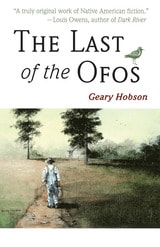
The Last of the Ofos
Geary Hobson
University of Arizona Press, 2000
In this subtle but inventive novel, presented as Thomas's memoirs, Geary Hobson offers us a glimpse into a life filled with simple joys and sorrows. In relating his Louisiana childhood, Thomas recalls not just school-learning but being taught Indian ways by the small Ofo community. He tells of his life as a roustabout in the oil fields, of his courtship of the rambunctious Sally Fachette, and of his career as a bootlegger, which landed him in prison. We share Thomas's wartime stint with the Marines—where "for the first time in my life I was treated like a equal"—and his life as a farm laborer and a Hollywood extra portraying warbonneted Cheyennes. Then in his later years, when he truly has become the last of his kind, we find Thomas recruited by an anthropologist from the Smithsonian Institution to preserve his people's culture. In Washington, he is exposed to the vagaries of Indian policy and the emerging Native American movement.
Throughout Thomas's story, readers are introduced to a wide-ranging cast of characters, from the outlaws Bonnie and Clyde to a fellow Marine who is wary of Indians, to an uppity anthropologist who doesn't consider Thomas "expert" enough to handle an Ofo flute. Always poor in material wealth but rich in heritage, Thomas Darko is a Native American Everyman whose identity is shaped by family and homeland. His "autobiography" paints a realistic portrait of an Indian confronting the obstacles in his life and the dilemmas of his age as his story reveals the painful legacy of being the last of one's kind.