Results by title

6 books match the query 'Late Middle Ages'

cover of Between Church and State: The Lives of Four French Prelates in the Late Middle Ages

Between Church and State

The Lives of Four French Prelates in the Late Middle Ages

Bernard Guenée

University of Chicago Press, 1990

For the past several decades, French historians have emphasized the writing of history in terms of structures, cultures, and mentalities, an approach exemplified by proponents of the Annales school. With this volume, Bernard Guenée, himself associated with the Annalistes, marks a decisive break with this dominant mode of French historiography. Still recognizing the Annalistes' indispensable contribution, Guenée turns to the genre of biography as a way to attend more closely to chance, to individual events and personalities, and to a sense of time as people actually experienced it. His erudite, lively, elegantly written study links in sequence the lives of four French bishops, illuminating medieval and early modern history through their writings.

Guenée chooses as his frame the momentous period from the height of Saint Louis's reign in the mid-thirteenth century to the beginning of the Italian wars two hundred years later. During this time of schism in the church, of war between nascent states, and of treachery among princes, Bernard Gui (1261-1331), Gilles Le Muisit (1272-1353), Pierre D'Ailly (1351-1420), and Thomas Basin (1412-1490) all rose from modest circumstances to the dignity of office. Guenée shows us how these prelates used their talent, ambition, patrons, zeal, and experience to juggle the competing demands of obedience to church and state; to overcome competition from an upcoming new generation; and to cope with plague, war, and violence. Free of jargon yet steeped in learning, Between Church and State reveals the career patterns and politics of an era while forging a new model for points of departure in historical scholarship.
[more]
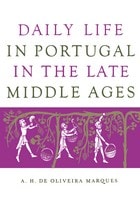
cover of Daily Life in Portugal in the Late Middle Ages

Daily Life in Portugal in the Late Middle Ages

A.H. de Oliviera Marques; Translated by S.S. Wyatt

University of Wisconsin Press, 1971
Past studies of medieval Portugal have focused on such specific themes as political or administrative history and voyages of discovery. Oliveira Marques, however, has captured the vast spectrum of Portuguese daily life from the twelfth through the fifteenth centuries The whole of medieval society is depicted, both on a national scale and, more important, society as it affected the individual in his everyday activities. Oliveira Marques gives us an engaging and original social history which examines customary meals, dress, homes, work, spiritual life, even ideas about courtship and love. Medieval Portuguese culture and education, amusements and funeral customs are all a part of this portrait.
[more]
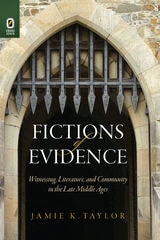
cover of Fictions of Evidence: Witnessing, Literature, and Community in the Late Middle Ages

Fictions of Evidence

Witnessing, Literature, and Community in the Late Middle Ages

Jamie K. Taylor

The Ohio State University Press, 2013
Throughout the Middle Ages, witnessing was a crucial way religious and legal “truths” were understood and produced. Religious and secular officials alike harnessed the power of testimony to assert doctrinal, political, or legal responsibilities. Swearing an oath, testifying in court, and signing a deposition were common ways to shape and discipline both devotional and legal communities. In Fictions of Evidence: Witnessing, Literature, and Community in the Late Middle Ages, Jamie K. Taylor traces depictions of witnessing in a wide range of late medieval texts and shows how witnessing practices formed and reformed, policed and challenged medieval communities.
 
Through close study of texts like the Man of Law’s Tale and Piers Plowman alongside sermon exempla, common law statutes, and pastoral treatises, Fictions of Evidence argues that vernacular literature was a vital site of criticism and dissent. It shows that devotional and legal witnessing practices offered medieval writers a distinct vocabulary they could use to expose how the ethical and legal obligations to one’s community were constructed. And since vernacular writers often challenged the ways ecclesiastical or secular authorities asserted community bonds, they found they could use those same witnessing practices and language to imagine extra-legal or extra-ecclesiastical communities that followed different ethical codes.
[more]
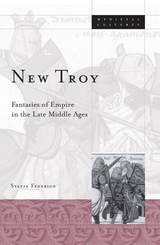
cover of New Troy: Fantasies Of Empire In The Late Middle Ages

New Troy

Fantasies Of Empire In The Late Middle Ages

Sylvia Federico

University of Minnesota Press, 2003

Examines the political and literary uses of the Trojan legend in the medieval period

England in the late fourteenth century witnessed a large-scale social revolt, a lingering and seemingly hopeless war with France, and fierce factional conflicts in royal politics and London civic government—struggles in which all parties sought to justify their actions by claiming historical precedent. How the Trojan legend figured in these claims—and in competing assertions of authorial legitimacy, nationhood, and rule in the later Middle Ages—is the complex nexus of history, myth, literature, and identity that Sylvia Federico explores in this ambitious book.

During the late medieval period, many European political and social groups took great pains to associate themselves with the ancient city; the claim on Troy, Federico asserts, was crucial to nationhood and was always a political act. Her book examines the poetry and prose of several late medieval authors, focusing particularly on how Chaucer’s use of the Trojan legend helped to set the terms by which the Ricardian and Lancastrian periods were distinguished, and further helped to establish English literary history as a noble precedent in its own right. Federico’s book affords remarkable insight into the workings of the medieval historical imagination.
[more]
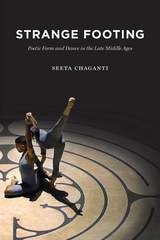
cover of Strange Footing: Poetic Form and Dance in the Late Middle Ages

Strange Footing

Poetic Form and Dance in the Late Middle Ages

Seeta Chaganti

University of Chicago Press, 2018

For premodern audiences, poetic form did not exist solely as meter, stanzas, or rhyme scheme. Rather, the form of a poem emerged as an experience, one generated when an audience immersed in a culture of dance encountered a poetic text.

Exploring the complex relationship between medieval dance and medieval poetry, Strange Footing argues that the intersection of texts and dance produced an experience of poetic form based in disorientation, asymmetry, and even misstep. Medieval dance guided audiences to approach poetry not in terms of the body’s regular marking of time and space, but rather in the irregular and surprising forces of virtual motion around, ahead of, and behind the dancing body. Reading medieval poems through artworks, paintings, and sculptures depicting dance, Seeta Chaganti illuminates texts that have long eluded our full understanding, inviting us to inhabit their strange footings askew of conventional space and time.

Strange Footing deploys the motion of dance to change how we read medieval poetry, generating a new theory of poetic form for medieval studies and beyond.
[more]
cover of The Theater of Devotion: East Anglian Drama and Society in the Late Middle Ages

The Theater of Devotion

East Anglian Drama and Society in the Late Middle Ages

Gail McMurray Gibson

University of Chicago Press, 1989

In this interdisciplinary study of drama, arts, and spirituality, Gail Gibson provides a provocative reappraisal of fifteenth-century English theater through a detailed portrait of the flourishing cultures of Suffolk and Norfolk. By emphasizing the importance of the Incarnation of Christ as a model and justification for late medieval drama and art, Gibson challenges currently held views of the secularization of late medieval culture.
[more]