75 books match the query 'Latin' and 15 start with a
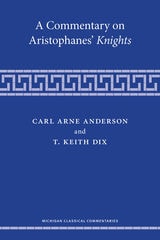
cover of A Commentary on Aristophanes' Knights

A Commentary on Aristophanes' Knights

Carl Arne Anderson and T. Keith Dix

University of Michigan Press, 2020

A Commentary on Aristophanes’ Knights presents a fresh look at the play that cemented Aristophanes’ reputation as a rising star in comic theater. Knights offers an examination of social and political life in ancient Athens during the empire-destroying Peloponnesian War, as well as giving us Aristophanes’ comic send-up of the dangerous populist demagogue Cleon. This is a thoroughly modern commentary on a key play in the theatrical genre of Old Comedy, which satirized virtually every aspect of Athenian life in a period when Athens was at the height of its power and international prestige.

In addition to the complete Greek text and commentary, this volume includes a substantial introduction to the playwright’s career and to the historical and political background of the play. It includes advice for students on grammar and syntax, meter, festivals and staging, as well as topical and literary references and allusions that will help guide students to a mature appreciation of the comedy’s humor, seriousness, and artistic quality. Priced and sized for classroom use, this is the first full commentary on Knights since 1901 and will be widely welcomed.
[more]
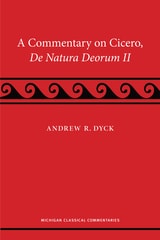
cover of A Commentary on Cicero, De Natura Deorum II

A Commentary on Cicero, De Natura Deorum II

Andrew R. Dyck

University of Michigan Press, 2025
Distinguished Latinist Andrew R. Dyck presents the first English commentary on Cicero’s De Natura Deorum II in over fifty years. This text is the only connected exposition of Stoic theology to survive from the ancient world. It includes an argument for the existence of the gods from the construction of the cosmos taken up by later thinkers, as well as an exposition of the world-order and divine providence according to Stoic doctrine. After a period in which Cicero’s philosophical works were treated mainly as sources for reconstructing the thought of earlier philosophers, they are now coming to be appreciated as intelligent and skillful works in their own right. This book will assist students and others studying Cicero’s De Natura Deorum II by providing its historical context, improved Latin text, and a detailed commentary with references to the latest literature on the subject.
[more]
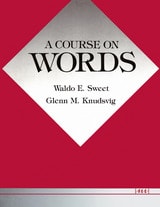
cover of A Course on Words

A Course on Words

Waldo E. Sweet and Glenn M. Knudsvig

University of Michigan Press, 1989

A great many students enter an etymology course with only one goal -- to learn new words with the hope that they will be more successful in classwork, in standardized exams, or in a variety of work-related situations. In A Course on Words students will indeed learn new words, but, more important, they will gain an understanding of how words are built and how they can use this information to analyze new words that they will encounter outside the classroom. They will spend most of the time learning elements of words that will enable them to determine the meanings of many new words in the future. As one student put it, this book seems to "sensitize us to words and get us to think about words."

The book is unusual in that it offers both programmed and nonprogrammed material. Each type of material is designed to provide students with the maximum amount of involvement and practice. The students do not simply read definitions of words, as is the case with some courses. Rather, they engage in many different activities; not only defining words but analyzing and build­ing them, and learning to use context to derive meaning. The programmed approach enables students to do the work on their own and receive immediate checks of their answers. Classroom time, therefore, is free for review, reinforcement of programmed activities, work on the non­programmed material, and attention to the needs of individual students. The book also includes at the end a set of Supplementary Exercises for each unit. The nonprogrammed materials include "Review Exercises," "Words of Interesting Origin," "Easily Confused Words," and "Latin Phrases." These provide practice in concepts learned in the unit and an opportunity to explore a wide variety of topics, such as eponymous words and the literal meanings of Latin expressions used in English.
[more]
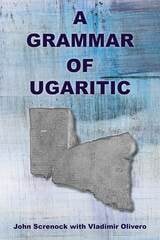
cover of A Grammar of Ugaritic

A Grammar of Ugaritic

John Screnock

SBL Press, 2022
A Grammar of Ugaritic is an accessible yet academically rigorous textbook for first-year students of Ugaritic. Eight digestible lessons include more than 150 exercises to strengthen readers’ understanding through translation and composition of not only vocalized Ugaritic but also transcribed texts and cuneiform script—strategies that develop language skills and provide a sound basis for classroom teaching. Short stories interspersed among the lessons help students consolidate their knowledge and bolster recognition of forms. An introduction to the language and its historical context, glossaries, paradigms, and a bibliography and guide for further learning supplement the lessons. Students who work through the grammar in the classroom or individually will be rewarded with the ability to read real Ugaritic texts in cuneiform.
[more]
cover of A Greek-English Lexicon of the New Testament and Other Early Christian Literature

A Greek-English Lexicon of the New Testament and Other Early Christian Literature

Walter Bauer

University of Chicago Press, 2000

Described as an "invaluable reference work" (Classical Philology) and "a tool indispensable for the study of early Christian literature" (Religious Studies Review) in its previous edition, this new updated American edition of Walter Bauer's Wörterbuch zu den Schriften des Neuen Testaments builds on its predecessor's staggering deposit of extraordinary erudition relating to Greek literature from all periods. Including entries for many more words, the new edition also lists more than 25,000 additional references to classical, intertestamental, Early Christian, and modern literature.

In this edition, Frederick W. Danker's broad knowledge of Greco-Roman literature, as well as papyri and epigraphs, provides a more panoramic view of the world of Jesus and the New Testament. Danker has also introduced a more consistent mode of reference citation, and has provided a composite list of abbreviations to facilitate easy access to this wealth of information.

Perhaps the single most important lexical innovation of Danker's edition is its inclusion of extended definitions for Greek terms. For instance, a key meaning of "episkopos" was defined in the second American edition as overseer; Danker defines it as "one who has the responsibility of safeguarding or seeing to it that something is done in the correct way, guardian." Such extended definitions give a fuller sense of the word in question, which will help avoid both anachronisms and confusion among users of the lexicon who may not be native speakers of English.

Danker's edition of Bauer's Wörterbuch will be an indispensable guide for Biblical and classical scholars, ministers, seminarians, and translators.
[more]
cover of A Latin Reader for Colleges

A Latin Reader for Colleges

H. L. Levy

University of Chicago Press, 1989
Selections from Aulus Gellius' Attic Nights, The Lives of Nepos, Phaedrus' Fables in verse, and some Caesar are carefully aimed to interest and challenge, but not overtax, the college student who is not yet ready for complicated readings in Latin.
[more]
cover of A Latin-Greek Index of the Vulgate New Testament

A Latin-Greek Index of the Vulgate New Testament

Theodore A. Bergren

SBL Press, 2003
“Scholars who work with Latin materials that have been or might have been translated from Greek originals are often frustrated by the lack of reference tools that can aid in determining accurately translational equivalences between the two languages. Greek-Latin or Latin-Greek lexica are inadequate, for they tend to give ‘ideal’ translational equivalences rather than ones actually attested in some text. The problem is acute, for example, in the study of the Vulgate New Testament, for which no reference tool has existed by which one could determine quickly the entire range of Greek translational equivalents for a given Latin word. The present work is intended to go some distance toward fulfilling this need.” — from the introduction
[more]
cover of A Sanskrit Grammar

A Sanskrit Grammar

Manfred Mayrhofer

University of Alabama Press, 1972

A translation of the revised version of the 1965 German edition
 
Translated for the benefit of English­speaking students of Sanskrit and students of comparative Indo-European linguistics. Mayrhofer's Sanskrit grammar can be used successfully in three different types of course: in elementary Sanskrit courses along with such an elementary text as Jan Gonda's A Concise Elementary Grammar of the Sanskrit Language, with exercises, reading selections, and a glossary, translated from the German by Gordon B. Ford, Jr.; in courses where the linguistic structure of Sanskrit is to be presented; and, finally, in comparative lndo-European courses together with such texts as Antoine Meillet's Introduction to the Comparative Study of the Inda-European Languages, translated from the French by Gordon B. Ford, Jr. All three groups of students should find this im­portant book extremely useful, and I hope that its publication in an English edition will promote the study of Sanskrit in the English-speaking world.
 
[more]
cover of A Sourcebook for Ancient Greek: Grammar, Poetry, and Prose

A Sourcebook for Ancient Greek

Grammar, Poetry, and Prose

John Tomarchio

Catholic University of America Press, 2022
This book was designed for students transitioning from the study of Greek grammar to translation of texts. It was developed in classroom use for classroom use, in the context of an integrated Great Books program in liberal arts and sciences. It is meant for students not only of Classics, but more, for students of Humanities interested in direct engagement of primary sources. Each Greek text offered for translation was chosen for its theoretical interest as well as the interest of its Greek. The selections of Greek literature offered in this Sourcebook are wide-ranging. The indisputable standard of excellence for classicists is of course the Attic dialect of Athens in its glory. However, this Sourcebook is meant for students of liberal arts and sciences whose interests range far more widely. Thus, it does not hesitate to extend not only backward to the archaic Greek of Homer, but also forward to the koine Greek of the Alexandrian and Roman empires. Greek works were chosen for being seminal to Western thinking today, chosen to give students of Western arts and sciences introductions to its Greek sources Naturally, Greek grammar is taught to the newcomer analytically and sequentially, but the continuing student needs to synthesize these distended enumerations of elements and principles. Accordingly, grammatical synopses are not appended as reference tables but placed front and center as objects of study. The grammar tables offer synoptic views of integral parts of Greek grammar to show the form and logic of the whole part of speech or part of a sentence. On the basis of these tables, detailed grammatical notes and commentary appended to Greek selections that follow are tailored for continuing students.
[more]
cover of A Student Commentary on Pausanias Book 2

A Student Commentary on Pausanias Book 2

Patrick Paul Hogan

University of Michigan Press, 2018
Patrick Paul Hogan guides students through Pausanias’ description of the strategic and rich city of Corinth and its neighbors
[more]
cover of A Student Commentary on Plato’s Euthyphro

A Student Commentary on Plato’s Euthyphro

Charles Platter

University of Michigan Press, 2019

The Euthyphro is crucially important for understanding Plato’s presentation of the last days of Socrates, dramatized in four brief dialogues: Euthyphro, Apology, Crito, and Phaedo. In addition to narrating this evocative series of events in the life of Plato’s philosophical hero, the texts also can be read as reflecting how a wise man faces death. This particular dialogue contains Socrates’ vivid examination of the intentions of Euthyphro to prosecute his own father for murder and culminates in an attempt to understand holiness—a topic central both to Euthyphro’s justification of his actions and to the charge of impiety that Socrates faces before the Athenian court.
 
This accessible student commentary by Charles Platter presents an introduction to the Euthyphro, the full Greek text, and a commentary designed for undergraduates and selected graduate students. As part of the series Michigan Classical Commentaries, now edited by Josiah Osgood and Alexander Sens at Georgetown University, and K. Sara Myers at the University of Virginia, the volume is sized and priced for student use.
 
[more]
cover of An Answer Key to 'A Primer of Ecclesiastical Latin'

An Answer Key to 'A Primer of Ecclesiastical Latin'

John R. Dunlap

Catholic University of America Press, 2006
[more]
cover of An Introduction to Chaghatay: A Graded Textbook for Reading Central Asian Sources

An Introduction to Chaghatay

A Graded Textbook for Reading Central Asian Sources

Eric Schluessel

Michigan Publishing Services, 2018

The Chaghatay language was used across Central Asia from the 1400s through the 1950s. Chroniclers, clerks, and poets in modern-day Afghanistan, Xinjiang, Uzbekistan, and beyond wrote countless volumes of text in Chaghatay, from the famed Baburnama to the documents of everyday life. However, even more and more material in Chaghatay is becoming available to scholars, few are able to read the language with ease.

An Introduction to Chaghatay is the first textbook in over a century to introduce this language to English-speaking students. This book is designed to build a foundation in reading Chaghatay without assuming any background knowledge on the part of the reader. These graded, cumulative lessons include common vocabulary, accessible grammar explanations, and examples of Chaghatay manuscripts. Authentic texts introduce the student to different genres, including hagiographies, documents, “stories of the prophets,” and newspapers while introducing critical skills in paleography.

Eric Schluessel is Assistant Professor of Chinese History and Politics at the University of Montana. He holds a PhD in History and East Asian Languages from Harvard University, an MA in Linguistics from the School of Oriental and African Studies, and an MA in Central Eurasian Studies from Indiana University. He is the author of several articles on the history of Chinese Central Asia and is currently preparing a critical edition and translation of Mullah Musa Sayrami’s Tarikh-i Hamidi, a chronicle of Xinjiang in the nineteenth century.
 
[more]
cover of An Introduction to the Study of Medieval Latin Versification

An Introduction to the Study of Medieval Latin Versification

Dag Norberg

Catholic University of America Press, 2004
Dag Norberg's analysis and interpretation of Medieval Latin versification, which was published in French in 1958 and remains the standard work on the subject, appears here for the first time in English with a detailed, scholarly introduction by Jan Ziolkowski that reviews the developments of the past fifty years.
[more]
cover of Aristophanes' Clouds: A Commentary

Aristophanes' Clouds

A Commentary

S. Douglas Olson

University of Michigan Press, 2021

This is the first substantial commentary on Clouds since Dover’s 1968 edition. Intended for intermediate Greek students at undergraduate and graduate levels, the commentary pays careful attention to the basic characteristics of ancient Greek syntax, as well as to how Greek words are formed and can be analyzed.  It offers robust staging notes, information about daily life in late 5th-century Athens, and constant reference to the rhetorical and dramatic strategies of the text. Full support is offered for those interested in the metrical structure of the songs, but in a way that allows instructors to leave such issues aside, should they choose to do so. The first and second appendices offer a basic means of entry into the rich but complex world of the comic fragments. An English-language bibliography is provided. The edition will interest professional classicists of all sorts seeking an accessible introduction to one of Aristophanes’ greatest plays, to philosophers concerned with Socrates and the sophistic movement, and to theater professionals who wish to stage the play.

[more]