Results by title
9 books match the query 'Law, Greek'
Ancient Greek Law in the 21st Century
Edited by Paula Perlman
University of Texas Press, 2018
The ancient Greeks invented written law. Yet, in contrast to later societies in which law became a professional discipline, the Greeks treated laws as components of social and political history, reflecting the daily realities of managing society. To understand Greek law, then, requires looking into extant legal, forensic, and historical texts for evidence of the law in action. From such study has arisen the field of ancient Greek law as a scholarly discipline within classical studies, a field that has come into its own since the 1970s.
This edited volume charts new directions for the study of Greek law in the twenty-first century through contributions from eleven leading scholars. The essays in the book’s first section reassess some of the central debates in the field by looking at questions about the role of law in society, the notion of “contracts,” feuding and revenge in the court system, and legal protections for slaves engaged in commerce. The second section breaks new ground by redefining substantive areas of law such as administrative law and sacred law, as well as by examining sources such as Hellenistic inscriptions that have been comparatively neglected in recent scholarship. The third section evaluates the potential of methodological approaches to the study of Greek law, including comparative studies with other cultures and with modern legal theory. The volume ends with an essay that explores pedagogy and the relevance of teaching Greek law in the twenty-first century.
Ancient Law, Ancient Society
Dennis P. Kehoe and Thomas A. J. McGinn, editors
University of Michigan Press, 2017
Essays cover topics such as using collective sanctions to enforce legal norms; the Greek elite’s marriage strategies for amassing financial resources essential for a public career; defenses against murder charges under Athenian criminal law, particularly in cases where the victim put his own life in peril; the interplay between Roman law and provincial institutions in regulating water rights; the Severan-age Greek author Aelian’s notions of justice and their influence on late-classical Roman jurisprudence; Roman jurists’ approach to the contract of mandate in balancing the changing needs of society against respect for upper-class concepts of duty and reciprocity; whether the Roman legal authorities developed the law exclusively to serve the Roman elite’s interests or to meet the needs of the Roman Empire’s broader population as well; and an analysis of the Senatus Consultum Claudianum in the Code of Justinian demonstrating how the late Roman government adapted classical law to address marriage between free women and men classified as coloni bound to their land.
In addition to volume editors Dennis P. Kehoe and Thomas A. J. McGinn, contributors include Adriaan Lanni, Michael Leese, David Phillips, Cynthia Bannon, Lauren Caldwell, Charles Pazdernik, and Clifford Ando.
Antiphon the Athenian
Oratory, Law, and Justice in the Age of the SophistsBy Michael Gagarin
University of Texas Press, 2002
Winner, Friends of the Dallas Public Library Award from the Texas Institute of Letters, 2003
Antiphon was a fifth-century Athenian intellectual (ca. 480-411 BCE) who created the profession of speechwriting while serving as an influential and highly sought-out adviser to litigants in the Athenian courts. Three of his speeches are preserved, together with three sets of Tetralogies (four hypothetical paired speeches), whose authenticity is sometimes doubted. Fragments also survive of intellectual treatises on subjects including justice, law, and nature (physis), which are often attributed to a separate Antiphon the Sophist. Were these two Antiphons really one and the same individual, endowed with a wide-ranging mind ready to tackle most of the diverse intellectual interests of his day?
Through an analysis of all these writings, this book convincingly argues that they were composed by a single individual, Antiphon the Athenian. Michael Gagarin sets close readings of individual works within a wider discussion of the fifth-century Athenian intellectual climate and the philosophical ferment known as the sophistic movement. This enables him to demonstrate the overall coherence of Antiphon's interests and writings and to show how he was a pivotal figure between the sophists and the Attic orators of the fourth century. In addition, Gagarin's argument allows us to reassess the work of the sophists as a whole, so that they can now be seen as primarily interested in logos (speech, argument) and as precursors of fourth-century rhetoric, rather than in their usual role as foils for Plato.
Disputes and Democracy
The Consequences of Litigation in Ancient AthensBy Steven Johnstone
University of Texas Press, 1999
Athenians performed democracy daily in their law courts. Without lawyers or judges, private citizens, acting as accusers and defendants, argued their own cases directly to juries composed typically of 201 to 501 jurors, who voted on a verdict without deliberation. This legal system strengthened and perpetuated democracy as Athenians understood it, for it emphasized the ideological equality of all (male) citizens and the hierarchy that placed them above women, children, and slaves.
This study uses Athenian court speeches to trace the consequences for both disputants and society of individuals' decisions to turn their quarrels into legal cases. Steven Johnstone describes the rhetorical strategies that prosecutors and defendants used to persuade juries and shows how these strategies reveal both the problems and the possibilities of language in the Athenian courts. He argues that Athenian "law" had no objective existence outside the courts and was, therefore, itself inherently rhetorical. This daring new interpretation advances an understanding of Athenian democracy that is not narrowly political, but rather links power to the practices of a particular institution.
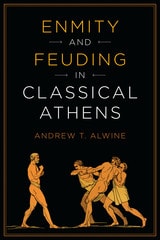
Enmity and Feuding in Classical Athens
By Andrew Alwine
University of Texas Press, 2015
Much has been written about the world’s first democracy, but no book so far has been dedicated solely to the study of enmity in ancient Athens. Enmity and Feuding in Classical Athens is a long-overdue analysis of the competitive power dynamics of Athenian honor and the potential problems these feuds created for democracies.
The citizens of Athens believed that harming one’s enemy was an acceptable practice and even the duty of every honorable citizen. They sought public wins over their rivals, making enmity a critical element in struggles for honor and standing, while simultaneously recognizing the threat that personal enmity posed to the community. Andrew Alwine works to understand how Athenians addressed this threat by looking at the extant work of Attic orators. Their speeches served as the intersection between private vengeance and public sanction of illegal behavior, allowing citizens to engage in feuds within established parameters. This mediation helped support Athenian democracy and provided the social underpinning to allow it to function in conjunction with Greek notions of personal honor.
Alwine provides a framework for understanding key issues in the history of democracy, such as the relationship between private and public realms, the development of equality and the rule of law, and the establishment of individual political rights. Serving also as a nuanced introduction to the works of the Attic orators, Enmity and Feuding in Classical Athens is an indispensable addition to scholarship on Athens.
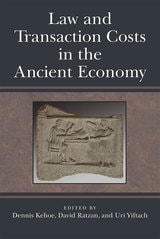
Law and Transaction Costs in the Ancient Economy
Dennis P. Kehoe, David M. Ratzan, and Uri Yiftach, editors
University of Michigan Press, 2015

The Discovery of the Fact
Clifford Ando and William P. Sullivan, Editors
University of Michigan Press, 2020
The Justice of the Greeks
Raphael Sealey
University of Michigan Press, 1994

The Law of Ancient Athens
David D. Phillips
University of Michigan Press, 2013
The Law of Ancient Athens contains the principal literary and epigraphical sources, in English, for Athenian law in the Archaic and Classical periods, from the first known historical trial (late seventh century) to the fall of the democracy in 322 BCE.
This accessible and important volume is designed for teachers, students, and general readers interested in the ancient Greek world, the history of law, and the history of democracy, an Athenian invention during this period. Offering a comprehensive treatment of Athenian law, it assumes no prior knowledge of the subject and is organized in user-friendly fashion, progressing from the person to the family to property and obligations to the gods and to the state. David D. Phillips has translated all sources into English, and he has added significant introductory and explanatory material.
Topics covered in the book include homicide and wounding; theft; marriage, children, and inheritance; citizenship; contracts and commerce; impiety; treason and other offenses against the state; and sexual offenses including rape and prostitution. The volume’s unique feature is its presentation of the actual primary sources for Athenian laws, with many key or disputed terms rendered in transliterated Greek. The translated sources, together with the topical introductions, notes, and references, will facilitate both research in the field and the teaching of increasingly popular courses on Athenian law and law in the ancient world.