Results by title
9 books match the query 'Lazer, Hank'
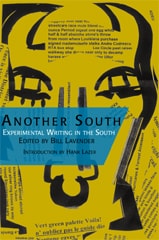
Another South
Experimental Writing in the SouthEdited by Bill Lavender, with an introduction by Hank Lazer
University of Alabama Press, 2002
Another South is an anthology of poetry from contemporary southern writers who are working in forms that are radical, innovative, and visionary. Highly experimental and challenging in nature, the poetry in this volume, with its syntactical disjunctions, formal revolutions, and typographic playfulness, represents the direction of a new breed of southern writing that is at once universal in its appeal and regional in its flavor.
Focusing on poets currently residing in the South, the anthology includes both emerging and established voices in the national and international literary world. From the invocations of Andy Young’s “Vodou Headwashing Ceremony” to the blues-informed poems of Lorenzo Thomas and Honorée Jeffers, from the different voicings of John Lowther and Kalamu ya Salaam to the visual, multi-genre art of Jake Berry, David Thomas Roberts, and Bob Grumman, the poetry in Another South is rich in variety and enthusiastic in its explorations of new ways to embody place and time. These writers have made the South lush with a poetic avant-garde all its own, not only redefining southern identity and voice but also offering new models of what is possible universally through the medium of poetry.
Hank Lazer’s introductory essay about “Kudzu textuality” contextualizes the work by these contemporary innovators. Like the uncontrollable runaway vine that entwines the southern landscape, their poems are hyperfertile, stretching their roots and shoots relentlessly, at once destructive and regenerative. In making a radical departure from nostalgic southern literary voices, these poems of polyvocal abundance are closer in spirit to "speaking in tongues" or apocalyptic southern folk art—primitive, astonishing, and mystic.
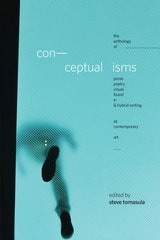
Conceptualisms
The Anthology of Prose, Poetry, Visual, Found, E- & Hybrid Writing as Contemporary ArtEdited by Steve Tomasula
University of Alabama Press, 2022
A wide-ranging anthology of experimental writing—prose, poetry, and hybrid—from its most significant practitioners and innovators
A variety of names have been used to describe fiction, poetry, and hybrid writing that explore new forms and challenges mainstream traditions. Those phrases include experimental, conceptual, avant-garde, hybrid, surfiction, fusion, radical, slip-stream, avant-pop, postmodern, self-conscious, innovative, L=A=N=G=U=A=G=E writing, alternative, and anti- or new literature. Conceptualisms: The Anthology of Prose, Poetry, Visual, Found, E- & Hybrid Writing as Contemporary Art is the first major anthology of writing that offers readers an overview of this other tradition as it lives in the early decades of the 21st century.
Featuring over 100 pieces from more than 90 authors, this anthology offers a plethora of aesthetics and approaches to a wide variety subjects. Editor Steve Tomasula has gathered poems, prose, and hybrid pieces that all challenge our understanding of what literature means. Intended as a collection of the most exciting and bold literary work being made today, Tomasula has put a spotlight on the many possibilities available to writers and readers wishing for a glimpse of literature’s future.
Readers will recognize authors who have shaped contemporary writing, as among them Lydia Davis, Charles Bernstein, Jonathan Safran Foer, Shelley Jackson, Nathaniel Mackey, David Foster Wallace, and Claudia Rankine. Even seasoned readers will find authors, and responses to the canon, not yet encountered. Conceptualisms is a book of ideas for writers, teachers and scholars, as well as readers who wonder how many ways literature can live.
The text features headnotes to chapters on themes such as sound writing, electronic literature, found text, and other forms, offering accessible introductions for readers new to this work. An online companion presents statements about the work and biographies of the authors in addition to audio, video, and electronic writing that can’t be presented in print. Visit www.conceptualisms.info to read more.
Opposing Poetries
Part One: Issues and InstitutionsHank Lazer
Northwestern University Press, 1996
Volume One examines the shift in the governing assumptions of contemporary poetic practice. Lazer inspects the key critical works addressing poetries in the 1980s and 1990s, as well as the political and aesthetic impact of modern critics, poetry reading programs, and of the publishing industry and libraries on contemporary poetic practice.
Opposing Poetries
Part Two: ReadingsHank Lazer
Northwestern University Press, 1996
In Volume Two, Lazer presents a series of sustained readings of important experimental texts. Included are the poets Susan Howe, Lyn Hejinian, Bruce Andrews, and James Sherry. Lazer places these poets in the context of contemporary literary theory, and inspects both the successes and failures of said theory to interpret these works.
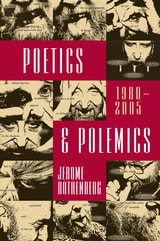
Poetics & Polemics
1980-2005Jerome Rothenberg
University of Alabama Press, 2008
Poetics & Polemics, 1980-2005 brings together in one volume a wide-ranging selection of essays and commentaries by one of the most significant poets, critics, and translators working with American and international poetry today.
Jerome Rothenberg’s work spans a period of over forty years and nearly one hundred books, and though perhaps best known as a poet, his critical and theoretical contributions to the fields of innovative, experimental poetry have become equally important facets of his work. Rothenberg’s earliest critical writings concerned themselves with ethnopoetics and the poetics of performance. In the last twenty years his critical thinking has evolved to encompass more explicitly issues of modernism, postmodernism, and the avant-garde, as well as meditations on the nature of the book and writing. This volume extends and elaborates all of those interests, allowing for the first time a comprehensive glimpse of the full trajectory of his thinking.
In the first section, “Poetics and Polemics,” Rothenberg’s essays address a range of issues with which he’s become closely associated, among them the anthology as a critical and polemical tool; the intersection of poetry with art, performance, and politics, in both contemporary and traditional practice; the poetics of Jewish mysticism as a traditional form of conceptual and language poetry; and the universality of poetic discourse, particularly as seen in tribal poetry or in poetic traditions long separated from the Western literary mainstream. In “A Gallery of Poets” is Rothenberg’s lively explorations of the work of other poets, as they relate to his own work, to avant-garde poetry in general, and to the poetic traditions that concern him the most. Finally, in “Dialogues and Interviews” are Rothenberg’s unbridled meditations and musings on what he calls “the life of poetry” outside the bounds of book and binding, class and category, a dynamic force at the center of all that we call human.
Radical Poetics and Secular Jewish Culture
Edited by Stephen Paul Miller and Daniel Morris
University of Alabama Press, 2009
--Franz Kafka
Kafka's quip--paradoxical, self-questioning, ironic--highlights vividly some of the key issues of identity and self-representation for Jewish writers in the 20th century. No group of writers better represents the problems of Jewish identity than Jewish poets writing in the American modernist tradition--specifically secular Jews: those disdainful or suspicious of organized religion, yet forever shaped by those traditions.
This collection of essays is the first to address this often obscured dimension of modern and contemporary poetry: the secular Jewish dimension. Editors Daniel Morris and Stephen Paul Miller asked their contributors to address what constitutes radical poetry written by Jews defined as "secular," and whether or not there is a Jewish component or dimension to radical and modernist poetic practice in general. These poets and critics address these questions by exploring the legacy of those poets who preceded and influenced them--Stein, Zukofsky, Reznikoff, Oppen, and Ginsberg, among others.
While there is no easy answer for these writers about what it means to be a Jew, in their responses there is a rich sense of how being Jewish reflects on their aesthetics and practices as poets, and how the tradition of the avant-garde informs their identities as Jews. Fragmented identities, irony, skepticism, a sense of self as "other" or "outsider," distrust of the literal, and belief in a tradition that questions rather than answers--these are some of the qualities these poets see as common to themselves, the poetry they make, and the tradition they work within.
Reading the Difficulties
Dialogues with Contemporary American Innovative PoetryThomas Fink
University of Alabama Press, 2013
New Strategies for Reading the Most Innovative Poetry of Our Time.
Definitions of what constitutes innovative poetry are innumerable and are offered from every quarter. Some critics and poets argue that innovative poetry concerns free association (John Ashbery), others that experimental poetry is a “re-staging” of language (Bruce Andrews) or a syntactic and cognitive break with the past (Ron Silliman and Lyn Hejinian). The tenets of new poetry abound.
But what of the new reading that such poetry demands? Essays in Reading the Difficulties ask what kinds of stances allow readers to interact with verse that deliberately removes many of the comfortable cues to comprehension—poetry that is frequently nonnarrative, nonrepresentational, and indeterminate in subject, theme, or message.
Some essays in Thomas Fink and Judith Halden-Sullivan’s collection address issues of reader reception and the way specific stances toward reading support or complement the aesthetic of each poet. Others suggest how we can be open readers, how innovative poetic texts change the very nature of reader and reading, and how critical language can capture this metamorphosis. Some contributors consider how the reader changes innovative poetry, what language reveals about this interaction, which new reading strategies unfold for the audiences of innovative verse, and what questions readers should ask of innovative verse and of events and experiences that we might bring to reading it.
The Cracks Between What We Are and What We Are Supposed to Be
Essays and InterviewsHarryette Mullen
University of Alabama Press, 2012
The Cracks Between What We Are and What We Are Supposed to Be forms an extended consideration not only of Harryette Mullen’s own work, methods, and interests as a poet, but also of issues of central importance to African American poetry and language, women’s voices, and the future of poetry.
Together, these essays and interviews highlight the impulses and influences that drive Mullen’s work as a poet and thinker, and suggest unique possibilities for the future of poetic language and its role as an instrument of identity and power.
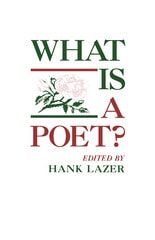
What Is A Poet?
Hank Lazer
University of Alabama Press, 1987
This book discusses the extent of distrust and the extent of the misunderstandings that exist in the poetry world.