Results by title
30 books match the query 'Lebanon'

A History of Modern Lebanon
Fawwaz Traboulsi
Pluto Press, 2012
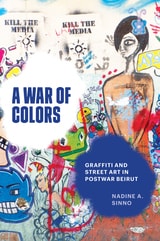
A War of Colors
Graffiti and Street Art in Postwar BeirutNadine A. Sinno
University of Texas Press, 2024
Demonstrates the role of Beirut’s postwar graffiti and street art in transforming the cityscape and animating resistance.
Over the last two decades in Beirut, graffiti makers have engaged in a fierce “war of colors,” seeking to disrupt and transform the city’s physical and social spaces. In A War of Colors, Nadine Sinno examines how graffiti and street art have been used in postwar Beirut to comment on the rapidly changing social dynamics of the country and region. Analyzing how graffiti makers can reclaim and transform cityscapes that were damaged or monopolized by militias during the war, Sinno explores graffiti’s other roles, including forging civic engagement, commemorating cultural icons, protesting political corruption and environmental violence, and animating resistance. In addition, she argues that graffiti making can offer voices to those who are often marginalized, especially women and LGBTQ people. Copiously illustrated with images of graffiti and street art, A War of Colors is a visually captivating and thought-provoking journey through Beirut, where local and global discourses intersect on both scarred and polished walls in the city.
An Imagined America
Language, Literacy, Identity, and Coloniality at Syrian Protestant College, 1866–1920Lisa Arnold
University Press of Colorado, 2026
An Imagined America presents a historical, transnational, translingual, and decolonial perspective on questions of identity, literacy, language, culture, and citizenship. In examining a variety of English- and Arabic-language archival documents from the founding of Syrian Protestant College in 1866 (today the American University of Beirut) until the fall of the Ottoman Empire in 1920, Lisa R. Arnold shows how transnational and translingual negotiations among faculty, students, and administrators, as well as the local and regional community, produced a tenuous and sometimes unsettling vision of America for foreigners and locals alike. As her account shows, transnational and translingual discourses provide the backdrop and motive for the assertion of coloniality in contexts of literacy education such as that of Syrian Protestant College. An Imagined America allows scholars and educators in rhetoric and writing studies, education, and related fields to consider how literacy education in English has, and often continues to, construct an imagined America that is both grounded on and reproduces colonial epistemology. Such constructions work to uphold exclusionary practices that are all too vivid in our world today.
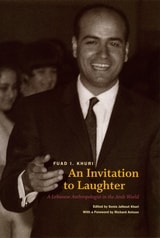
An Invitation to Laughter
A Lebanese Anthropologist in the Arab WorldFuad I. Khuri
University of Chicago Press, 2007
For the late Fuad I. Khuri, a distinguished career as an anthropologist began not because of typical concerns like accessibility, money, or status, but because the very idea of an occupation that baffled his countrymen made them—and him—laugh. “When I tell them that ‘anthropology’ is my profession . . . they think I am either speaking a strange language or referring to a new medicine.” This profound appreciation for humor, especially in the contradictions inherent in the study of cultures, is a distinctive theme of An Invitation to Laughter, Khuri’s astute memoir of life as an anthropologist in the Middle East.
A Christian Lebanese, Khuri offers up in this unusual autobiography both an insider’s and an outsider’s perspective on life in Lebanon, elsewhere in the Middle East, and in West Africa. Khuri entertains and informs with clever insights into such issues as the mentality of Arabs toward women, eating habits of the Arab world, the impact of Islam on West Africa, and the extravagant lifestyles of wealthy Arabs, and even offers a vision for a type of democracy that could succeed in the Middle East. In his life and work, as these astonishing essays make evident, Khuri demonstrated how the discipline of anthropology continues to make a difference in bridging dangerous divides.
Disruptive Situations
Fractal Orientalism and Queer Strategies in BeirutGhassan Moussawi
Temple University Press, 2020
Disruptive Situations challenges representations of contemporary Beirut as an exceptional space for LGBTQ people by highlighting everyday life in a city where violence is the norm. Ghassan Moussawi, a Beirut native, seeks to uncover the underlying processes of what he calls “fractal orientalism,” a relational understanding of modernity and cosmopolitanism that illustrates how transnational discourses of national and sexual exceptionalism operate on multiple scales in the Arab world.
Moussawi’s intrepid ethnography features the voices of women, gay men and genderqueers in Beirut to examine how queer individuals negotiate life in this uncertain region. He examines “al-wad’,” or “the situation,” to understand the practices that form these strategies and to raise questions about queer-friendly spaces in and beyond Beirut.
Disruptive Situations alsoshows how LGBTQ Beirutis resist reconciliation narratives and position their identities and visibility at different times as ways of simultaneously managing their multiple positionalities and al-wad’. Moussawi argues that the daily survival strategies in Beirut are queer—and not only enacted by LGBTQ people—since Beirutis are living amidst an already queer situation of ongoing precarity.
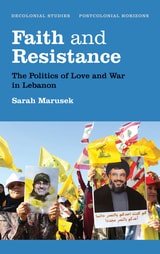
Faith and Resistance
The Politics of Love and War in LebanonSarah Marusek
Pluto Press, 2018
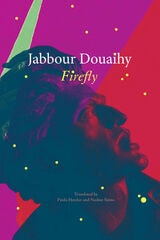
Firefly
Jabbour Douaihy
Seagull Books, 2022
Firefly paints a searing portrait of the city of Beirut at the outbreak of the Lebanese Civil War in the early 1970s, as seen through the eyes of its simple, yet perplexing, protagonist, Nizam al-Alami. On Nizam’s national ID card, no religion is listed. Muslim by birth, he is Christian by baptism. As a young boy, he found his way into an orchard while playing, and its owners, Touma and Rakheema, instantly fell for him and agreed to raise him as their own, as a Christian, without much resistance from his Muslim parents.
When he is grown, Nizam makes his way to Beirut to study law. Unable to bear the confines of the classroom, he abandons college to explore the city as he pleases. His apartment soon becomes a meeting place for his communist comrades, and he falls in love with Janan, the tormented artist whose dark paintings prophesy the city’s bloody future. When Beirut explodes, and the city is divided into a Christian East and a Muslim West, Nizam’s apartment turns into a hideout for armed militiamen, and Burj Square is emptied of everything except the Martyrs’ Statue that bears witness to the city’s most difficult moments. Nizam, too, bears witness, as he sees the corpses of the civil war’s victims pile up.
Jabbour Douaihy takes us through Nizam’s adventures and struggles as he faces stigmatization, homelessness, and violence in a society that considers him an outsider. Like the light-producing, charismatic fireflies that captured his imagination and eluded him as a child, Nizam is the glimmer of hope epitomized by those who reject binary identities in favor of the in-between. But how long, Douaihy asks, can this glimmer of hope truly last?
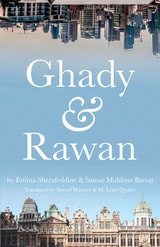
Ghady & Rawan
By Fatima Sharafeddine and Samar Mahfouz Barraj, translated by M. Lynx Qualey and Sawad Hussain
University of Texas Press, 2019
Ghady and Rawan is a heartfelt and timely novel by the award-winning author Fatima Sharafeddine (The Servant, Cappuccino) and Samar Mahfouz Barraj. The novel follows the close-knit friendship of two Lebanese teenagers, Ghady, who lives with his family in Belgium, and Rawan, who lives in Lebanon. Ghady’s family travels every summer to Beirut, where Ghady gets to spend all his time with Rawan and their other friends, enjoying their freedom from school. During the rest of the year, he and Rawan keep in touch by email. Through this correspondence, we learn about the daily ups and downs of their lives in Brussels and Beirut, including Ghady’s homesickness and his struggles with racism at school, as well as Rawan’s changing relationship to her family. The novel offers a glimpse into the lives of Lebanese adolescents while exploring a range of topics relevant to young people everywhere: bullying, parental conflicts, racism, belonging and identity, and peer pressure. Through the connection between the two main characters, Sharafeddine and Mahfouz Barraj show how the love and support of a good friend can help you through difficulties as well as sweeten life’s triumphs and good times.
Hezbollah
The Political Economy of Lebanon's Party of GodJoseph Daher
Pluto Press, 2016
By discarding more common approaches to the party that focus on religious discourse or military questions, Daher is freed up to analyze what the party actually is: an organization that is operating within a specific political and socio-economic context, one that simultaneously offers it a rich ground of support and limits its range of action. Daher clearly and carefully positions Hezbollah within that context, focusing on its historic ties with its main sponsor, Iran, its media and cultural wings, its relationship with Western economic policies, and the impact of the Shi’a population on the sectarian politics of Lebanon. Offering additional attention to the party’s positions on worker’s rights and women’s issues, this fresh take on Hezbollah will be incredibly useful for understanding the world’s most tumultuous region.
Hizbu'llah
Politics and ReligionAmal Saad-Ghorayeb
Pluto Press, 2001
Hizbu’llah is the largest and most prominent political party in Lebanon, and one of the most renowned Islamist movements in the world. In this book, Amal Saad-Ghorayeb examines the organisation’s understanding of jihad and how this, together with its belief in martyrdom, brought about the withdrawal of Israeli occupation forces from Lebanon in May 2000.
Saad-Ghorayeb explores the nature of the party’s struggle against the West by studying its views on the use of violence against Westerners. Crucially, she also addresses the question of whether Hizbu’llah depicts this struggle in purely political or civilisational terms. The existential nature of the movement’s conflict with Israel is analysed and the Islamic roots of its anti-Judaism is unearthed.
The author explores the mechanics and rationale behind the party’s integration into the Lebanese political system, and sheds light on how it has reconciled its national idenitity with its solidarity with the Muslim umma.
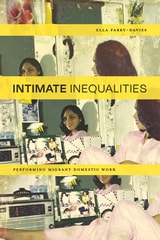
Intimate Inequalities
Performing Migrant Domestic WorkElla Parry-Davies
Northwestern University Press, 2025
Intimate inequalities exist where the embodied and the everyday rub up against transnational structures of power. Ella Parry-Davies conducted collaborative research with migrant domestic workers from the Philippines living in the UK and Lebanon, where migration is regulated by employer sponsorship systems, to explore how they negotiate the intimacy of the family home and the attendant inequalities of laboring within it. Intimate Inequalities: Performing Migrant Domestic Work brings these conditions into focus while articulating a methodological inquiry into the dynamics of collaborative performance research. Parry-Davies examines site-specific soundwalks, recorded and coedited with domestic workers, which steer the book between church choirs in Beirut and activist gatherings in London, and from urban performances in Lebanon’s 2019 revolution to mutual aid organizing amid COVID-19 in the UK. Breaking with prevalent depictions of migrant domestic workers as voiceless and victimized, Intimate Inequalities mobilizes performance as both an analytic lens and a practical methodology, amplifying its subjects’ expertise while reckoning with the intimate yet unequal dynamics of research itself.

Lebanese Amber
The Oldest Insect Ecosystem in Fossilized ResinGeorge Poinar Jr.
Oregon State University Press, 2001
Lebanon in Strife
Student Preludes to the Civil WarBy Halim Barakat
University of Texas Press, 1977
In this study, an eminent sociologist of the Arab world analyzes student politics in Lebanon and their relationship to the civil war. This focus is part of a larger concern with upheaval in Arab society and with political and social integration in mosaic societies in general. Professor Barakat provides a clear, thorough, and comprehensive analysis of late twentieth century Lebanese society and the dominant ideological veins within it.
Lebanon in Strife is a comparative study of Lebanese youth with special emphasis on their alienation from society and politics and their place at the vanguard of social change. The study is set in the context of the continual confrontation between forces for change and the established order in Lebanon, viewed from both a local and an international perspective. The author argues that vertical loyalties (based on religious, ethnic, or regional ties) are more significant than horizontal loyalties (based on socioeconomic class) in determining Lebanese student political behavior and attitudes. However, vertical loyalties are explained in socioeconomic terms, for the two forms of cleavages coincide; and the whole society is composed of religious communities arranged in a hierarchy of power and status. The author shows that these ties conflict with and undermine orderly social change and national unity and that they could account for conditions that have led to civil war in Lebanon.
In an epilogue, Professor Barakat relates his analysis of student politics to political developments in Lebanon during the civil war of 1975–1976, including an assessment of the role of Syria and the prospects for a negotiated end to armed struggle in the country.
This is the first empirical study of Lebanese political life viewed from the standpoint of its central force for change, the students. It is an invaluable resource for students of the modem Middle East as well as for specialists in sociology, politics, and history. Lebanon in Strife has special relevance to problems of political change and development in the Third World countries, providing a sociopolitical model for the analysis of student politics in traditional and transitional societies.
Limbo Beirut
By Hilal Chouman<br>Translated by Anna Ziajka Stanton
University of Texas Press, 2016
In Hilal Chouman’s Limbo Beirut, a gay artist, a struggling novelist, a pregnant woman, a disabled engineering student, a former militia member, and a medical intern all take turns narrating the violent events of May 2008, when Hezbollah militants and Sunni fighters clashed in the streets of Beirut. For most of these young men and women, the Lebanese Civil War (1975–1990) is but a vague recollection, but the brutality of May 2008 serves to reawaken forgotten memories and stir up fears of a revival of sectarian violence. Yet despite these fears, the violence these characters witness helps them to break free from the mundane details of their lives and look at the world anew.
The multiple narrative voices and the dozens of pen-and-ink illustrations that accompany the text allow Chouman to achieve a mesmerizing cinematic quality with this novel that is unique in modern Arabic fiction. Not only will readers appreciate the meaningful exploration of the effects of violence on the psyche, but they will also enjoy discovering how the lives of these characters—almost all of whom are strangers to one another—intersect in surprising ways.
Memoirs of an Early Arab Feminist
The Life and Activism of Anbara Salam KhalidiAnbara Salam Khalidi
Pluto Press, 2013
Memoirs of an Early Arab Feminist is the first English translation of the memoirs of Anbara Salam Khalidi, the iconic Arab feminist. At a time when women are playing a leading role in the Arab Spring, this book brings to life an earlier period of social turmoil and women's activism through one remarkable life.
Anbara Salam was born in 1897 to a notable Sunni Muslim family of Beirut. She grew up in 'Greater Syria', in which unhindered travel between Beirut, Jerusalem and Damascus was possible, and wrote a series of newspaper articles calling on women to fight for their rights within the Ottoman Empire. In 1927 she caused a public scandal by removing her veil during a lecture at the American University of Beirut.
Later she translated Homer and Virgil into Arabic and fled from Jerusalem to Beirut following the establishment of Israel in 1948. She died in Beirut in 1986. These memoirs have long been acclaimed by Middle East historians as an essential resource for the social history of Beirut and the larger Arab world in the 19th and 20th centuries.
Passage to Dusk
By Rashid al-Daif
University of Texas Press, 2001
Passage to Dusk deals with the Lebanese civil war of the 1970s in a postmodern, poetic style. The narrative focuses on the deranged, destabilized, confused, and hyper-perceptive state of mind created by living on the scene through a lengthy war. The story is filled with details that transcend the willed narcissism of the main character, while giving clues to the culture of the time. It is excellent fiction, written in a surrealistic mode, but faithful to the characters of the people of Lebanon, their behavior during the war, and their contradictions. Issues of gender and identity are acutely portrayed against Lebanon's shifting national landscape.
The English-language reader has not been much exposed to Lebanese literature in translation, and Rashid al-Daif is one of Lebanon's leading writers. He has been translated into eight languages, including French, German, Italian, Polish, and Spanish. Translator Nirvana Tanoukhi manages to preserve Daif's unusual, moving, and at times humorous style in her English rendition.

Pericles
William Shakespeare
Arizona Center for Medieval and Renaissance Studies, 2023
Shakespeare’s romance Pericles follows Pericles, the Prince of Tyre, on a series of adventures across the Mediterranean Sea. Navigating one heroic challenge after another, Pericles strives to be reunited with his wife and child. Ellen McLaughlin’s translation of Pericles illuminates Shakespeare’s text, untangling syntax and bringing forth the poetry of the verse. An encounter between the contemporary and the iconic, this translation brings the play to life as audiences would have experienced it in Shakespeare’s time.
This translation of Pericles was written as part of the Oregon Shakespeare Festival’s Play On! project, which commissioned new translations of thirty-nine Shakespeare plays. These translations present work from “The Bard” in language accessible to modern audiences while never losing the beauty of Shakespeare’s verse. Enlisting the talents of a diverse group of contemporary playwrights, screenwriters, and dramaturges from diverse backgrounds, this project reenvisions Shakespeare for the twenty-first century. These volumes make these works available for the first time in print—a new First Folio for a new era.
Posthumous Images
Contemporary Art and Memory Politics in Post–Civil War LebanonChad Elias
Duke University Press, 2018
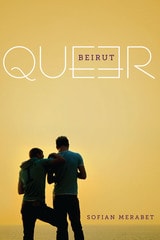
Queer Beirut
By Sofian Merabet
University of Texas Press, 2014
Gender and sexual identity formation is an ongoing anthropological conversation in both Middle Eastern studies and urban studies, but the story of gay and lesbian identity in the Middle East is only just beginning to be told. Queer Beirut is the first ethnographic study of queer lives in the Arab Middle East. Drawing on anthropology, urban studies, gender studies, queer studies, and sociocultural theory, Sofian Merabet’s compelling ethnography suggests a critical theory of gender and religious identity formations that will disrupt conventional anthropological premises about the contingent role that society and particular urban spaces have in facilitating the emergence of various subcultures within the city.
From 1995 to 2014, Merabet made a series of ethnographic journeys to Lebanon, during which he interviewed numerous gay men in Beirut. Through their life stories, Merabet crafts moving ethnographic narratives and explores how Lebanese gays inhabit and perform their gender as they formulate their sense of identity. He also examines the notion of “queer space” in Beirut and the role that this city, its class and sectarian structure, its colonial history, and religion have played in these people’s discovery and exploration of their sexualities. In using Beirut as a microcosm for the complexities of homosexual relationships in contemporary Lebanon, Queer Beirut provides a critical standpoint from which to deepen our understandings of gender rights and citizenship in the structuring of social inequality within the larger context of the Middle East.
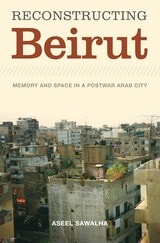
Reconstructing Beirut
Memory and Space in a Postwar Arab CityBy Aseel Sawalha
University of Texas Press, 2010
Once the cosmopolitan center of the Middle East, Beirut was devastated by the civil war that ran from 1975 to 1991, which dislocated many residents, disrupted normal municipal functions, and destroyed the vibrant downtown district. The aftermath of the war was an unstable situation Sawalha considers "a postwar state of emergency," even as the state strove to restore normalcy. This ethnography centers on various groups' responses to Beirut's large, privatized urban-renewal project that unfolded during this turbulent moment.
At the core of the study is the theme of remembering space. The official process of rebuilding the city as a node in the global economy collided with local day-to-day concerns, and all arguments invariably inspired narratives of what happened before and during the war. Sawalha explains how Beirutis invoked their past experiences of specific sites to vie for the power to shape those sites in the future. Rather than focus on a single site, the ethnography crosses multiple urban sites and social groups, to survey varied groups with interests in particular spaces. The book contextualizes these spatial conflicts within the discourses of the city's historical accounts and the much-debated concept of heritage, voiced in academic writing, politics, and journalism. In the afterword, Sawalha links these conflicts to the social and political crises of early twenty-first-century Beirut.
Revolution and Disenchantment
Arab Marxism and the Binds of EmancipationFadi A. Bardawil
Duke University Press, 2020
Sabra and Shatila
September 1982Bayan Nuwayhed Al-Hout
Pluto Press, 2004
The book covers the history of the Sabra and Shatila massacre, which took place over three bloody days in the Lebanese capital Beirut. It was committed against Palestinian refugees by Lebanese militias, aided and supervised by the Israeli Army, which had encircled the district.
Now available for the first time in English, this classic book is the most comprehensive, authoritative account of what happened and who was responsible. The author, Bayan Nuwayhed al-Hout, was a Professor at the Lebanese University at the time. Driven by the horror of what occurred, she interviewed survivors and set up an oral history project immediately after the massacre to preserve testimonies. This book is the result.
Following a general introduction, the first part contains interviews mainly with victims' families. The second part analyses statistical data and attempts to determine the number of victims. The conclusion, 'Who Was Responsible?', sheds light on the various parties responsible.
Over five-hundred pages long, illustrated with photographs and maps, unrivalled in detail and scope, this book is a courageous attempt to make sense of what happened and an important political document in its own right.
Seeds of Hate
How America's Flawed Middle East Policy Ignited the JihadLawrence Pintak
Pluto Press, 2003
The Diasporic Condition
Ethnographic Explorations of the Lebanese in the WorldGhassan Hage
University of Chicago Press, 2021
In The Diasporic Condition, Ghassan Hage engages with the diasporic Lebanese community as a shared lifeworld, defining a common cultural milieu that transcends spatial and temporal distance—a collective mode of being here termed the “diasporic condition.” Encompassing a complicated transnational terrain, Hage’s long-term ethnography takes us from Mehj and Jalleh in Lebanon to Europe, Australia, South America, and North America, analyzing how Lebanese migrants and their families have established themselves in their new homes while remaining socially, economically, and politically related to Lebanon and to each other.
At the heart of The Diasporic Condition lies a critical anthropological question: How does the study of a particular sociocultural phenomenon expand our knowledge of modes of existing in the world? As Hage establishes what he terms the “lenticular condition,” he breaks down the boundaries between “us” and “them,” “here” and “there,” showing that this convergent mode of existence increasingly defines everyone’s everyday life.
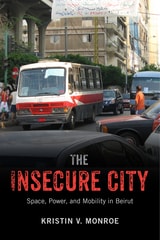
The Insecure City
Space, Power, and Mobility in BeirutMonroe, Kristin V
Rutgers University Press, 2016
Download open access ebook here.
The Kingdom of Strangers
Elias Khoury
University of Arkansas Press, 1996
The Politics of Sectarianism in Postwar Lebanon
Bassel Salloukh, Rabie Barakat, Jinan S. Al-Habbal, Lara W. Khattab and Shoghig Mikaelian
Pluto Press, 2015
The Politics of Sectarianism in Postwar Lebanon builds on extensive field work to find the answers to those questions and more. Bassel Salloukh, Lebanon’s leading political scientist, analyses the mix of institutional, clientelist, and discursive practices that sustain the sectarian nature of Lebanon, revealing an expanding sectarian web that occupies ever-more-substantial areas of everyday life in Lebanon. It also highlights the struggles waged by opponents of the system, including women, public sector employees, teachers, students, and NGO-based coalitions, and how their efforts often fail to bear fruit because of sabotage by various systematic forces.
Toward Translingual Realities in Composition
(Re)Working Local Language Representations and PracticesNancy Bou Ayash
Utah State University Press, 2019
Translingualism work has concentrated on critiquing monolingual and multilingual notions of language, but it is only beginning to examine translingual enactments in writing programs and classrooms. Focusing on language representations and practices at both the macro and micro levels, author Nancy Bou Ayash places the study and teaching of university-level writing in the context of the globalization and pluralization of English(es) and other languages. Individual chapters feature various studies that Bou Ayash brings together to address how students act as agents in marshaling their language practices and resources and shows a deliberate translingual intervention that complicates and enriches students’ assumptions about language and writing. Her findings about writing programs, instructors, and students are detailed, multidimensional, and complex.
A substantial contribution to growing translingual scholarship in the field of composition studies, Toward Translingual Realities in Composition offers insights into how writing teacher-scholars and writing program administrators can more productively intervene in local postmonolingual tensions and contradictions at the level of language representations and practices through actively and persistently reworking the design and enactment of their curricula, pedagogies, assessments, teacher training programs, and campus-wide partnerships.
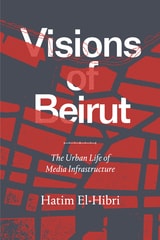
Visions of Beirut
The Urban Life of Media InfrastructureHatim El-Hibri
Duke University Press, 2021
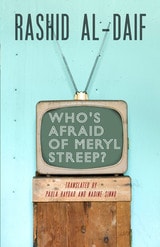
Who's Afraid of Meryl Streep?
By Rashid al-Daif Translated by Paula Haydar and Nadine Sinno
University of Texas Press, 2014
Rashid al-Daif’s provocative novel Who’s Afraid of Meryl Streep? takes an intimate look at the life of a recently married Lebanese man. Rashoud and his wife struggle as they work to negotiate not only their personal differences but also rapidly changing attitudes toward sex and marriage in Lebanese culture. As their fragile bond disintegrates, Rashoud finds television playing a more prominent role in his life; his wife uses the presence of a television at her parents’ house as an excuse to spend time away from her new home. Rashoud purchases a television in the hopes of luring his wife back home, but in a pivotal scene, he instead finds himself alone watching Kramer vs. Kramer. Without the aid of subtitles, he struggles to make sense of the film, projecting his wife’s behavior onto the character played by Meryl Streep, who captivates him but also frightens him in what he sees as an effort to take women’s liberation too far.
Who’s Afraid of Meryl Streep? offers a glimpse at evolving attitudes toward virginity, premarital sex, and abortion in Lebanon and addresses more universal concerns such as the role of love and lust in marriage. The novel has found wide success in Arabic and several European languages and has also been dramatized in both Arabic and French.