Results by title
19 books match the query 'Legal Education'

American Legal English, 2nd Edition, Supplemental Audiofiles
Using Language in Legal ContextsDebra S. Lee, J.D., Charles Hall, Susan Barone
University of Michigan Press, 2012
This product contains the supplemental listening activities (21 tracks) to support the textbook American Legal English (978-0-472-03206-0), and are available via MP3 download. Running time: 000:36:43.
The American Legal English products were developed to help non-native speakers improve their ability to understand and communicate in English with their legal counterparts around the world. The text is an introduction to basic legal information and the U.S. legal system that addresses the major areas of law and provides actual cases and statutes so that students can become familiar with legal syntax and legal vocabulary.
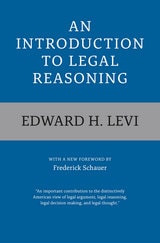
An Introduction to Legal Reasoning
Edward H. Levi
University of Chicago Press, 2013
For this edition, the book includes a substantial new foreword by leading contemporary legal scholar Frederick Schauer that helpfully places this foundational book into its historical and legal contexts, explaining its continuing value and relevance to understanding the role of analogical reasoning in the law. This volume will continue to be of great value to students of logic, ethics, and political philosophy, as well as to members of the legal profession and everyone concerned with problems of government and jurisprudence.
An Introduction to Legal Reasoning
Edward H. Levi
University of Chicago Press, 2013
Originally published in 1949, An Introduction to Legal Reasoning is widely acknowledged as a classic text. As its opening sentence states, “This is an attempt to describe generally the process of legal reasoning in the field of case law and in the interpretation of statutes and of the Constitution.” In elegant and lucid prose, Edward H. Levi does just that in a concise manner, providing an intellectual foundation for generations of students as well as general readers.
For this edition, the book includes a substantial new foreword by leading contemporary legal scholar Frederick Schauer that helpfully places this foundational book into its historical and legal contexts, explaining its continuing value and relevance to understanding the role of analogical reasoning in the law. This volume will continue to be of great value to students of logic, ethics, and political philosophy, as well as to members of the legal profession and everyone concerned with problems of government and jurisprudence.
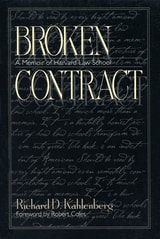
Broken Contract
A Memoir of Harvard Law SchoolRichard D. Kahlenberg
University of Massachusetts Press, 1999
In 1986, 70 percent of the first-year class of Harvard Law School wanted to pursue careers in public-interest law. Ten years later, the same percentage of this class was pursuing careers in private corporate firms. How is it that these students began their careers interested in using law as a vehicle for social change, but ended up in those very law firms most resistant to change? How are law students able to reconcile liberal politics with careers in corporate law?
Richard D. Kahlenberg's Broken Contract serves to warn prospective law students on the transformation that happens during the second and third years. His memoir explores the intense competitiveness and insidious pressure leading to jobs that are lucrative, prestigious, and challenging, but ultimately unsatisfying.
Though Broken Contract doesn't seek to convince every law student to go into public service, Kahlenberg means to challenge and restructure our social institutions to make it easier to follow our impulses toward good instead of toward the goods.
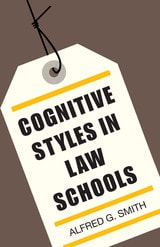
Cognitive Styles in Law Schools
By Alfred G. Smith
University of Texas Press, 1979
People differ in their cognitive styles—their ways of getting and using information to solve problems and make decisions. Alfred G. Smith and his associates studied these differences in a selected group of over 800 students at a score of law schools throughout the United States. Two major cognitive styles were identified: that of the monopath, who follows a single route of established principles and procedures, and that of the polypath, who takes many routes, as circumstances suggest.
A battery of both original and standard tests was administered to both law students and their professors to investigate differences in cognitive style and their relationships to self-image, anxiety, and academic achievement. This also revealed differences in prevailing styles at different schools.
The results will be of special interest to readers concerned with legal education, to psychologists, and to behavioral scientists. The research format developed here will serve equally well for raising significant questions about the professions of medicine, education, social work, and others in which cognitive and communication styles play a central role in determining outcomes.
Failing Law Schools
Brian Z. Tamanaha
University of Chicago Press, 2012
On the surface, law schools today are thriving. Enrollments are on the rise, and their resources are often the envy of every other university department. Law professors are among the highest paid and play key roles as public intellectuals, advisers, and government officials. Yet behind the flourishing facade, law schools are failing abjectly. Recent front-page stories have detailed widespread dubious practices, including false reporting of LSAT and GPA scores, misleading placement reports, and the fundamental failure to prepare graduates to enter the profession.
Addressing all these problems and more in a ringing critique is renowned legal scholar Brian Z. Tamanaha. Piece by piece, Tamanaha lays out the how and why of the crisis and the likely consequences if the current trend continues. The out-of-pocket cost of obtaining a law degree at many schools now approaches $200,000. The average law school graduate’s debt is around $100,000—the highest it has ever been—while the legal job market is the worst in decades, with the scarce jobs offering starting salaries well below what is needed to handle such a debt load. At the heart of the problem, Tamanaha argues, are the economic demands and competitive pressures on law schools—driven by competition over U.S. News and World Report ranking. When paired with a lack of regulatory oversight, the work environment of professors, the limited information available to prospective students, and loan-based tuition financing, the result is a system that is fundamentally unsustainable.
Growing concern with the crisis in legal education has led to high-profile coverage in the Wall Street Journal and the New York Times, and many observers expect it soon will be the focus of congressional scrutiny. Bringing to the table his years of experience from within the legal academy, Tamanaha has provided the perfect resource for assessing what’s wrong with law schools and figuring out how to fix them.
From Expectation to Experience
Essays on Law and Legal EducationJames Boyd White
University of Michigan Press, 2000
The essays here are united by two basic themes. First, the essays suggest that law can usefully be regarded not only as a set of rules designed to produce results in the material world, as it usually is regarded, but also as an imaginative and intellectual activity that has as its end the claim of meaning for human experience, both individual and collective. Second, they argue that education, including in the law, works by the constant modification of expectation by experience.
White claims that as we grow, whether as individuals or as a community, we constantly shape our expectations to our experiences. This happens with particular force and clarity in the law, which seeks to create both a certain set of expectations--this is how it works as a system of regulation--and a series of occasions and methods for their revision. White's interest is in the way these understandings can affect legal teaching, practice, and criticism.
The essays in this book examine such topics as the nature of legal education; the possibilities for writing in the law for both judges and lawyers; the relation between the practice of making and claiming meaning as it works in the law and in literatures more usually though of as imaginative, such as poetry or drama; the ways in which the law talks, and ought to talk, about business corporations, religion, and individual judgments; and the ethical possibilities of the practice of law when it is conceived of as a field for the making of meaning.
From Expectation to Experience will be of interest to lawyers, legal scholars, as well as students of law, law and literature, and ethics and literature.
James Boyd White is Hart Wright Professor of Law, Professor of English, and Adjunct Professor of Classical Studies, University of Michigan.
Incidental Racialization
Performative Assimilation in Law SchoolYung-Yi Diana Pan
Temple University Press, 2017
Despite the growing number ofAsian American and Latino/a law students, many panethnic students still feel as if they do not belong in this elite microcosm, which reflects the racial inequalities in mainstream American society. While in law school, these students—often from immigrant families, and often the first to go to college—have to fight against racialized and gendered stereotypes. In Incidental Racialization, Diana Pan rigorously explores how systemic inequalities are produced and sustained in law schools.
Through interviews with more than 100 law students and participant observations at two law schools, Pan examines how racialization happens alongside professional socialization. She investigates how panethnic students negotiate their identities, race, and gender in an institutional context. She also considers how their lived experiences factor into their student organization association choices and career paths.
Incidental Racialization sheds light on how race operates in a law school setting for both students of color and in the minds of white students. It also provides broader insights regarding racial inequalities in society in general.

International Handbook on Clinical Tax Education
Edited by Amy Lawton
University of London Press, 2023
Tax clinics, a government-funded initiative to help people who may not be able to afford professional advice and representation with their tax affairs, have existed in the United States since the early 1990s. Now they are being established throughout the world, particularly in Australia, the UK, and Ireland. This practical handbook explores the benefits that a clinical tax education can have and equips readers with the tools needed to start a clinical tax project. It investigates the ways in which tax clinics can both educate and remedy tax positions for local communities in supporting those without access to the tax profession to understand their tax liabilities. It also explores the higher education setting, in which community tax projects rely on students for their success, offering them the benefits of an alternative learning environment in tax and experience in the tax profession while studying. Beyond identifying the practical benefits, this handbook uses learning from tax clinics to uncover the burdens and impacts of tax policy on more marginalized taxpayers, and how policymakers can tailor tax systems to overcome them.
Neglected Policies
Constitutional Law and Legal Commentary as Civic EducationIra L. Strauber
Duke University Press, 2002
Strauber situates agnostic skepticism within contemporary legal thought, explaining how it draws upon sociological jurisprudence, legal realism, and critical legal studies. Through studies of cases involving pornography, adoption custody battles, flag burning, federalism, and environmental politics, he demonstrates how agnostic skepticism applies to constitutional issues. Strauber contends that training in skeptical critique will enable a new kind of civic education and culture—one in which citizens are increasingly tolerant of the ambiguities and contradictions inherent in the law and politics of a pluralistic society.
Using insights from the social sciences to examine the ways constitutional cases are studied and taught, Neglected Policies will interest scholars of jurisprudence, political science, and the sociology of law.
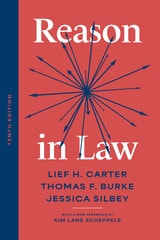
Reason in Law, Tenth Edition
Lief H. Carter, Thomas F. Burke and Jessica Silbey
University of Chicago Press, 2026
An indispensable introduction to legal reasoning, updated for today’s political and legal environment.
Since it was first published nearly five decades ago, Reason in Law has become the starting point for understanding legal reasoning, a critical component of the rule of law. The editors show how judges can integrate all the elements of a case to persuasively explain their rulings—and, even more importantly, why they sometimes fail to do so. Drawing on cases old and new, Reason in Law enables readers to become sophisticated “judges of judging.”
Now in its tenth edition, Reason in Law includes a new chapter on the increasingly contentious and politically consequential field of administrative law and addresses recent developments in the American legal landscape, including growing conservatism in the federal judiciary and the flood of lawsuits brought against the second Trump administration. It also analyzes new cases on the First Amendment rights of high schoolers, transgender civil rights, the responsibilities universities have for student safety, Donald Trump’s sweeping claims of executive power, and historic Supreme Court decisions expanding the rights of gun owners and allowing states to criminalize abortion. As always, Reason in Law connects legal theory with empirical research on the American judicial system, showing how trustworthy legal reasoning helps preserve social peace and the rule of law.
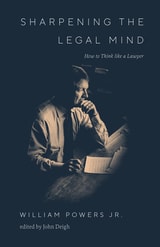
Sharpening the Legal Mind
How to Think Like a LawyerWilliam Powers Jr, edited by John Deigh
University of Texas Press, 2023
The way lawyers think about the law can seem deeply mysterious. They see nuance and meaning in statutes and implications in judicial opinions that are opaque to the rest of us. Accessible and thought provoking, Sharpening the Legal Mind explains how lawyers analyze the cases and controversies that come before the courts.
Written by William Powers Jr., the former president of the University of Texas at Austin, this book is an authoritative introduction to the academic study of law and legal reasoning, including insights into the philosophy of law and the intellectual history of legal thought. Powers discusses the methods lawyers use to interpret the law, the relation between law and morals, and the role of courts in shaping the law. In eight chapters, he follows the historical debate on these issues and others through different generations and movements in American legal thought—formalism, realism, positivism—to critical legal studies and postmodern theory. The perfect read for anyone looking for a primer on legal reasoning, Sharpening the Legal Mind demystifies the debates and approaches to thinking like a lawyer that profoundly influence the rule of law in our lives.
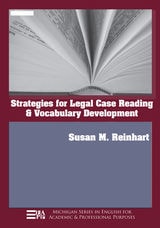
Strategies for Legal Case Reading and Vocabulary Development
Susan M. Reinhart
University of Michigan Press, 2007
Strategies for Legal Case Reading and Vocabulary Development begins with an overview of the American legal system and relevant research and guidelines relating to case reading. The book is divided into sections on common law, statutory law, and constitutional law. Approximately twenty cases (some abridged) and eight readings are included in the text. Questions for Discussion follow each case to help students prepare to actively participate in class case discussions. Additional features include hypotheticals (often posed by law professors), vocabulary tasks, and short writing assignments.
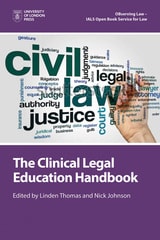
The Clinical Legal Education Handbook
Edited by Linden Thomas and Nicholas Johnson
University of London Press, 2020
CLE has become an increasingly popular method of legal education in recent years. By the end of 2013 at least 70% of all law schools in the United Kingdom were delivering some type of CLE, and 25% of these offered credit-bearing CLE programs. It is almost certain that this number will increase in the years to come with the advent of the forthcoming Solicitors’ Qualifying Examination, which will allow time spent volunteering in a student law clinic to count as “qualifying work experience.” However, despite the popularity of CLE, there is currently very little information available about the best practices for setting up and delivering these programs.
The Handbook seeks to remedy this gap, offering an invaluable resource to staff involved in running law clinics, both as a practical guide to establishing and running their programs and as a teaching resource and recommended text on clinical programs. It will also act as a resource for clinical legal education researchers who wish to engage in regulatory, pedagogic, and legal service delivery research in this area.
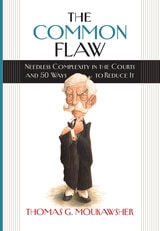
The Common Flaw
Needless Complexity in the Courts and 50 Ways to Reduce ItThomas Moukawsher
Brandeis University Press, 2023
Americans are losing faith in their courts. After long delays, judges often get rid of cases for technical reasons, or force litigants to settle rather than issue a decision. When they do decide cases, we can't understand why.
The Common Flaw seeks to rid the American lawsuit of this needless complexity. The book proposes fifty changes from the filing of a complaint in court to the drafting of appellate decisions to replace the legal system’s formalism with a kind of humanism. Thomas G. Moukawsher calls for courts that decide cases promptly based more on the facts than the law, that prioritize the parties involved over lawyers, that consider the consequences for the people and the public, and that use words we can all understand. Sure to spark an important conversation about court reform, The Common Flaw makes the case for a more effective and credible legal system with warmth and humor, incorporating cartoons alongside insightful reflection.
The Cultural Study of Law
Reconstructing Legal ScholarshipPaul W. Kahn
University of Chicago Press, 1999
"Professor Kahn's perspective is neat and alluring: We need a form of legal scholarship released from the project of reform so that we can better understand who and what we are. The new discipline should study 'not legal rules, but the imagination as it constructs a world of legal meaning.' . . . [C]oncise, good reading, and recommended." —New York Law Journal
The Lawyer Myth
A Defense of the American Legal ProfessionFrank T. Rennard and Read Stickland
Ohio University Press, 2008
The Lawyer's Myth
Reviving Ideals in the Legal ProfessionWalter Bennett
University of Chicago Press, 2001
Bennett draws on his experience as a lawyer, judge, and law teacher, as well as upon oral histories of lawyers and judges, in his exploration of how and why the legal profession has lost its ennobling mythology. Effectively using examples from history, philosophy, psychology, mythology, and literature, Bennett shows that the loss of professionalism is more than merely the emergence of win-at-all-cost strategies and a scramble for personal wealth. It is something more profound—a loss of professional community and soul. Bennett identifies the old heroic myths of American lawyers and shows how they informed the values of professionalism through the middle of the last century. He shows why, in our more diverse society, those myths are inadequate guides for today's lawyers. And he also discusses the profession's agony over its trickster image and demonstrates how that archetype is not only a psychological reality, but a necessary component of a vibrant professional mythology for lawyers.
At the heart of Bennett's eloquently written book is a call to reinvigorate the legal professional community. To do this, lawyers must revive their creative capacities and develop a meaningful, professional mythology—one based on a deeper understanding of professionalism and a broader, more compassionate ideal of justice.

Witness Lab
Performance and the LawCourtney McClellan
Michigan Publishing Services, 2020