Results by title
276 books match the query 'Legal History' and 19 start with a
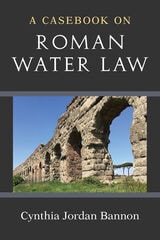
A Casebook on Roman Water Law
Cynthia Jordan Bannon
University of Michigan Press, 2020
This casebook aims to cross historical and disciplinary boundaries by making the primary evidence for Roman water rights accessible to students and researchers. Cases are presented in both original Latin and English translation. To prepare for study of the cases, each chapter opens with an overview of its topic while the introduction presents the evidence for water rights and contextualizes them within historical and conceptual frameworks.
A Century of Controversy
Constitutional Reform in AlabamaH. Bailey Thomson
University of Alabama Press, 2002
A timely examination of Alabama’s severely criticized state constitution
Alabama’s present constitution, adopted in 1901, is widely viewed as the source of many, if not most, of the state’s historic difficulties and inequities. Chief among these is a poorly funded school system, an imbalanced tax system that favors special business interests, legislated racism, and unchecked urban sprawl. Many citizens believe that, after 100 years of overburdening amendments and confusing addendums, the constitution urgently needs rewriting.
With this book, Bailey Thomson has assembled the best scholarship on the constitution, its history, and its implications for the future. Historian Harvey H. Jackson III details the degree to which the 1901 document was drafted as a legal tool to ensure white supremacy at the expense of poor whites and blacks, while Joe A. Sumners illustrates how the constitution ties the hands of elected civic leaders by handing authority for local decisions to state government in Montgomery. James W. Williams Jr. explores the impact of the state constitution on the beleaguered tax system and the three principal “revenue crises” it has engendered. Thomson’s own contribution explains how, in contrast to the previous failed attempts for constitutional change by past governors who appealed to their fellow power brokers, the current reform movement arose from the grassroots level.
As citizens and politicians in Alabama review the 1901 constitution for revision, as they navigate the pitfalls and opportunities inherent in change, it is incumbent that they inform themselves adequately on the controversies that have swirled around the constitution since its adoption. The future of Alabama’s government will depend upon it, as will the fortunes of Alabama’s business interests and the well-being of every citizen in the state for years to come.
A Court That Shaped America
Chicago's Federal District Court from Abe Lincoln to Abbie HoffmanRichard Cahan
Northwestern University Press, 2002
A Court That Shaped America traces the flesh-and-blood courtroom scenes from the district's first cases in the early nineteenth century through the turn of the millennium. Historical figures—including Mormon leader Joseph Smith, inventor Thomas Edison, and author Mark Twain—as well as contemporary superstars like Michael Jackson and Oprah Winfrey have all had their day in the Northern Illinois court. Some were victorious; some came out scathed. This book examines these great trials and the people behind them to offer a unique look at Chicago and U.S. history.
A Drunkard's Defense
Alcohol, Murder, and Medical Jurisprudence in Nineteenth-Century AmericaMichele Rotunda
University of Massachusetts Press, 2021
Is drunkenness a defense for murder? In the early nineteenth century, the answer was a resounding no. Intoxication was considered voluntary, and thus provided no defense. Yet as the century progressed, American courts began to extend exculpatory value to heavy drinking. The medicalization of alcohol use created new categories of mental illness which, alongside changes in the law, formed the basis for defense arguments that claimed unintended consequences and lack of criminal intent. Concurrently, advocates of prohibition cast “demon rum” and the “rum-seller” as the drunkard's accomplices in crime, mitigating offenders' actions. By the postbellum period, a backlash, led by medical professionals and an influential temperance movement, left the legacy of an unsettled legal standard.
In A Drunkard's Defense, Michele Rotunda examines a variety of court cases to explore the attitudes of nineteenth-century physicians, legal professionals, temperance advocates, and ordinary Americans toward the relationship between drunkenness, violence, and responsibility, providing broader insights into the country's complicated relationship with alcohol.
A Journey in Brazil
Henry Washington Hilliard and the Brazilian Anti-Slavery SocietyDavid I. Durham and Paul M. Pruitt Jr.
University of Alabama Press, 2008
Throughout a diverse career that spanned six decades, Hilliard’s personal challenges, moderated by his faith in Divine Providence, eventually allowed him to return to his ideological roots and find a sense of redemption late in life by becoming an unlikely spokesman for the Brazilian emancipation movement through his association with Joaquim Nabuco. In A Journey in Brazil, authors David I. Durham and Paul M. Pruitt Jr. establish context for Hilliard’s beliefs, document his journey in Brazil, and offer a variety of primary documents—selections from newspapers, transcripts of letters, translations of speeches, and other documents that have never before been published.
AboutOccasional Publications of the Bounds Law Library
This collection offers a series of edited documents that contribute to an understanding of the development of legal history, culture, or doctrine. Series editors Paul M. Pruitt Jr. and David I. Durham have selected a variety of materials—a lecture, diaries, letters, speeches, a ledger, commonplace books, a code of ethics, court reports—to illustrate unique examples of legal life and thought.
A Place of Recourse
A History of the U.S. District Court for the Southern District of Ohio, 1803–2003Roberta Sue Alexander
Ohio University Press, 2005
The first history of a federal district court in a midwestern state, A Place of Recourse explains a district court’s function and how its mission has evolved. The court has grown from an obscure institution adjudicating minor debt and land disputes to one that plays a central role in the political, economic, and social lives of southern Ohioans.
In tracing the court’s development, Alexander explores the central issues confronting the district court judges during each historical era. She describes how this court in a non-slave state responded to fugitive slave laws and how a court whose jurisdiction included a major coal-mining region responded to striking workers and the unionization movement. The book also documents judicial responses to Prohibition, New Deal legislation, crime, mass tort litigation, and racial desegregation.
The history of a court is also the history of its judges. Accordingly, Alexander provides historical insight on current and past judges. She details behind-the-scenes maneuvers in judicial appointments and also the creativity some judges displayed on the bench—such as Judge Leavitt, who adopted admiralty law to deal with the problems of river traffic.
A Place of Recourse demonstrates that, at least in the Southern District of Ohio, the federal district court has played the role its creators hoped it would—upholding federal law even when the citizens of the region actively opposed such enforcement.
A Rogue's Paradise
Crime and Punishment in Antebellum Florida, 1821-1861James M. Denham
University of Alabama Press, 1997
A history of frontier justice and legal systems in early Florida.
The pervasive influence of the frontier is fundamental to an understanding of antebellum Florida. James M. Denham traces the growth and social development of this sparsely settled region through its experience with crime and punishment. He examines such issues as Florida's criminal code, its judicial and law enforcement officers, the accommodation of criminals in jails and courts, outlaw gangs, patterns of punishment, and the attitude of the public toward lawbreakers.
Using court records, government documents, newspapers, and personal papers, Denham explores how crime affected ordinary Floridians—whites and blacks, perpetrators, victims, and enforcers. He contends that although the frontier determined the enforcement and administration of the law, the ethic of honor dominated human relationships.

A Rule of Property for Bengal
An Essay on the Idea of Permanent SettlementRanajit Guha
Duke University Press, 1996
By proclaiming the Permanent Settlement in 1793, the British hoped to promote a prosperous capitalist agriculture of the kind that had developed in England. The act renounced for all time the state’s right to raise the assessment already made upon landowners and thus sought to establish a system of property that was, in the British view, necessary for the creation of a stable government. Guha traces the origins of the Permanent Settlement to the anti-feudal ideas of Phillip Francis and the critique of feudalism provided by physiocratic thought, the precursor of political economy. The central question the book asks is how the Permanent Settlement, founded in anti-feudalism and grafted onto India by the most advanced capitalist power of the day became instrumental in the development of a neo-feudal organization of landed property and in the absorption and reproduction of precapitalist elements in a colonial regime.
Guha’s examination of the British attempt to mold Bengal to the contours of its own society without an understanding of the traditions and obligations upon which the Indian agrarian system was based is a truly pioneering work. The implications of A Rule of Property for Bengal remain rich for the current discussions from the postcolonialist perspective on the meaning of modernity and enlightenment.

A Rumor of Revolt
The "Great Negro Plot" in Colonial New YorkT. J. Davis
University of Massachusetts Press, 1990
This groundbreaking historical examination analyzes the 1741 New York Conspiracy trials: a pivotal moment in colonial American history when the city's legal system prosecuted an alleged slave conspiracy with severe and controversial consequences. Thomas J. Davis meticulously reconstructs the trials and executions that resulted from this supposed uprising, providing crucial insights into the intersection of race, ethnicity, legal practice, and social control in colonial New York.
During the spring and summer of 1741, New York authorities conducted dramatic trials in response to fears of a coordinated slave rebellion. Between May 11 and August 29, 1741, the city executed 35 individuals: thirteen Black men were burned at the stake, seventeen Black men were hanged, and two white men and two white women were also executed. These brutal punishments reflected the city's intense fear and the racialized nature of colonial justice.
Davis's analysis examines the primary source material to investigate what this historical episode reveals about colonial New York's racial hierarchies, ethnic tensions, and legal systems. The work scrutinizes the trials themselves, asking critical questions: Was there truly a conspiracy, or was the event primarily a product of hysteria and rumor? How did racial prejudices, economic anxieties, and the structure of colonial authority shape legal proceedings?
Beyond the courtroom drama, Davis explores the broader implications of these trials for understanding slavery in northern colonies, where enslaved people were not as visible but equally integral to colonial society. The book demonstrates how fear, whether grounded in reality or stoked by rumor, could mobilize entire communities and transform legal systems into instruments of racialized control. This work has become essential reading for understanding how colonial societies constructed narratives of racial threat and employed legal mechanisms to enforce racial subordination.
A Weak Woman in a Strong Battle
Women and Public Execution in Early Modern EnglandJennifer Lillian Lodine-Chaffey
University of Alabama Press, 2022
A scholarly study of how women’s executions were staged, interpreted, and recorded in Renaissance England
A Weak Woman in a Strong Battle: Women and Public Execution in Early Modern England provides critical insights on representations of women on the scaffold, focusing on how female victims and those writing about them constructed meaning from the ritual. Jennifer Lodine-Chaffey draws on a wide range of genres, from accounts of martyrdom to dramatic works, to explore not only the words of women executed in Tudor and Stuart England, but also the ways that writers represented female bodies as markers of penitence or deviance.
A significant part of the execution spectacle—one used to assess the victim’s proper acceptance of death and godly repentance—was the final speech offered at the foot of the gallows or before the pyre. To ensure their final words held value for audiences, women adopted conventionally gendered language and positioned themselves as subservient and modest. The reception of women’s speeches, Lodine-Chaffey argues, depended on their performances of accepted female behaviors and language as well as physical signs of interior regeneration. Indeed, when women presented themselves or were represented as behaving in stereotypically feminine and virtuous ways, they were able to offer limited critiques of their fraught positions in society.
Just as important as their words, though, were the depictions of women’s bodies. The executed woman’s body, Lodine-Chaffey contends, functioned as a text, scrutinized by witnesses and readers for markers of innocence or guilt. The intense focus on the words and bodies of women facing execution during this period, Lodine-Chaffey argues, became a catalyst for a more thorough interest in and understanding of women’s roles not just as criminals but as subjects
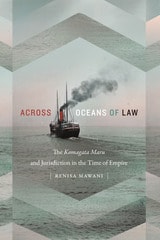
Across Oceans of Law
The Komagata Maru and Jurisdiction in the Time of EmpireRenisa Mawani
Duke University Press, 2018
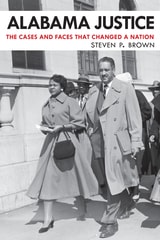
Alabama Justice
The Cases and Faces That Changed a NationSteven P. Brown
University of Alabama Press, 2020
WINNER OF THE ANNE B. & JAMES B. MCMILLAN PRIZE IN SOUTHERN HISTORY
Examines the legacies of eight momentous US Supreme Court decisions that have their origins in Alabama legal disputes.
Unknown to many, Alabama has played a remarkable role in a number of Supreme Court rulings that continue to touch the lives of every American. In Alabama Justice: The Cases and Faces That Changed a Nation, Steven P. Brown has identified eight landmark cases that deal with religion, voting rights, libel, gender discrimination, and other issues, all originating from legal disputes in Alabama.
Written in a concise and accessible manner, each case law chapter begins with the circumstances that created the dispute. Brown then provides historical and constitutional background for the issue followed by a review of the path of litigation. Excerpts from the Court’s ruling in the case are also presented, along with a brief account of the aftermath and significance of the decision. The First Amendment (New York Times v. Sullivan), racial redistricting (Gomillion v. Lightfoot), the Equal Protection Clause of the Fourteenth Amendment (Frontiero v. Richardson), and prayer in public schools (Wallace v. Jaffree) are among the pivotal issues stamped indelibly by disputes with their origins in Alabama legal, political, and cultural landscapes. By examining such landmark twentieth-century milestones and eras such as the Scottsboro Boys trial, the Civil Rights movement, and the fight for women’s rights through a legal lens, Brown sheds new and unexpected light on the ways that events in Alabama have shaped the nation.
In addition to his analysis of cases, Brown discusses the three associate Supreme Court justices from Alabama to the Supreme Court: John McKinley, John Archibald Campbell, and Hugo Black. Their cumulative influence on constitutional interpretation, the institution of the Court, and the day-to-day rights and liberties enjoyed by every American is impossible to measure. A closing chapter examines the careers and contributions of these three Alabamians.
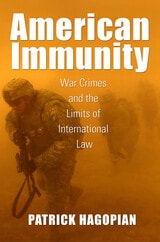
American Immunity
War Crimes and the Limits of International LawPatrick Hagopian
University of Massachusetts Press, 2013
In 1955 the Supreme Court ruled that veterans of the U.S. armed forces could not be court-martialed for overseas crimes that were not detected until after they had left military service. Territorial limitations placed such acts beyond the jurisdiction of civilian courts, and there was no other American court in which they could be adjudicated. As a result, a jurisdictional gap emerged that for decades exempted former troops from prosecution for war crimes. “This was not merely a theoretical possibility,” Patrick Hagopian writes. Over a dozen former soldiers who participated in the My Lai massacre did in fact “get away with murder.” Further court rulings expanded the gap to cover civilian employees and contractors that accompanied the armed forces.
In American Immunity, Hagopian places what he calls the “superpower exemption” in the context of a long-standing tension between international law and U.S. sovereignty. He shows that despite the U.S. role in promulgating universal standards of international law and forming institutions where those standards can be enforced, the United States has repeatedly refused to submit its own citizens and troops to the jurisdiction of international tribunals and failed to uphold international standards of justice in its own courts.
In 2000 Congress attempted to close the jurisdictional gap with passage of the Military Extraterritorial Jurisdiction Act. The effectiveness of that legislation is still in question, however, since it remains unclear how willing civilian American juries will be to convict veterans for conduct in foreign war zones.
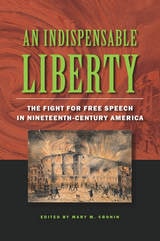
An Indispensable Liberty
The Fight for Free Speech in Nineteenth-Century AmericaEdited by Mary M. Cronin
Southern Illinois University Press, 2016
The eleven essays that make up this collection show how, despite judicial, political, and public proclamations of support for freedom of expression, factors like tradition, gender stereotypes, religion, and fear of social unrest often led to narrow judicial and political protection for freedom of expression by people whose views upset the status quo. These views, expressed by abolitionists, suffragists, and labor leaders, challenged rigid cultural mores of the day, and many political and cultural leaders feared that extending freedom of expression to agitators would undermine society. The Civil War intensified questions about the duties and privileges of citizenship. After the war, key conflicts over freedom of expression were triggered by Reconstruction, suffrage, the Comstock Act, and questions about libel.
The volume’s contributors blend social, cultural, and intellectual history to untangle the complicated strands of nineteenth-century legal thought. By chronicling the development of modern-day notions of free speech, this timely collection offers both a valuable exploration of the First Amendment in nineteenth-century America and a useful perspective on the challenges we face today.
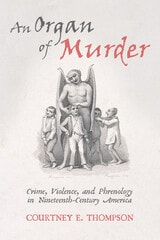
An Organ of Murder
Crime, Violence, and Phrenology in Nineteenth-Century AmericaCourtney E. Thompson
Rutgers University Press, 2021
An Organ of Murder explores the origins of both popular and elite theories of criminality in the nineteenth-century United States, focusing in particular on the influence of phrenology. In the United States, phrenology shaped the production of medico-legal knowledge around crime, the treatment of the criminal within prisons and in public discourse, and sociocultural expectations about the causes of crime. The criminal was phrenology’s ideal research and demonstration subject, and the courtroom and the prison were essential spaces for the staging of scientific expertise. In particular, phrenology constructed ways of looking as well as a language for identifying, understanding, and analyzing criminals and their actions. This work traces the long-lasting influence of phrenological visual culture and language in American culture, law, and medicine, as well as the practical uses of phrenology in courts, prisons, and daily life.
Ancient Greek Law in the 21st Century
Edited by Paula Perlman
University of Texas Press, 2018
The ancient Greeks invented written law. Yet, in contrast to later societies in which law became a professional discipline, the Greeks treated laws as components of social and political history, reflecting the daily realities of managing society. To understand Greek law, then, requires looking into extant legal, forensic, and historical texts for evidence of the law in action. From such study has arisen the field of ancient Greek law as a scholarly discipline within classical studies, a field that has come into its own since the 1970s.
This edited volume charts new directions for the study of Greek law in the twenty-first century through contributions from eleven leading scholars. The essays in the book’s first section reassess some of the central debates in the field by looking at questions about the role of law in society, the notion of “contracts,” feuding and revenge in the court system, and legal protections for slaves engaged in commerce. The second section breaks new ground by redefining substantive areas of law such as administrative law and sacred law, as well as by examining sources such as Hellenistic inscriptions that have been comparatively neglected in recent scholarship. The third section evaluates the potential of methodological approaches to the study of Greek law, including comparative studies with other cultures and with modern legal theory. The volume ends with an essay that explores pedagogy and the relevance of teaching Greek law in the twenty-first century.
Animals and the Law in Antiquity
Saul M. Olyan
SBL Press, 2021
Animal law has become a topic of growing importance internationally, with animal welfare and animal rights often assuming center stage in contemporary debates about the legal status of animals. While nonspecialists routinely decontextualize ancient texts to support or deny rights to animals, experts in fields such as classics, biblical studies, Assyriology, Egyptology, rabbinics, and late antique Christianity have only just begun to engage the topic of animals and the law in their respective areas. This volume consists of original studies by scholars from a range of Mediterranean and West Asian fields on a variety of topics at the intersection of animals and the law in antiquity. Contributors include Rozenn Bailleul-LeSuer, Beth Berkowitz, Andrew McGowan, F. S. Naiden, Saul M. Olyan, Seth Richardson, Jordan D. Rosenblum, Andreas Schüle, Miira Tuominen, and Daniel Ullucci. The volume is essential reading for scholars and students of both the ancient world and contemporary law.
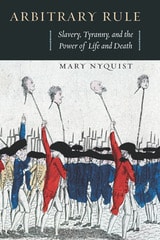
Arbitrary Rule
Slavery, Tyranny, and the Power of Life and DeathMary Nyquist
University of Chicago Press, 2013
Throughout, Nyquist demonstrates how principles relating to political slavery and tyranny are bound up with a Roman jurisprudential doctrine that sanctions the power of life and death held by the slaveholder over slaves and, by extension, the state, its representatives, or its laws over its citizenry.
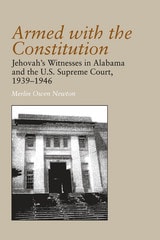
Armed with the Constitution
Jehovah's Witnesses in Alabama and the U.S Supreme Court, 1939-1946Merlin Owen Newton
University of Alabama Press, 1995
Armed with the Constitution stresses the courage of a black man, Rosco Jones, and a white woman, Grace Marsh, who dared to challenge the status quo in Alabama in the early 1940s. These two Jehovah’s Witnesses helped to lay a foundation for testing the constitutionality of state and local laws, establishing precedents that the Civil Rights movement, the feminist movement, and similar forces could follow. Newton has prepared a finely woven tale of oral, legal, and social history that opens a window on the world of the Jehovah’s Witnesses in Alabama.
More than a legal study, this book is also a dramatic history of two powerful personalities whose total commitment to their faith enabled them to carry the Jehovah’s Witnesses’ battle from rural Alabama to the halls of the U.S. Supreme Court.